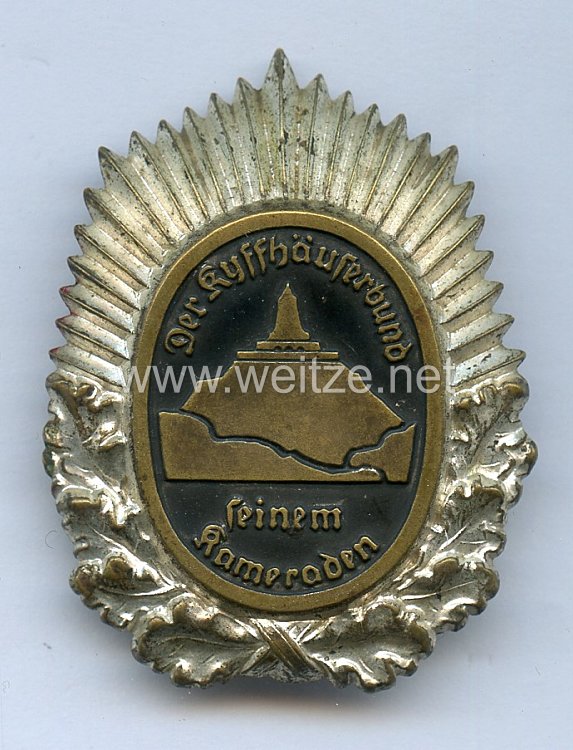
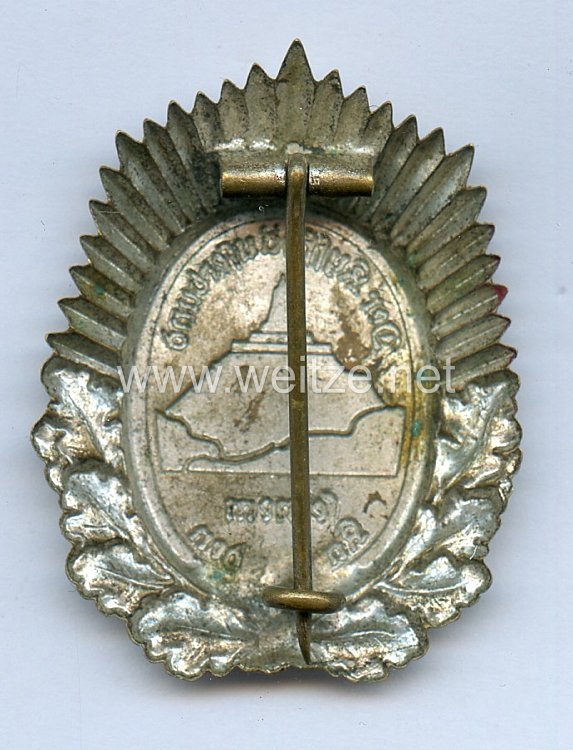
Kyffhäuserbund Honor Badge 1st Class 2nd Model 1935-1938
The Kyffhäuserbund Badge of Honor 1st Class, 2nd Model (1935-1938) represents a significant artifact from German veterans' organizations during the interwar period. This badge documents the complex history of the Kyffhäuserbund, one of the largest and most influential veterans' associations in the German-speaking world.
The Kyffhäuserbund der Deutschen Landeskriegerverbände (Kyffhäuser League of German Regional Veterans' Associations) was founded in 1900 as an umbrella organization for various regional veterans' clubs. Named after the Kyffhäuser Monument in Thuringia, which was dedicated to Emperor Wilhelm I, the League united former soldiers and promoted comradeship, remembrance of fallen soldiers, and patriotic values. After World War I, membership grew substantially as millions of veterans returned to civilian society.
The Badge of Honor was awarded in different classes, with the 1st Class representing the highest distinction. It was conferred upon deserving members for special achievements in League activities. Award criteria included long-term membership, outstanding commitment to veterans' work, or significant contributions to the organization.
The 2nd Model, worn between 1935 and 1938, originated during a period of profound political change. After the Nazi seizure of power in 1933, all veterans' organizations were increasingly brought into line with Nazi ideology. The Kyffhäuserbund lost its independence and was integrated into the National Socialist organizational structure. In 1938, the League was finally dissolved and absorbed into the NS-Reichskriegerbund (National Socialist Reich Warriors League), marking the end of the independent Kyffhäuserbund tradition.
The design of the 2nd Model Badge of Honor reflects this transitional period. Compared to the first model, which bore stronger imperial-monarchist symbolism, the second model already shows adaptations to the new political reality. The pin fastening was typical for awards of this era and allowed wearing on civilian clothing.
Technically, the badge was usually manufactured from non-ferrous metal and frequently silver-plated or enameled. Production was carried out by various minting establishments and jewelers specialized in military decorations. Quality of execution varied by manufacturer, with the 1st Class generally showing superior craftsmanship compared to lower classes.
From a historical perspective, this Badge of Honor documents the complex role of veterans' organizations in German history. The Kyffhäuserbund operated in the tension between maintaining military traditions, providing social care for wounded veterans, and political instrumentalization. While the organization was originally conceived as non-political and dedicated to fostering comradeship, it increasingly became an instrument of political mobilization.
The period 1935-1938, during which this model was worn, was characterized by massive German rearmament, the reintroduction of universal conscription in 1935, and increasing war preparation. Veterans' organizations played an important role during this phase in the militarization of society and preparing the population for a new war.
After 1945, the Kyffhäuserbund was re-established in the Federal Republic of Germany and continues to exist today as a non-political veterans' and tradition organization. Badges of Honor from the pre-1945 period, particularly those from the Nazi era, are today regarded as historical documents and are subjects of military-historical research and collecting.
For collectors and historians, the 2nd Model Badge of Honor offers important insights into organizational history, award practices, and Germany's political development in the 1930s. Condition is usually graded on a scale from 1 (mint) to 6 (heavily damaged), with condition 2 designating a very well-preserved award with only minimal signs of wear.
The badge with its pin attachment represents not merely a decorative object, but a tangible link to a pivotal period in German and European history, serving as a reminder of how veterans' organizations were transformed and ultimately subsumed into totalitarian structures.