Third Reich Police Parade Dress Belt for Officers from 1939

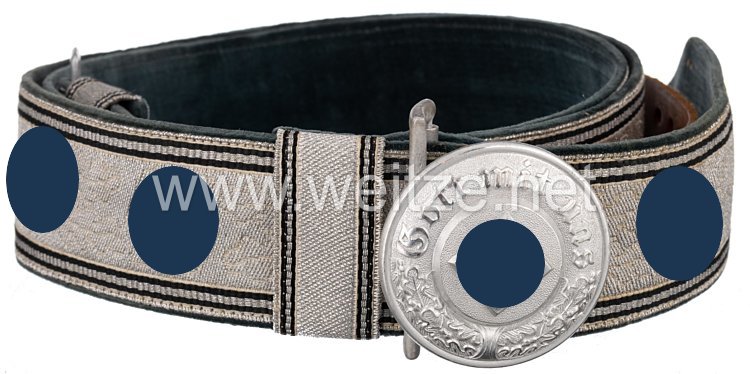
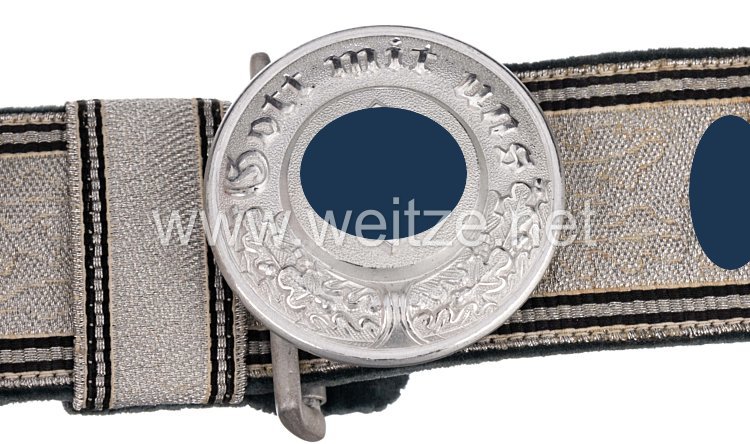
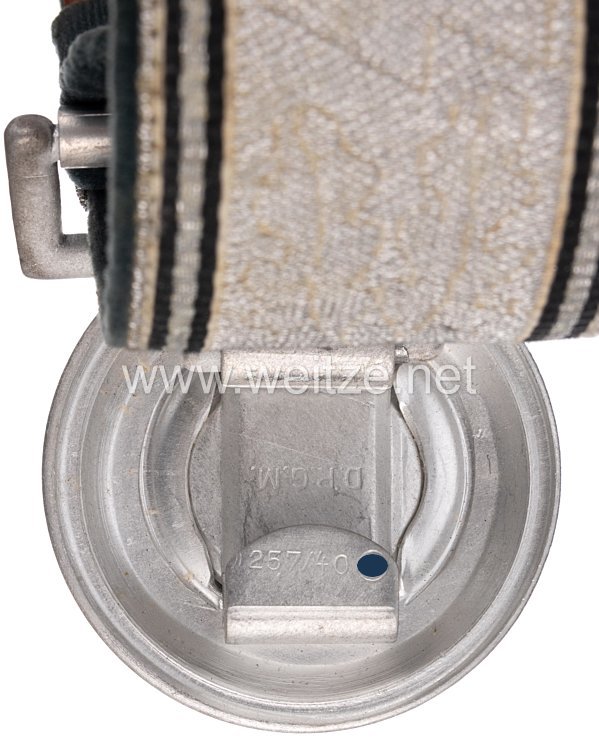
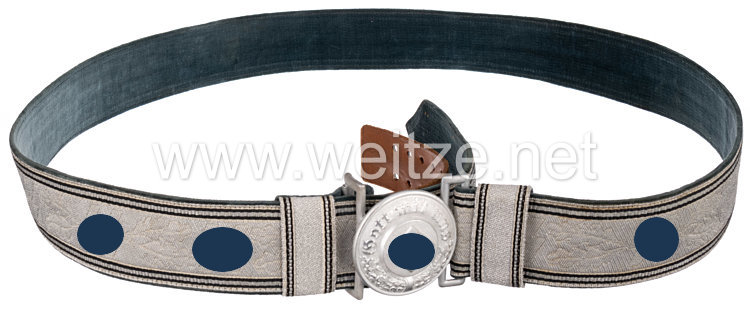
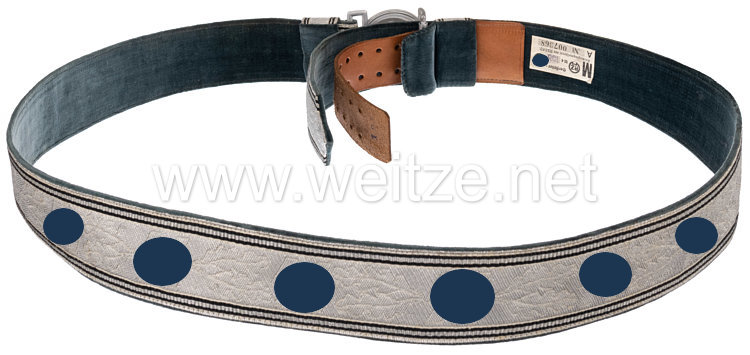
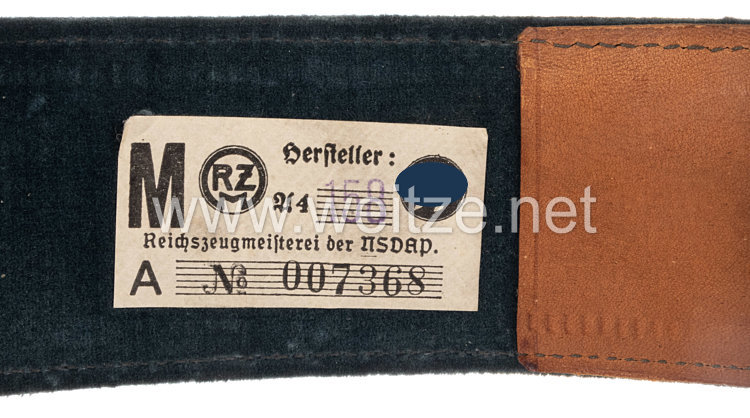
The buckle aluminum with polished edges, manufactured by C.T. Dicke in Lüdenscheid marked RZM 257/40 SS and D.R.G.M., the dress belt made of aluminum thread with woven SS runes and oak leaves, backed with green velvet on reverse, approx. 120 cm. With RZM label.
416811
3.000,00

Third Reich Police Parade Dress Belt for Officers from 1939

The present Police Parade Field Belt for Officers from the Third Reich era represents a characteristic example of the uniform equipment issued to higher-ranking police officials after 1939. Such field belts were essential components of parade uniforms and served as rank insignia as well as for representation at official occasions.

Following the seizure of power in 1933 and particularly after the takeover of the police by Heinrich Himmler as Reichsführer-SS, the German police underwent fundamental restructuring. The police were gradually integrated into the SS power apparatus, which was reflected in uniform regulations and equipment items. The Regulation on the Uniform Equipment of the Police of 1936 and subsequent amendments standardized uniform components throughout the Reich.

The field belt described here was manufactured by the renowned producer C.T. Dicke from Lüdenscheid, one of the most significant manufacturers of military effects and equipment items of that era. The Dicke company was registered as an RZM supplier (Reichszeugmeisterei) under the number 257/40 SS. The Reichszeugmeisterei was the central procurement and inspection agency for uniforms and equipment of the NSDAP and its formations, including the SS and later also the police.

The aluminum buckle with polished edges displays the typical manufacturing quality of the late 1930s and early 1940s. The marking D.R.G.M. (Deutsches Reichsgebrauchsmuster - German Reich Registered Design) indicates a protected design, which was common for high-quality militaria. The buckle served not only as a functional element for fastening the field belt but also as the decorative centerpiece of the equipment item.

The field belt itself consists of aluminum thread, a silver-colored material that appeared particularly representative due to its metallic appearance. The woven SS runes and oak leaf motifs illustrate the close connection between police and SS during this period. The oak leaf was a traditional German symbol for loyalty, strength, and honor and was used in various military contexts. The backing with green velvet increased wearing comfort and corresponded to the police color green, traditionally associated with law enforcement.

With a length of approximately 120 centimeters, the field belt could be worn diagonally across the uniform from the right shoulder to the left hip, where it was attached to the belt buckle. This method of wear was prescribed for officers at parades, roll calls, and other ceremonial occasions.

The preserved RZM label is of particular significance for collectors and historians, as it documents the authenticity and provenance of the piece. Such labels were often removed or lost over time, making their presence considerably increase the historical and documentary value.

The use of such parade field belts was part of a comprehensive system for the visual representation of rank, affiliation, and authority. While ordinary police officers wore simpler equipment, only officers were permitted to wear these elaborately designed field belts at parade occasions. This emphasized the hierarchical structure of the National Socialist police.

The production of such equipment items ended with the collapse of the Third Reich in May 1945. After the war, many of these objects were destroyed or lost. Surviving examples are now found in museums, private collections, and serve historical research as important material witnesses of a dark epoch in German history.

From today's scholarly perspective, such objects are significant sources for researching uniform studies, the organizational history of the NS police, and the material culture of the Third Reich. They document the aestheticization of power and the symbolic charging of everyday service items in the totalitarian system.

r