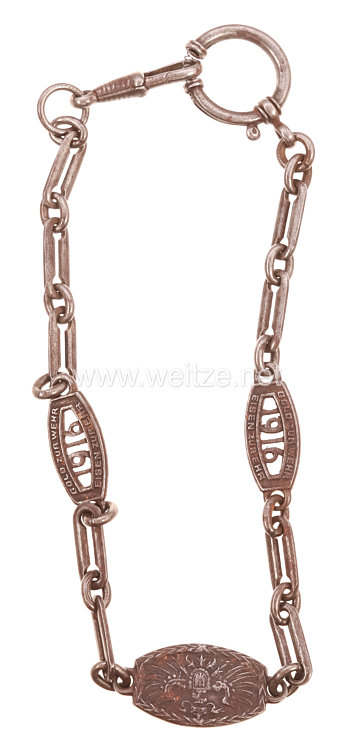
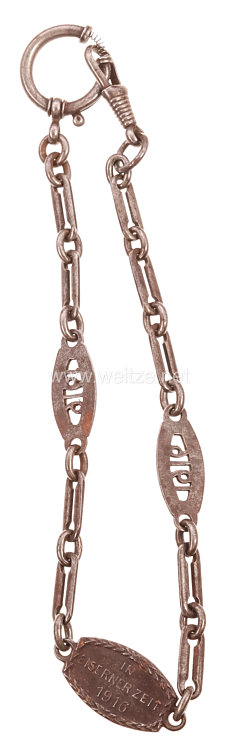
World War I Patriotic Watch Chain “Gold zur Wehr Eisen zur Ehr 1916”
Patriotic Watch Chain from World War I: “Gold zur Wehr, Eisen zur Ehr 1916”
This watch chain bearing the inscription “Gold zur Wehr Eisen zur Ehr 1916” (Gold for Defense, Iron for Honor 1916) and “In Eiserner Zeit 1916” (In Iron Times 1916) represents a significant artifact from the German home front during World War I. It belongs to a special category of objects created as part of the so-called gold collections or metal donations organized by the German Empire to finance the war effort.
Historical Background of the Metal Collections
As World War I dragged on longer than initially expected, the German Empire found itself in increasingly dire economic straits. The British naval blockade cut Germany off from vital raw material imports, and the conduct of the war consumed enormous financial and material resources. By 1916, this crisis reached a critical point. The Reich government found itself compelled to directly involve the civilian population in the war effort.
On January 13, 1916, the Federal Council issued an ordinance providing for the surrender of gold and silver items to support war financing. This measure was accompanied by a massive propaganda campaign that appealed to the patriotism and willingness to sacrifice of the German population. The slogan “Gold gab ich für Eisen” (I gave gold for iron), already known from the Wars of Liberation against Napoleon (1813-1815), was revived and used in various versions.
The Symbolism of Gold and Iron
The formula “Gold zur Wehr, Eisen zur Ehr” embodied a dual message: the surrendered gold was to serve “defense” (Wehr), meaning the military protection of the fatherland, while the iron received in exchange was to bring “honor” (Ehr) – as a visible sign of patriotic willingness to sacrifice. This reversal of material value into moral value was a clever psychological maneuver. Those who wore iron jewelry publicly demonstrated their loyalty to the fatherland and their readiness to make personal sacrifices for the success of the war.
The designation “In Eiserner Zeit” (In Iron Times) played on multiple meanings: it referred to the harsh war years, to the material of the replacement jewelry, and to the demanded hardness and steadfastness of the population. The year 1916 was particularly significant, as it belonged to the bloodiest phases of the war with the Battle of Verdun and the Battle of the Somme.
Production and Distribution
Iron replacement pieces for surrendered gold jewelry were manufactured by various manufactories and workshops throughout the Reich. Watch chains were particularly popular items, as they were visibly worn in everyday life and thus could unfold their propagandistic effect. The pieces varied considerably in their quality and execution – from simple, machine-made specimens to elaborately crafted individual pieces.
The inscriptions and dates served not only for documentation but also for permanent commemoration of the willingness to sacrifice. Many of these objects bore additional local references, coats of arms, or names of cities and communities that conducted their own collection campaigns.
The Reality Behind the Propaganda
Despite the intensive propaganda, the actual material success of the gold collections was limited. Many people hesitated to surrender valuable family jewelry, especially pieces with sentimental value. Nevertheless, social pressure exerted considerable influence. Those who did not wear iron jewelry could easily fall under suspicion of lacking patriotism.
The collections of 1916 and subsequent years must also be seen in the context of the increasing supply crisis. The infamous “Turnip Winter” of 1916/17 brought considerable hardships for the civilian population. The demand for gold and jewelry came at a time when many families were already suffering from hunger and deprivation.
Collector Value and Historical Significance
Today, such patriotic watch chains are important historical documents. They testify to the mobilization of the home front, the propaganda strategies of the Kaiserreich, and the material culture of World War I. For collectors and museums, they are valuable objects that illustrate the connection between everyday items and grand history.
The condition of such objects varies considerably. Defective clasps, as with the described specimen, are not unusual after more than a century and diminish the historical, though possibly the monetary, value. The patina and signs of use make these pieces authentic and tell of their actual use.
Conclusion
The watch chain “Gold zur Wehr Eisen zur Ehr 1916” is more than a simple piece of jewelry. It is a material testimony to the total mobilization of German society in World War I, a document of propaganda, and simultaneously an object that represents the personal sacrifices and the reality of wartime everyday life. Such objects remind us how wars were fought not only on battlefields but also in the hearts, minds, and wallets of the civilian population.