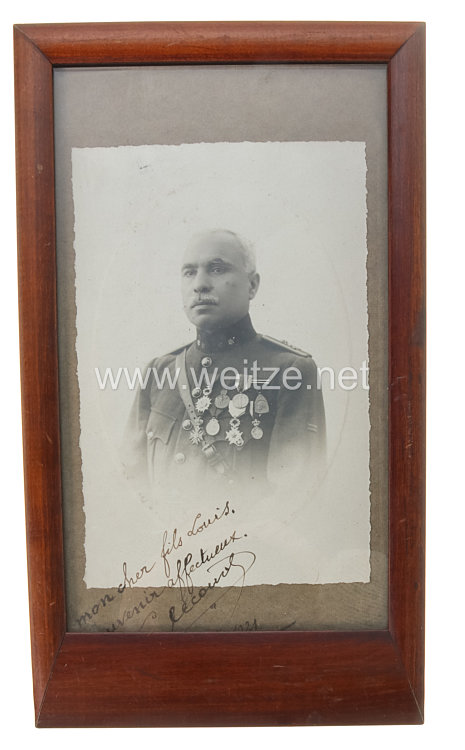
Belgium Portrait Photograph of an Officer with Decorations
This portrait photograph of a Belgian officer from 1921 represents a significant period in Belgian military history – the immediate post-war years following World War I. Such framed portrait photographs were a common medium in the 1920s for documenting and honoring military dignitaries and their service achievements.
Historical Context: Belgium in World War I
Belgium played a central role in the First World War when the neutral kingdom was invaded by German troops on August 4, 1914. The heroic defense by the Belgian Army under King Albert I was internationally celebrated as a symbol of resistance against aggression. Although most of Belgian territory was occupied, the Belgian army held a narrow strip in the western part of the country along the Yser Front and fought for four years alongside the Allies.
Belgian officers who survived these difficult years were frequently honored with numerous decorations after the Armistice of November 11, 1918. The year 1921, when this photograph was taken, marks a period of consolidation and reorganization of the Belgian armed forces, as well as official recognition of war veterans.
Belgian Military Decorations
The decorations visible on such portrait photographs could include various Belgian and Allied orders. Among the most important Belgian military decorations were:
The Order of Leopold (Ordre de Léopold), founded in 1832, was and remains Belgium's highest decoration. During World War I, it was frequently awarded to officers who demonstrated extraordinary military merit.
The Order of the Crown (Ordre de la Couronne), introduced in 1897, was awarded for civil and military merit and was also a prestigious decoration.
The Iron Cross (Croix de Fer), not to be confused with the German decoration, was created in 1915 as a Belgian valor award. It was given to soldiers and officers who distinguished themselves particularly in combat.
The War Medal 1914-1918 (Médaille Commémorative de la Guerre 1914-1918) was awarded to all members of the Belgian armed forces who served during the war.
In addition to Belgian decorations, many Belgian officers also received orders from allied nations such as France (e.g., the Légion d'Honneur), Great Britain, and the United States.
Photographic Tradition and Military Portraiture
The tradition of military portrait photography developed in the late 19th century and reached its peak during and after World War I. Framed photographs of officers in their uniforms with decorations served multiple purposes: they documented the military status and career of the subject, functioned as family heirlooms, and were often displayed in public buildings, officers' clubs, or military institutions.
The photographic technique of the early 20th century enabled detailed images that precisely reproduced uniform details, rank insignia, and medal ribbons. Professional military photographers in cities such as Brussels, Antwerp, and Ghent specialized in such portraits.
The Belgian Army in the Interwar Period
The years after 1918 were a time of reconstruction for the Belgian Army. The country had to cope with the enormous destruction caused by the war while simultaneously modernizing its armed forces and adapting them to new geopolitical realities. The occupation of the Rhineland, in which Belgian troops participated until 1929, required maintaining a considerable military presence.
Officers who had survived World War I formed the backbone of the army during this transitional period. Their experience in modern warfare – with machine guns, artillery, poison gas, and the emerging use of tanks and aircraft – was invaluable for training the next generation.
Collector Value and Historical Significance
Photographs like this are important historical documents today. They provide insights into uniform regulations, decoration systems, and the social position of the officer corps of that era. For collectors of military antiques and historians, such objects are particularly valuable when dated and in good condition.
The preservation of such artifacts helps maintain the memory of the sacrifices and service of the Belgian armed forces during one of humanity's most devastating conflicts. They remind us of the individual stories behind great historical events and the people who lived through them.