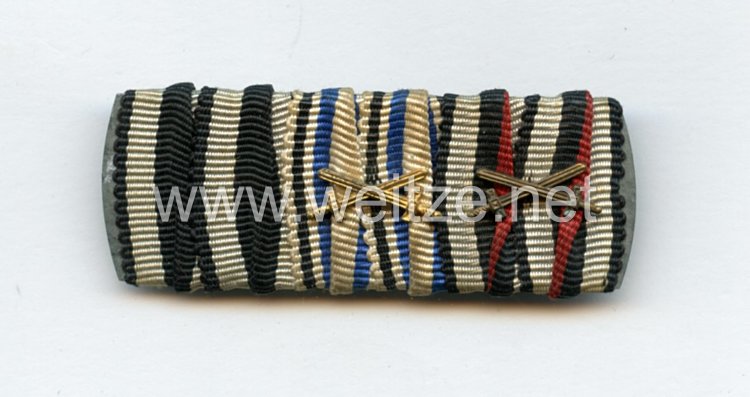
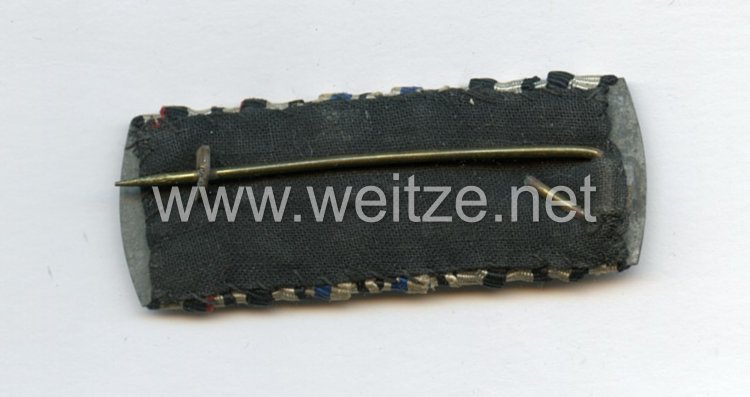
Medal Bar of a Bavarian Veteran of World War I

3 awards: Iron Cross 2nd Class 1914, Bavarian Military Merit Order with Swords, Honor Cross for Combatants, width 60 mm, condition 2-3.
399710
30,00

Medal Bar of a Bavarian Veteran of World War I

This medal bar represents the military career of a Bavarian veteran of World War I and documents his bravery as well as his participation in front-line combat between 1914 and 1918. The ribbon bar unites three significant decorations that together provide impressive testimony to military service in the Kingdom of Bavaria and the German Empire.

The Iron Cross 2nd Class of 1914 forms the first decoration on this bar. Kaiser Wilhelm II renewed this Prussian decoration on August 5, 1914, just one day after Germany's entry into the war. The Iron Cross was awarded as a general German war decoration and was open to all soldiers of the German Reich, regardless of their origin or rank. The characteristic black and white ribbon colors symbolized the Prussian national colors. The award criteria were strict: there had to be a concrete act of bravery before the enemy or special merit in wartime service. By 1918, approximately five million Iron Crosses 2nd Class had been awarded, reflecting the intensity and scope of the war.

The Bavarian Military Merit Order with Swords represents the second decoration. King Ludwig I of Bavaria established this order on July 19, 1866, as a reward for special services in war and peace. The version “with swords” was awarded exclusively for wartime merit, while the version without swords was reserved for peacetime services. The order existed in four classes, with the 4th Class being the most frequently awarded. Bavarian military decorations retained their independent significance even after the founding of the Reich in 1871, as the German federal states largely preserved their sovereignty in military honors. The light blue ribbon colors with white stripes represented the Bavarian state colors.

The Honor Cross for Combatants, also known as the Hindenburg Cross, forms the third decoration. Reich President Paul von Hindenburg established this decoration through the decree of July 13, 1934, during the early phase of the Nazi regime. The Honor Cross was awarded retroactively to all participants in World War I and existed in three variants: for combatants (with swords), for war participants without front-line service (without swords), and for surviving relatives of fallen soldiers. The version for combatants was only received by those veterans who had demonstrably served at the front. The black-white-red ribbon symbolized the colors of the fallen Empire. By 1945, approximately 6.2 million Honor Crosses for combatants had been issued.

The combination of these three decorations on a medal bar tells a specific story: the wearer served actively at the front in World War I, demonstrated personal bravery (Iron Cross), rendered special services to the Kingdom of Bavaria (Military Merit Order), and survived the war to later receive the Honor Cross. The time span between the first award (earliest 1914) and the last (earliest 1934) encompasses at least two decades and two completely different political systems: the Empire and the Third Reich.

Medal bars of this type were widespread in the Weimar Republic and the Third Reich. Veterans wore them at official occasions, commemorative ceremonies, and comradeship meetings. The bars were either assembled by specialized medal dealers or put together by the wearers themselves. The order of the ribbons followed strict rules of precedence, with Prussian decorations like the Iron Cross traditionally placed first, followed by state orders and finally later honors.

From a military-historical perspective, such medal bars document not only individual fates but also the political ruptures of German history in the 20th century. They connect imperial tradition, republican memory culture, and Nazi appropriation of war veterans. The condition of the present bar (2-3) suggests regular wear and thus the continuing significance of these decorations to their wearer.

r