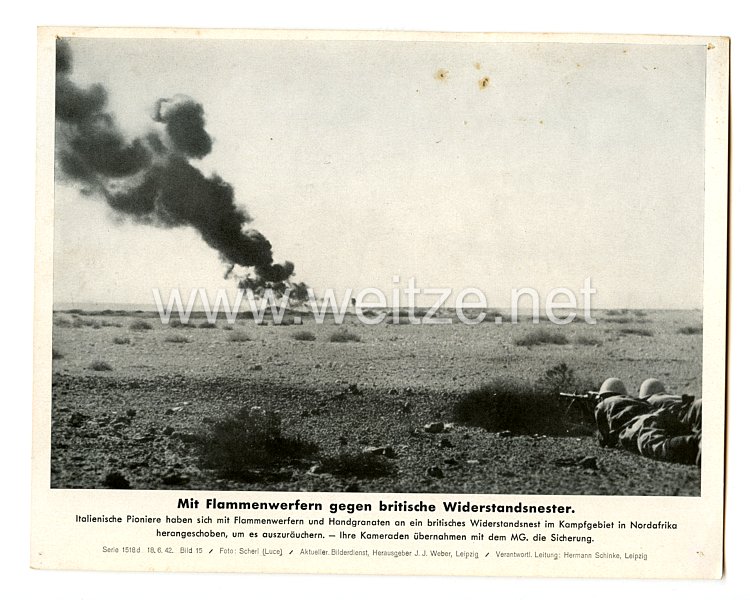
Wehrmacht - Printed Press Photograph “With Flamethrowers Against British Resistance Nests” 18.6.42
This press photograph from 1942 represents a significant artifact of the National Socialist propaganda machinery during World War II. Titled “With Flamethrowers Against British Resistance Nests” and dated June 18, 1942, this image documents the methods by which the Nazi regime presented the Wehrmacht's military operations to the German population and the world public.
The Aktueller Bilderdienst (Current Picture Service), listed as the publisher of this photograph, was one of several official and semi-official picture agencies that produced and distributed press material during the Third Reich. These agencies worked closely with the Reich Ministry of Public Enlightenment and Propaganda under Joseph Goebbels. Control over pictorial material was a central element of National Socialist information policy, as photographs had an immediate emotional impact on viewers.
In June 1942, Germany was engaged in intense military activities on multiple fronts. On the Eastern Front, the Wehrmacht was preparing the summer offensive that would later become known as Case Blue. In the Mediterranean theater, fighting continued in North Africa, where Erwin Rommel's Afrika Korps was operating against British forces. The use of flamethrowers against “British resistance nests” could refer to various theaters where German troops encountered British defensive positions.
Flamethrowers had been an integral part of the German military arsenal since World War I. The Wehrmacht primarily deployed two types: the portable Flammenwerfer 35 and the larger Flammenwerfer 41. These weapons were particularly effective against fortified positions, bunkers, and trenches. Their psychological effect was as significant as their tactical impact, as they spread fear and terror among enemy troops.
The use of flamethrowers in propaganda served multiple purposes. On one hand, it was meant to demonstrate the technical superiority and combat power of German troops. On the other hand, such images served to assure the home front that the Wehrmacht possessed the necessary means to break through enemy defenses. The portrayal of the enemy as entrenched in “resistance nests” suggested that the Allies were in a defensive position.
The distribution of press photographs followed a strictly regulated system. War correspondents and propaganda companies (Propagandakompanien or PK) were directly attached to combat units. They produced photographs, films, and reports that were then forwarded to the press through official channels. Every image had to pass military censorship and was frequently accompanied by explanatory captions that guided the desired interpretation.
The fact that this photograph is unprinted on the reverse corresponds to the usual practice for press photos intended for direct use in newspapers and magazines. Editorial offices could then add their own captions, although the content framework was already predetermined by the supplied title.
The format of 23.5 x 18.5 cm was a standard size for press photographs of this period and allowed flexible use in various publications. The quality and preservation of such documents varies greatly, with the indicated Condition 2 according to military historical collection standards suggesting a well-preserved specimen with minor signs of use.
Today, such press photographs are important sources for historical research. They document not only military events but also the mechanisms of propaganda and the manner in which war events were presented to the public. Critical analysis of such materials helps understand how the Nazi regime attempted to manipulate public opinion and what narratives about the war were constructed.
For collectors and historians, authentic press photographs from this period are valuable documents that provide insight into the visual culture of World War II. However, they must always be viewed in the context of their propagandistic function, as they represented not objective documentation but targeted instruments of opinion manipulation.