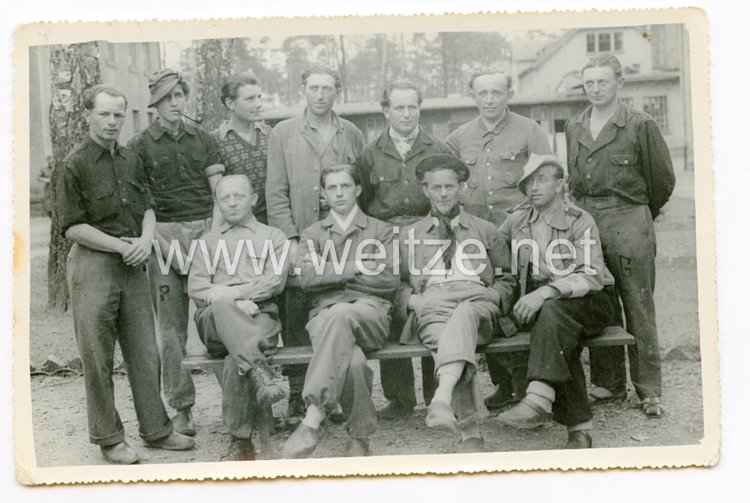
Wehrmacht Group Photo, Germans in French Captivity
The object in question is a group photograph of Wehrmacht soldiers in French captivity, produced in postcard format. Such photographic documents represent significant historical testimonies that provide insight into the fate of German soldiers after the capitulation of Nazi Germany in May 1945.
Following the unconditional surrender of the Wehrmacht on May 8, 1945, millions of German soldiers fell into Allied captivity. France interned an estimated 740,000 to over one million German prisoners of war. French authorities initially classified these prisoners as Disarmed Enemy Forces (DEF) or later as Prisoners of War (POW) according to the Geneva Convention of 1929.
The accommodation of German prisoners of war in France took place in numerous camps (Dépôts) distributed throughout French territory, including North Africa. Conditions in these camps varied considerably. In the first months after the war's end, circumstances were frequently extremely difficult: food shortages, inadequate shelter, and harsh working conditions characterized the daily life of many prisoners. France itself suffered from the consequences of German occupation and economic exhaustion, which further complicated the provision for prisoners of war.
Photographs like the present one served various purposes. For the prisoners themselves, they were important signs of life that could be sent to family members back home. The International Committee of the Red Cross (ICRC) played a central role in transmitting such messages and photographs between prisoners of war and their families. The postcard format was particularly practical, as it corresponded to official regulations for prisoner of war mail and was relatively easy to send.
The existence of group photographs indicates a certain level of organization within the camps. Often such images were created by professional or semi-professional photographers, sometimes by fellow prisoners who possessed the necessary skills. In some cases, French camp authorities permitted the production of such photographs as part of humanitarian measures or for payment.
The work assignments of German prisoners of war in France were extensive and diverse. Prisoners were employed in reconstructing destroyed infrastructure, in agriculture, in mining, and in clearing minefields. These work assignments were initially harsh and arduous but gradually improved after 1946 as France's economic situation stabilized and international criticism of detention conditions increased.
The repatriation of German prisoners of war from French captivity occurred gradually. While some were released as early as 1946, France retained many prisoners longer due to labor shortages. The last German prisoners of war were not released from French captivity until 1948/1949, significantly later than from British or American custody.
Such photographs are today important sources for researching the post-war period and prisoner of war experience. They document not only the physical appearance and clothing of prisoners but also psychological aspects: posture, facial expressions, and group dynamics provide clues about morale, comradeship, and prisoners' coping strategies.
The indicated condition 2 suggests a well-preserved photograph, which is not taken for granted with such historical documents. Many such images were stored and transported under difficult conditions, frequently resulting in damage.
In the context of German-French history after 1945, such documents are part of the complex process of coming to terms with the war's legacy. They remind us of human suffering on all sides and of the difficult years of transition from war to peace that ultimately led to German-French reconciliation and European integration.