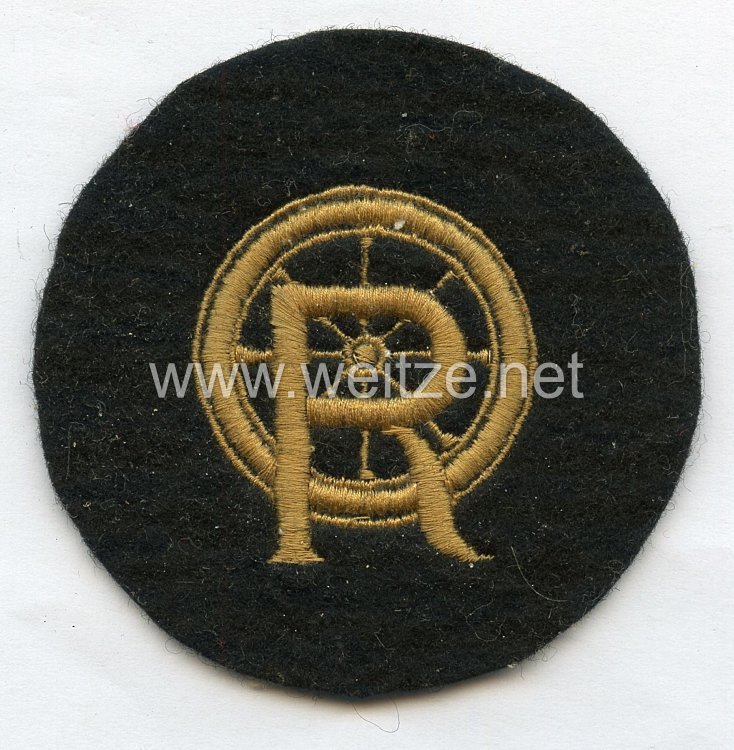
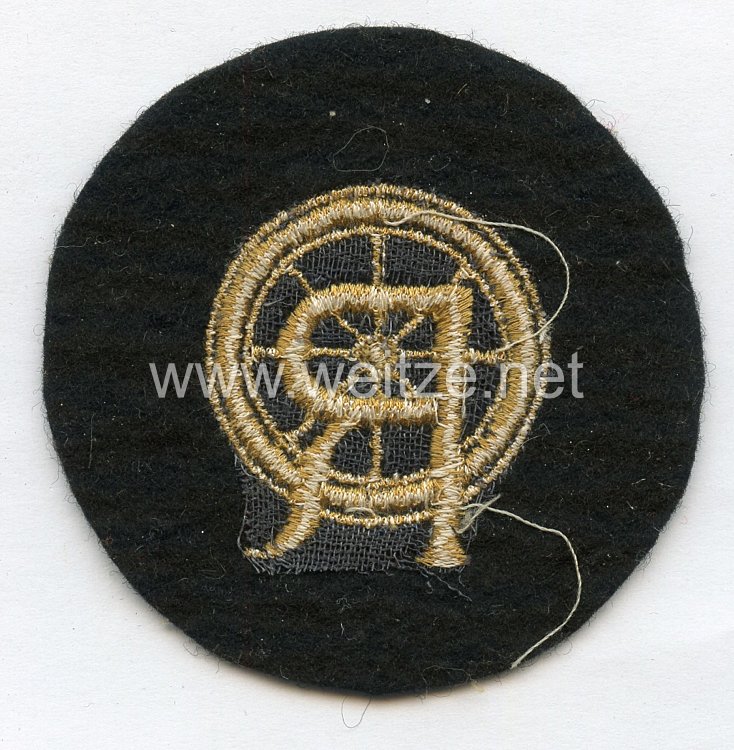
Reichsbahn Specialist Badge for Yard Supervisor
The Reichsbahn specialist service badge for shunting supervisors represents a significant testimony to the organizational structure and visual hierarchy of the German Reichsbahn during the National Socialist period. These machine-embroidered sleeve badges on dark blue fabric served to clearly identify specialist personnel within the complex system of German railways.
The Deutsche Reichsbahn was the state railway company of the German Reich, established in 1920 through the merger of various regional railways. After the Nazi seizure of power in 1933, the Reichsbahn became increasingly integrated into the National Socialist infrastructure and played a central role in both civilian and military logistics. At its peak, the organization employed over 1.2 million people, making it one of the largest employers in the German Reich.
The shunting supervisor (Rangieraufseher) held an important supervisory function within this massive organization. He was responsible for overseeing and coordinating shunting movements at stations and marshalling yards. This position required extensive technical knowledge, experience, and leadership qualities, as shunting operations were among the most dangerous and complex activities in railway operations. The shunting supervisor not only had to master technical procedures but also coordinate personnel and ensure the safety of all involved.
The introduction of standardized specialist service badges occurred as part of the Reichsbahn's uniformization efforts in the 1930s. These badges were worn in accordance with the uniform and clothing regulations of the Deutsche Reichsbahn and enabled immediate recognition of the wearer's function and responsibilities. The machine embroidery on dark blue fabric corresponded to the official color specifications for Reichsbahn uniforms of that era.
The design of such badges followed strict guidelines. They had to be clearly visible, durable, and unambiguously identifiable. The dark blue base material corresponded with the typical uniform of Reichsbahn employees, while the embroidery itself was usually executed in contrasting colors to ensure maximum visibility. Machine manufacturing guaranteed standardization and uniformity throughout the entire Reichsbahn territory.
The historical significance of such badges lies not only in their practical function but also in their testimonial value regarding the bureaucratic and hierarchical organization of the Nazi state. The Reichsbahn was deeply implicated in the crimes of National Socialism, particularly through organizing deportation transports. While shunting supervisors were primarily responsible for regular operational procedures, the entire organization was part of the National Socialist infrastructure.
After 1945, the Deutsche Reichsbahn continued differently in the various occupation zones. In the Soviet zone, it retained its name until German reunification in 1994, while the Deutsche Bundesbahn was established in the West. Old uniform pieces and badges from the pre-1945 period were no longer used and today exist exclusively as collector's items of historical interest.
For collectors and historians, such specialist service badges represent important sources for researching the everyday history and organizational structure of the Reichsbahn. The indicated condition 2 denotes in collector nomenclature a well-preserved state with possibly slight signs of wear, which is quite remarkable for textiles from this period. Machine embroidery enabled precise execution and greater durability compared to hand-embroidered variants.
The documentation and scholarly examination of such objects contributes to understanding the complex structures that characterized the German Reich and its organizations. They remind us of the importance of railways as the backbone of infrastructure and of the many people who worked in this system, regardless of their individual attitudes toward the regime.