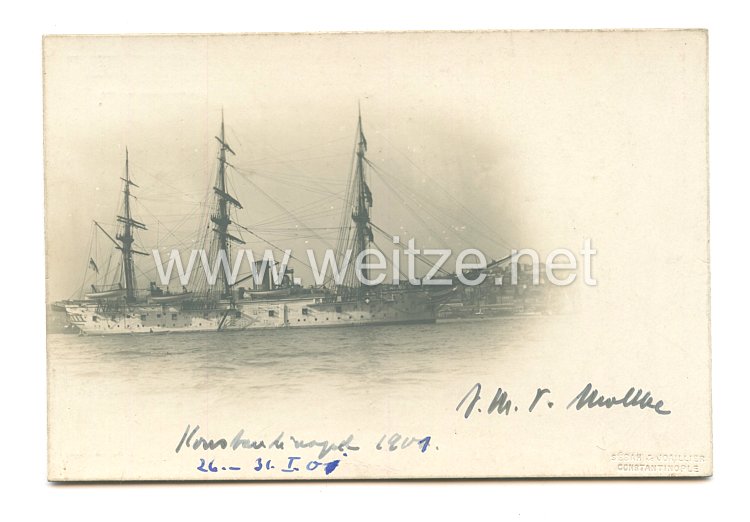
German Empire Photograph, S.M.S. Moltke in Constantinople

Postcard size, condition 2.
350409
15,00

German Empire Photograph, S.M.S. Moltke in Constantinople

S.M.S. Moltke in Constantinople: A Photographic Testament to German Naval Diplomacy in World War I

This postcard-sized photograph documents a significant moment in the history of the Imperial German Navy and German-Ottoman relations during the First World War. The image shows the S.M.S. Moltke, one of the most modern battlecruisers of the Imperial fleet, during her visit to Constantinople (modern-day Istanbul), the capital of the Ottoman Empire.

The S.M.S. Moltke was a battlecruiser of the Imperial German Navy, named after the Prussian Field Marshal Helmuth von Moltke. The ship was built between 1908-1910 at the Blohm & Voss shipyard in Hamburg and commissioned on September 30, 1911. With a displacement of 22,979 tons, a length of 186.6 meters, and a top speed of 28.4 knots, she belonged to the Moltke-class and represented an evolution of the Von der Tann design. She was armed with ten 28-cm guns in five twin turrets and twelve 15-cm guns.

Visits by German warships to Constantinople held special political and military significance. Since the late 19th century, the German Empire had cultivated intensive relations with the Ottoman Empire. The most famous symbol of this connection was the military mission under General Liman von Sanders, which from 1913 onwards was tasked with reforming the Ottoman army. The German naval presence in the eastern Mediterranean intensified significantly after the Ottoman Empire entered the war on the side of the Central Powers on November 2, 1914.

A decisive moment in this alliance was the spectacular flight of two German warships, S.M.S. Goeben and S.M.S. Breslau, through the Mediterranean to Constantinople in August 1914. These ships were formally sold to the Ottoman Navy but retained their German crews. The Moltke herself operated primarily in the North Sea, where she participated in major engagements such as the Battle of Dogger Bank (1915) and the Battle of Jutland (1916).

Photographs like this one in postcard format were an important medium of documentation and propaganda during World War I. The Imperial Navy systematically photographed its ships and operations. These images were frequently reproduced as postcards and served both military documentation purposes and morale-boosting on the home front. Such cards were sent by soldiers to their families or kept as collectibles.

The presence of the Moltke or other German capital ships in Constantinople demonstrated the maritime strength of the German Empire and the close military cooperation with its Ottoman ally. The Bosphorus and the Dardanelles were of paramount strategic importance, as they represented the only connection between the Black Sea and the Mediterranean. Control over these straits by the Central Powers effectively cut off Russia from its western allies.

The technical quality of such photographs varied considerably. Professional naval photographers used high-quality equipment, while many images were also taken by officers and crew members with private cameras. The postcard format (typically 9 x 14 cm) was the standard for military documentary photography of this era.

After World War I, the S.M.S. Moltke was taken from the Imperial Navy in accordance with the provisions of the Treaty of Versailles. She was interned at Scapa Flow in 1919, where the German crew carried out the scuttling on June 21, 1919, along with the entire interned fleet. The Moltke sank in shallow water and was later raised and scrapped in 1927.

Such historical photographs are valuable historical documents today. They enable historians and collectors to reconstruct the maritime history of World War I and understand the significance of naval forces in warfare. The condition of such documents is typically rated on a scale, with preserved details and image clarity being important criteria.

r