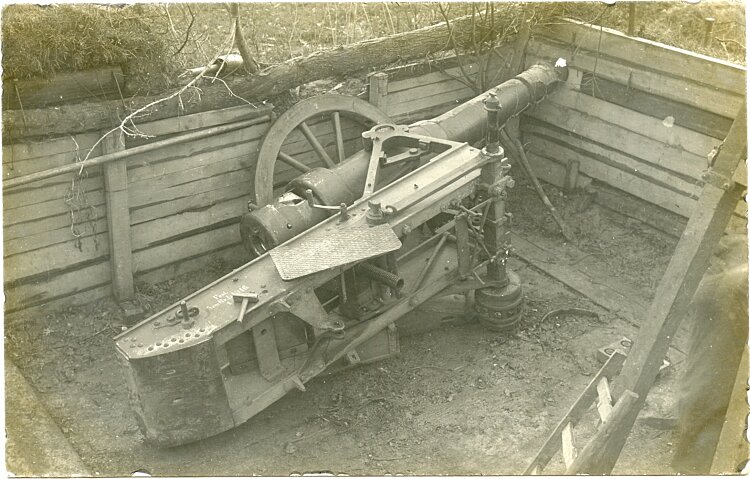
World War I Photograph: Destroyed Artillery Piece
Destroyed Artillery Pieces in World War I: Documentation of Material Warfare
This postcard-sized photograph documents a destroyed artillery piece from World War I (1914-1918). Such photographic images were widespread during the war and served various purposes – from military reconnaissance to propaganda material to personal mementos for soldiers.
Artillery in World War I
World War I is considered the first industrialized mass war in history, in which artillery assumed an entirely new, dominant role. Estimates suggest that artillery fire caused between 60 and 70 percent of all casualties on the Western Front. Guns ranged from light field cannons with calibers of 77mm (Germany) or 75mm (France) to medium howitzers to heavy siege guns and railway artillery.
The most important artillery types included the German 7.7 cm Feldkanone 96 n.A., the French Canon de 75 modèle 1897, considered technically revolutionary, and various howitzers such as the German 15 cm schwere Feldhaubitze 13. These weapons dominated the battlefield and transformed vast landscapes into moonscapes.
Destruction of Artillery Pieces
Artillery pieces were destroyed or rendered inoperable in various ways. Counter-battery fire from enemy artillery was the most common cause, with the development of sound ranging and flash spotting from 1915/16 significantly improving the location of enemy batteries. Direct hits on ammunition dumps near gun positions often led to devastating explosions.
Other causes of destruction included air attacks, which were increasingly flown against artillery positions from 1917 onwards, as well as bore bursts – explosions in the gun barrel due to faulty ammunition or material fatigue. During retreats, guns were frequently rendered unusable by their own troops by detonating charges in the barrel or removing essential breech components.
Photographic Documentation
Photographs of destroyed enemy equipment were popular subjects for several purposes. Propaganda photographs were intended to demonstrate one's own military superiority and strengthen morale on the home front. Official war correspondents from various armies systematically documented combat operations and their results.
At the same time, soldiers made private recordings that served as field postcards or personal mementos. The production and distribution of such photographs was subject to military censorship, with regulations varying between the warring nations. The German military established the Bild- und Filmamt (BUFA) as early as 1914, which coordinated all photographic war documentation from 1917 onwards.
The Postcard Format
The postcard format (typically 9 x 14 cm or 10.5 x 14.8 cm) was the standard format for photographic correspondence in World War I. Millions of field postcards were sent during the war, with photographs being more popular than text-only cards. Commercial photographers in areas near the front offered soldiers the opportunity to have photographs taken and reproduced as postcards.
Condition and Collector Aspects
The indicated condition of 2- corresponds in standard military-historical collector grading to good to very good preservation with possibly minor signs of use. For photographs over a hundred years old, this is remarkable, as contemporary developing and fixing processes were not always optimal and many images faded or became damaged over the decades.
Historical Value
Photographs like this are important primary historical sources. They document not only military equipment and destruction, but also the reality of industrialized warfare. For modern historical research, they provide visual evidence of weapon types, tactical situations, and the effects of material warfare. Archives such as the Bundesarchiv in Koblenz, the Imperial War Museum in London, or the Bibliothèque nationale de France preserve millions of such images as part of the collective memory of World War I.
Such documents serve as reminders of the devastating effects of the first total war of the modern era and stand as sobering testimony to an epoch that fundamentally changed Europe.