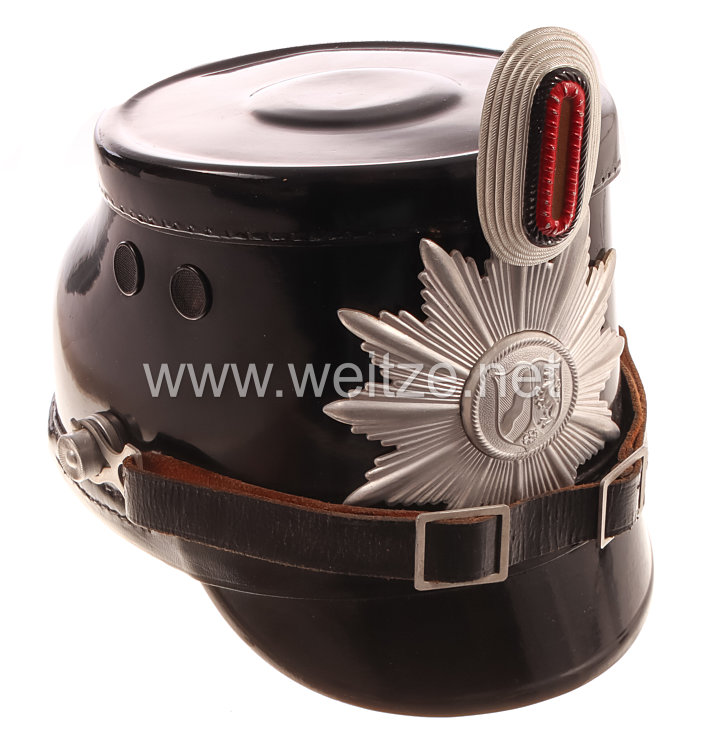
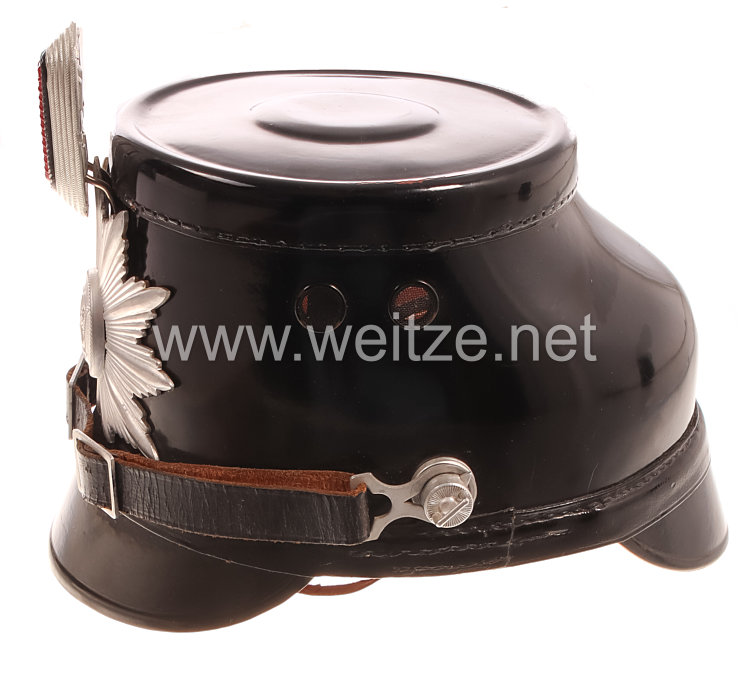
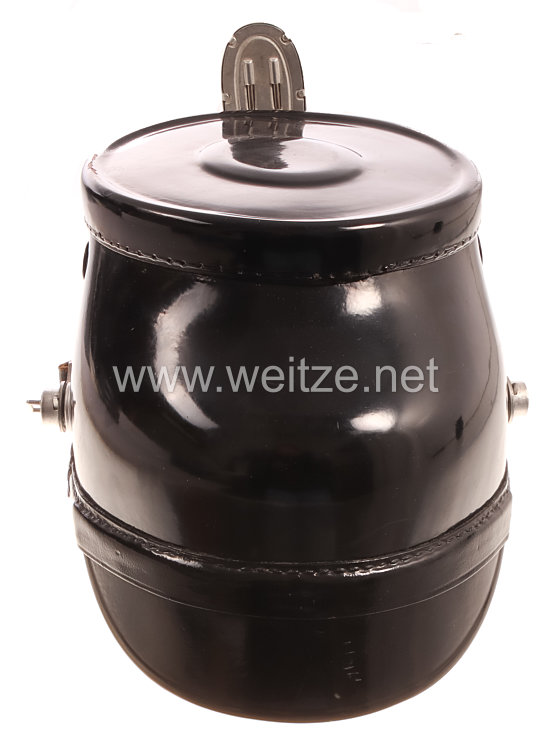
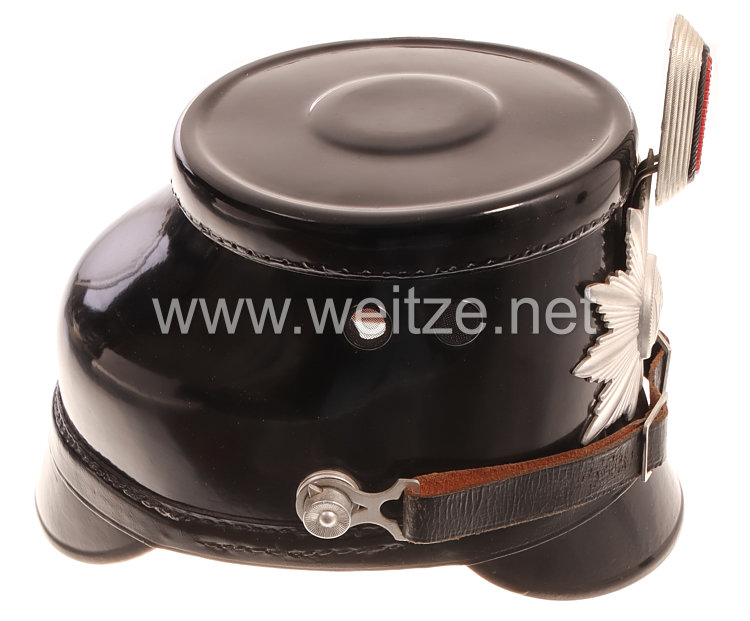
Federal Republic of Germany (FRG) Police Shako for Enlisted Men, Nordrhein Westfalen

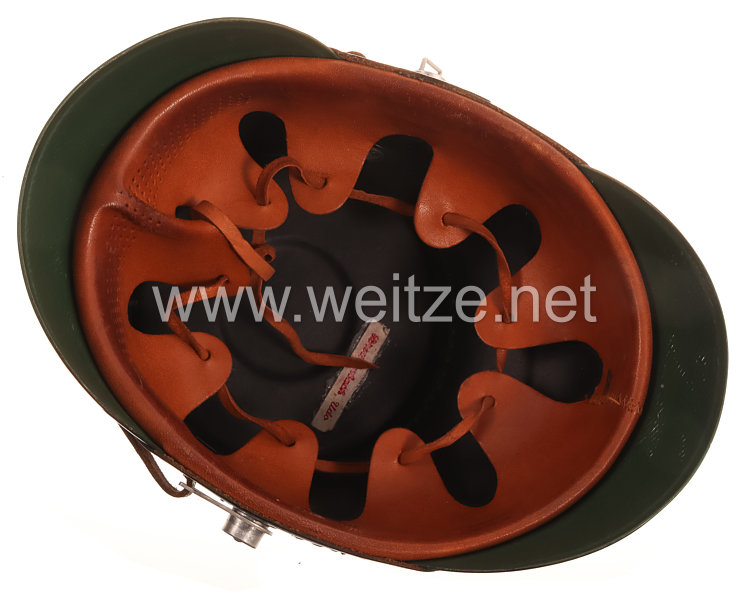
Worn circa 1950. Black shako made of vulcanized fiber. Front features large silver-colored police star, center displays the coat of arms of Nordrhein Westfalen, black leather chin strap attached to button 91. Complete with cockade. Interior with tabbed lining, with owner’s label “Udo ...”, size 57. Condition 2.
447107
180,00

Federal Republic of Germany (FRG) Police Shako for Enlisted Men, Nordrhein Westfalen

The police shako from North Rhine-Westphalia represents a significant chapter in the history of German police uniforms in the early Federal Republic of Germany. This black headgear made of vulcanized fiber was worn around 1950 and symbolically stands for the reconstruction of state order structures in post-war Germany.

After the end of World War II and Germany's unconditional surrender in May 1945, police structures in the western occupation zones had to be completely rebuilt. The Allies had initially dissolved all German police forces. From 1946 onwards, the military governments of the Western powers began the controlled reconstruction of decentralized police units. The state of North Rhine-Westphalia was formed on August 23, 1946, by the British military government from the Prussian province of Westphalia and the northern part of the Rhine province.

The uniforming of the new state police forces took place in the late 1940s and early 1950s. Those responsible deliberately drew on traditional German police uniforms from the pre-war period, but avoided any reference to the National Socialist era. The shako as headgear had a long tradition in German police history, dating back to the 19th century.

The described specimen consists of black vulcanized fiber, a pressed, hardened fiber material that had been used for military and police headgear since the late 19th century. Vulcanized fiber was inexpensive to produce, relatively lightweight, yet stable enough to maintain the characteristic shape of the shako. In the economically difficult post-war period, this was an important practical advantage over more expensive materials.

On the front of the shako is the large silver-colored police star, the central identifying mark of the German police. In the center of the star is the coat of arms of North Rhine-Westphalia, indicating the regional affiliation of the police unit. This federal principle was characteristic of the police organization of the new Federal Republic, which deliberately distanced itself from a centralized structure.

The black leather chin strap is attached to button 91 and serves the practical purpose of securing the headgear. Such chin straps had been standard on military and police shakos since the 19th century. Button number 91 refers to the standardized uniform production of this period. The cockade as an additional decorative element completes the equipment.

The inner lining is tabbed, a construction method that provided better wearing comfort. The wearer's label with the name "Udo..." and size 57 indicates that this shako was personally assigned to a specific police officer. Such personalizations were common, as uniform pieces were generally issued for longer service periods.

The uniforming of the police in the early years of the Federal Republic had several functions. On the one hand, it was to represent authority and state order; on the other hand, it was also to strengthen the population's trust in democratic institutions. The police of the young Federal Republic deliberately distanced themselves from the militarized police of the Nazi era and tried to establish a citizen-friendly image.

The shako as headgear was increasingly replaced by more practical peaked caps in the 1950s and 1960s. However, the representative function of the shako made it indispensable for some time at special occasions and ceremonies. Different federal states retained this traditional headgear for varying lengths of time.

Today, such police shakos from the early period of the Federal Republic are sought-after collector's items that represent important testimonies to German police history. They document the transitional phase from the end of the war to the establishment of democratic structures and show how state authority was visually represented in the new Federal Republic. The combination of traditional elements with new, democratic symbols such as the state coat of arms is characteristic of this era.

The described specimen in condition 2 is well preserved and allows an authentic insight into the uniforming of the North Rhine-Westphalian police around 1950. It represents an important epoch of German history in which new democratic institutions were built after the horrors of National Socialism and the war.

r