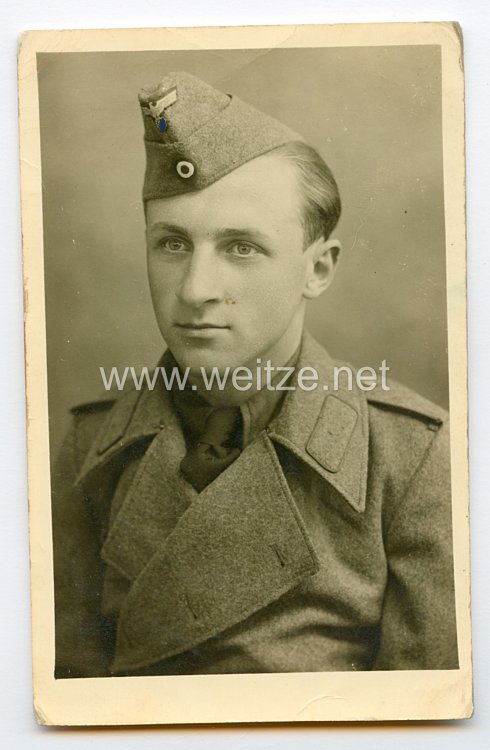
Wehrmacht Portrait Photograph, Member of a Sturmgeschütz Battalion
This portrait photograph depicts a member of a Wehrmacht Sturmgeschütz (assault gun) battalion during World War II. Photographs of this type were an important medium for documenting military identity during the war and served both personal and propaganda purposes.
The Sturmgeschütze (assault guns) evolved into one of the most successful weapon systems of the German Wehrmacht. Originally conceived in 1936-1937 as an armored infantry support weapon, the first Sturmgeschütz III (StuG III) entered serial production in 1940. The first independent unit, Sturmgeschütz-Abteilung 640, was established in September 1939. By war's end, over 10,500 assault guns of various types had been produced, more than any other German armored fighting vehicle.
Members of Sturmgeschütz battalions initially wore the black panzer uniform but later switched to the field-grey uniform of the artillery, as the assault gun branch was organizationally part of the artillery. The Waffenfarbe (branch color) pink for armored and assault artillery marked this branch on collar patches and shoulder straps. Crews frequently wore the Sturmabzeichen (Assault Badge), a decoration awarded from June 1, 1940, for participation in combat operations.
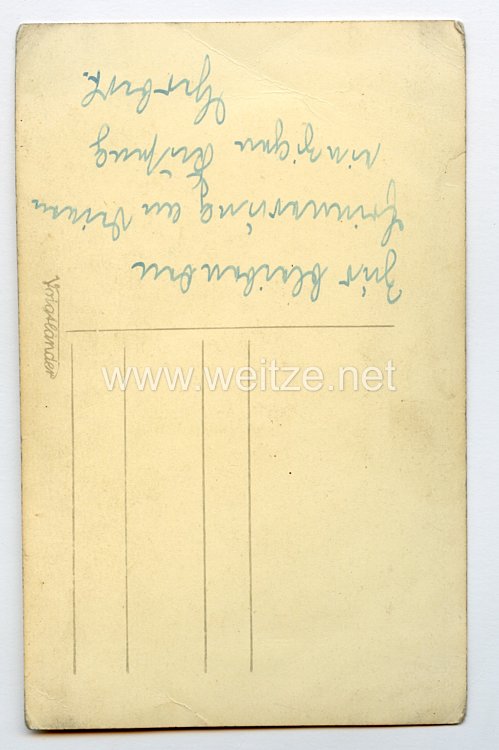
Portrait photographs in postcard format were extraordinarily common during World War II. Soldiers had their pictures taken at professional photography studios or by regimental photographers to send these images to family members, fiancées, or friends. These photographs served multiple functions: personal remembrance, maintaining family ties during long separations, and not least, self-presentation in uniform with acquired decorations.
The technical execution of such portraits followed contemporary photographic standards. They were usually taken in studios with controlled lighting conditions, with the soldier typically posed in half-figure or bust format, looking at the camera or slightly to the side. The uniform was carefully arranged, and decorations and badges were clearly visible. The postcard format (approximately 9 x 14 cm) corresponded to contemporary standards and enabled postal delivery.
Sturmgeschütz battalions played a decisive role in nearly all Wehrmacht campaigns. From the Blitzkrieg operations in Poland and France through the Balkans campaign to the Eastern Front campaign and fighting in Africa and Italy, they were present. Their primary mission evolved during the war: while initially serving primarily for direct infantry support, they were increasingly deployed as tank destroyers, especially on the Eastern Front against Soviet armored formations. The StuG III proved extraordinarily effective in this role and achieved more confirmed kills than any other German combat vehicle.
The organization of Sturmgeschütz battalions changed several times during the war. A battalion typically consisted of three batteries with six to seven vehicles each; later, reinforced battalions with over 30 assault guns were also established. Crews consisted of four men: commander, gunner, loader, and driver.
From a historical perspective, such portrait photographs are important sources today for uniform studies, decoration research, and the social history of the war. They document not only military hierarchies and decorations but also soldiers' self-perception and the visual culture of the era. At the same time, they must be viewed critically, as they often represented staged self-presentation and were part of National Socialist military culture.
The indicated condition 2 suggests a well-preserved photograph with light signs of wear, as expected for documents over 80 years old. Such photographs are now sought-after collectibles for military historians and collectors interested in Wehrmacht history and specifically the armored forces.