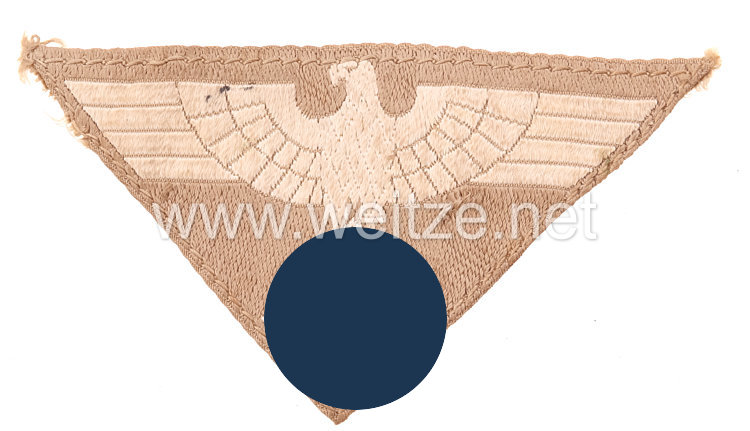
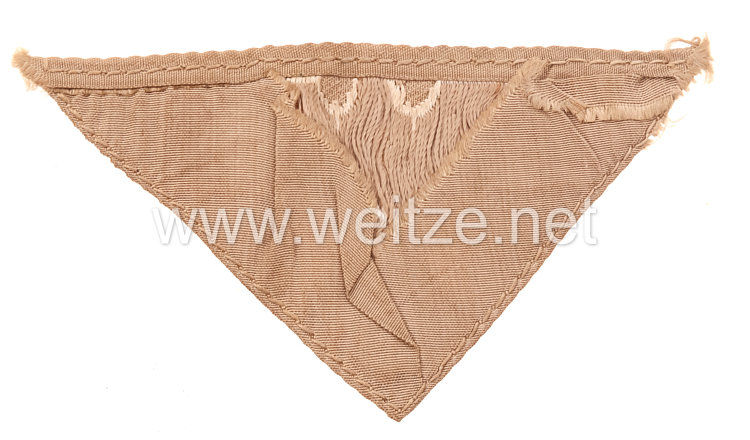
TeNo Sleeve Eagle for Enlisted Men “Technische Nothilfe”

Woven construction on beige wool for work overalls. Lightly worn, condition 2. Rare.
444306
300,00

TeNo Sleeve Eagle for Enlisted Men “Technische Nothilfe”

The Technische Nothilfe (TeNo) sleeve eagle for enlisted personnel represents a significant artifact from the history of German civil defense during the Weimar Republic and early Third Reich periods. This woven version on beige background was specifically designed for the work overalls of ordinary ranks and embodies the paramilitary organization of a technical emergency service that emerged during a turbulent epoch of German history.

The Technische Nothilfe was founded on September 30, 1919, by Prussian Interior Minister Wolfgang Heine during the revolutionary unrest of the post-war period. Its original purpose was to maintain public order and essential infrastructure services during strikes and uprisings. In an era of massive social upheaval, when communist and socialist movements were shaking Germany, the TeNo was intended to serve as a technical reserve to protect and operate utilities, water and electrical plants, and transportation systems.

The organization primarily recruited volunteers with technical expertise – engineers, mechanics, electricians, and other skilled workers. TeNo members were organized in strict, quasi-military structures, although it officially remained a civilian organization. This paramilitary orientation was reflected in the uniforms and rank insignia, which included the characteristic sleeve eagle.

The sleeve badge in the form of an eagle served to identify TeNo members during their operations. The woven version on beige background was typical for the work uniform – sturdy work overalls in beige or khaki tones worn during practical deployments. Unlike more representative uniform variants with embroidered or metal badges, the woven version was more cost-effective to produce and more durable in daily use.

The iconography of the eagle was deeply rooted in German symbolism and was used by numerous state and paramilitary organizations of the Weimar Republic. However, the TeNo eagle differed in its specific design from other contemporary variants. The visual representation followed the organization's official regulations and was kept in a simple, functional form for enlisted ranks.

During the Weimar Republic, the Technische Nothilfe experienced steady expansion. It was deployed during natural disasters, technical emergencies, and especially in strike-breaking operations. The latter made it extremely unpopular with the labor movement, while it was supported by conservative and nationalist circles. The organization possessed specialized vehicles, technical equipment, and depots throughout Germany.

After the Nazi seizure of power in 1933, the TeNo was integrated into the NS system and placed under the Reich Aviation Ministry under Hermann Göring. In 1937, it was renamed Technische Nothilfe e.V. and later fully incorporated into civilian air defense. During World War II, the organization played an important role in rescue operations after air raids and in maintaining war-essential infrastructure.

The TeNo sleeve badges underwent several modifications during the various phases of its existence. The early Weimar versions differed in details from the later NS-period versions. Collectors and historians can often determine approximate dating through material composition, weaving technique, and stylistic characteristics.

After the end of World War II in 1945, the Technische Nothilfe was dissolved by the Allies. Its functions were later partially assumed by the Technisches Hilfswerk (THW), which was founded in 1950 in the Federal Republic of Germany and continues to exist today as a civil defense organization.

Today, original TeNo sleeve eagles are sought-after collector's items that provide insight into the complex history of German civil defense organizations. The woven versions for enlisted personnel are particularly interesting because they reflect the practical, everyday reality of the organization, as opposed to the more representative uniform pieces of higher ranks. The condition of such fabric badges varies considerably, as they were subject to heavy wear and many examples did not survive the war.