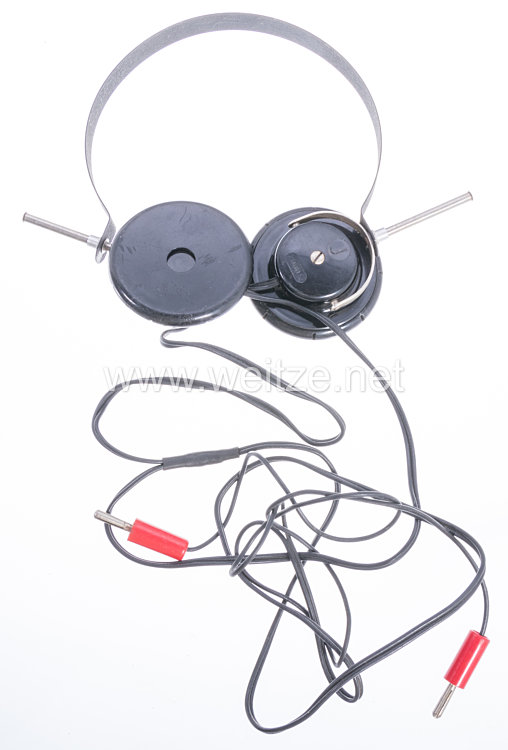
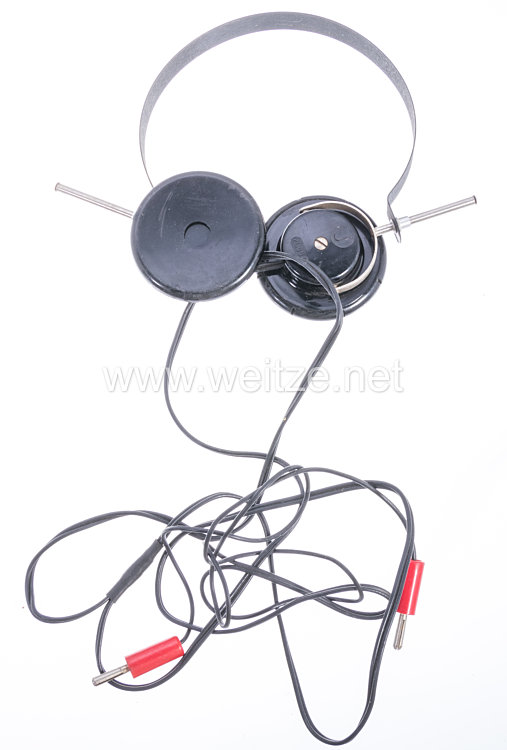
Federal Republic of Germany (FRG) Early Headphones
Early Federal Republic of Germany headphones from around 1948 represent a significant transition in post-war German history, both technologically and politically. These headphones with Bakelite ear cups emerged during a time of profound transformation, as Germany recovered from the ruins of World War II and established new state structures.
The year 1948 marked a turning point in German history. The currency reform of June 20, 1948, introduced the Deutsche Mark and laid the foundation for the economic miracle. In the western occupation zones, structures began to form that would lead to the founding of the Federal Republic of Germany in 1949. In this context of reorganization, military and communications infrastructure also had to be rebuilt.
Bakelite, an early synthetic plastic material developed by Leo Baekeland in 1907, was particularly valuable in the post-war period. It was heat-resistant, insulating, and relatively inexpensive to manufacture – important properties during a time of scarce resources. The use of Bakelite for the ear cups of these headphones was typical of late 1940s technical production, before more modern plastics like polyvinyl chloride (PVC) or polypropylene became widely used.
Communications equipment in the early Federal Republic was subject to complex requirements. After the unconditional surrender in 1945, the Allies had initially prohibited Germany from having any military capacity. The occupying powers strictly controlled the production and use of communications equipment. Nevertheless, even in the late occupation period, there was a need for reliable communications equipment for various purposes: from police to border guards to civilian administrative offices.
Headphones of this type typically found use in various areas: with radio and telegraph operators, in the early Federal Post Office, with police and security forces, and later with the emerging armed forces. The Federal Border Guard, founded in 1951, and the Bundeswehr, established in 1955, required extensive communications equipment. The technical standards and equipment from 1948-1950 often formed the basis for later military procurement.
The technical construction with cable and plug indicates standardized application. In the post-war period, German manufacturers attempted to build on pre-war standards while simultaneously adapting to new norms prescribed by the Allies. The electrical and acoustic specifications of such headphones were critical for military and professional applications, as they had to ensure clear voice communication even under difficult conditions.
The manufacture of such devices occurred during a time of industrial reconstruction. Many German industrial plants had been destroyed or dismantled. The dismantling of industrial facilities as reparations particularly affected the years 1945-1948. Manufacturers had to work with limited raw materials and under the supervision of the occupying powers. Nevertheless, German industry managed surprisingly quickly to rebuild production capacity.
The Cold War fundamentally changed the security situation. The Berlin Blockade of 1948-1949 and increasing tensions between East and West led the western Allies to develop an interest in West Germany's rearmament. This created a demand for military equipment and communications technology that brought German industry back into play as producers.
From a cultural-historical perspective, such objects document the technological state and material conditions of the early post-war period. They are witnesses to a transitional era in which Germany stood between occupation and sovereignty, between disarmament and rearmament, between destruction and reconstruction. The robust, functional design reflects the priorities of a time when durability and reliability were more important than aesthetic considerations.
Today, such early headphones from the FRG period are sought-after collector's items that document an important part of German technical and military history. They recall the beginnings of the Federal Republic and the challenges of reconstruction in a divided nation during the beginning of the Cold War.