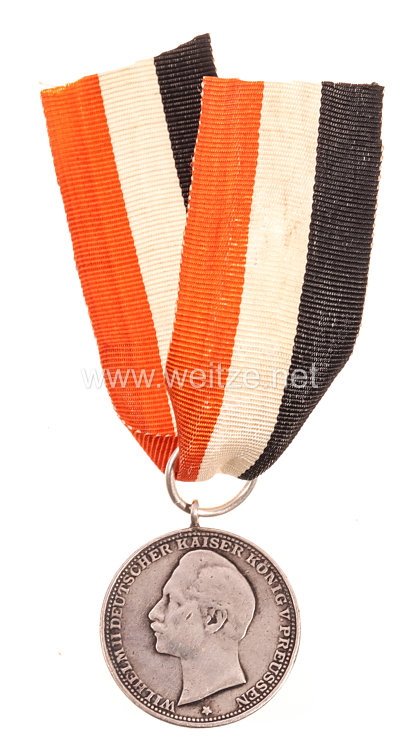
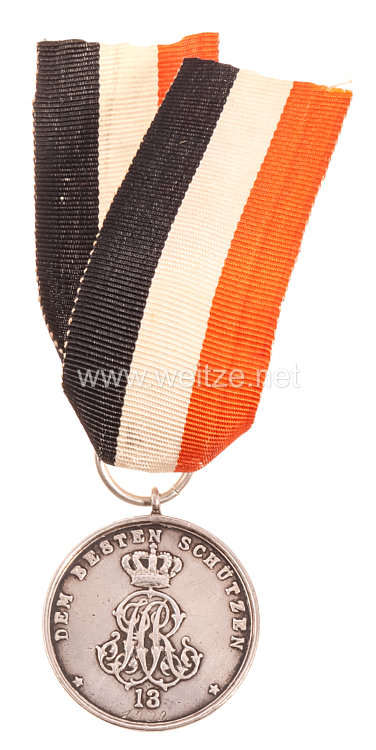
Prussia Portable Marksmanship Award of Infantry Regiment Herwarth von Bittenfeld (1st Westphalian) No. 13 "To the Best Marksman 1909"

Garrison Münster. Silver medal, diameter 30 mm, on patriotic ribbon, condition 2.
446005
150,00

Prussia Portable Marksmanship Award of Infantry Regiment Herwarth von Bittenfeld (1st Westphalian) No. 13 "To the Best Marksman 1909"

The Shooting Award of the Infantry Regiment Herwarth von Bittenfeld (1st Westphalian) No. 13 from 1909 represents a significant tradition of the Prussian military system in the late Imperial period. This silver medal with a diameter of 30 mm was awarded to the regiment's best marksman and documents the high importance placed on rifle training in the Prussian Army.

Infantry Regiment No. 13 bore the name of the Prussian General Hans Karl von Herwarth von Bittenfeld (1796-1884), a respected military leader of the Prussian Army who played a significant role in the Wars of German Unification. The regiment was stationed in Münster in Westphalia, an important garrison town of the Prussian military district. As a Westphalian regiment, it belonged to the VII Army Corps and had a long tradition dating back to the 18th century.

The awarding of shooting distinctions had been institutionalized in the Prussian Army since the mid-19th century. After the experiences of the Napoleonic Wars and the technical developments in rifle technology, the Prussian military leadership recognized the crucial importance of individual marksmanship for the combat effectiveness of troops. The introduction of rifled guns and later the Gewehr 98 repeating rifle made the individual infantryman a far more effective fighter, provided he mastered his weapon.

In 1909, when this award was presented, the German Empire was in a phase of intense military armament. Political tensions in Europe were increasing, and the general staffs of all major powers were preparing for a possible conflict. The Prussian Army, which formed the backbone of the German armed forces, placed the greatest emphasis on training its soldiers. Regular shooting exercises and competitions were an integral part of military routine.

The medal was worn on the so-called patriotic ribbon, which displayed the colors of Prussia - black and white. This color combination symbolized allegiance to the Prussian Crown and was widespread among military decorations. The production of such medals was typically carried out by specialized military equipment manufacturers who struck individual awards for the various regiments.

Each regiment of the Prussian Army had the right to establish and award its own regimental decorations. Although these were not state orders, they enjoyed high prestige within the military community. The presentation usually took place during a ceremonial occasion, often on the anniversary of a significant event from the regiment's history or on the birthday of the regimental chief.

The awarding of the distinction “To the Best Marksman” was based on the results of the annual shooting competitions, where soldiers had to demonstrate their accuracy. These competitions included various disciplines: shooting at different distances, from various positions, and under time pressure. Evaluation followed a strict point system established in military service regulations.

Infantry Regiment No. 13 had participated in numerous campaigns throughout its history. In the Wars of Liberation against Napoleon, in the Austro-Prussian War of 1866, and in the Franco-Prussian War of 1870/71, the regiment had distinguished itself. This tradition obligated soldiers to exceptional performance and made such an award all the more honorable.

The size of 30 mm in diameter was typical for shooting awards of this type. They were dimensioned so that they could be worn on the uniform without being too conspicuous, yet still recognizable as a sign of special achievement. The use of silver as material emphasized the value of the award and was common for military honors of this category.

Only five years after the presentation of this award, World War I began, in which Infantry Regiment No. 13 suffered heavy losses. Many of the soldiers who had received such peacetime decorations had to prove their training-acquired skills in the trenches of France and Belgium. The marksmanship training promoted by such awards proved valuable in the first months of the war, before the conflict descended into grinding trench warfare.

Today, such regimental decorations are important military historical documents that provide insight into the daily life of the Prussian Army before World War I. They testify to the importance attached to military excellence and individual skill, and are witnesses to a military culture that placed great value on tradition, honor, and achievement.

r