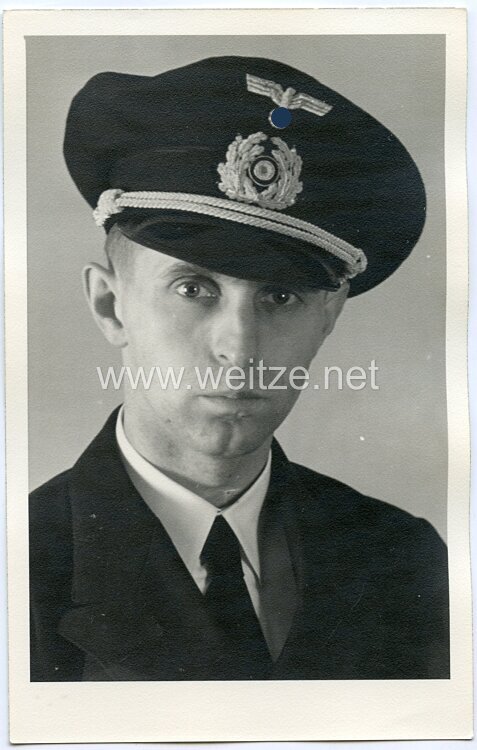
Portrait Photograph of a Kriegsmarine Officer and Official

Postcard size, condition 2.
246105
10,00

Portrait Photograph of a Kriegsmarine Officer and Official

The portrait photograph of a Kriegsmarine officer and official in postcard size represents an important aspect of military photography and identity culture during German naval history in the early to mid-20th century. Such photographs served not only as personal mementos but also as official documents of military affiliation, representing social status within the military hierarchy.

The Kriegsmarine was the official designation of the German Navy from 1935 to 1945. It was established following the reintroduction of conscription and the renaming of the Reichsmarine, constituting one of the three branches of the Wehrmacht. The Kriegsmarine evolved from the heavily restricted Reichsmarine under the Treaty of Versailles and grew substantially during the rearmament phase of the 1930s.

Portrait photographs of naval officers and officials were widespread during this period. They were frequently produced in professional photo studios specializing in military photography. The postcard size, typically around 9 x 14 cm or similar formats, was the standard format for such photographs, allowing for easy storage, mailing to family members, or use in official documents.

Kriegsmarine uniforms followed strict regulations detailed in the corresponding uniform orders. The Anzugordnung für die Kriegsmarine (Uniform Regulations for the Navy) of 1935 and its subsequent amendments precisely regulated which uniform components were to be worn on which occasions. Officers wore characteristic dark blue or white uniforms, depending on season and occasion, with specific rank insignia on shoulder boards and sleeves.

The distinction between officers and officials of the Kriegsmarine was significant. Officers underwent military training and held command authority, while officials performed specialized functions in areas such as administration, engineering, medical services, or other specialized branches. Both groups wore uniforms that clearly indicated their respective status and rank.

The photographic practice of this era followed certain conventions. Images were typically taken against neutral backgrounds or with subtle maritime motifs. Subjects were typically photographed in a dignified, upright posture, often in half-profile or frontal view, to make rank insignia and decorations clearly visible. Lighting was carefully arranged to optimally display uniform details and the subject's facial features.

Such photographs served various purposes. They functioned as identification documents, were kept in military records, sent to family members, or preserved as mementos of service. Many naval personnel had these photographs taken on special occasions, such as promotions, award ceremonies, or before important deployments.

The preservation of such historical photographs is of great importance for military-historical research. They document not only uniform history and military rank structures but also provide insight into the social history and self-perception of naval forces of that era. The indicated condition 2 suggests good preservation, which is not self-evident for photographs of this age, as they are susceptible to fading, discoloration, and physical damage.

The Kriegsmarine comprised various career paths and specializations. From sea officers to naval engineers, medical officers, and administrative officials, there existed a complex hierarchy with specific uniform characteristics for each area. The photographic documentation of this diversity today enables detailed reconstruction of the organizational structure and visual culture of the navy of this epoch.

For collectors and historians, such photographs represent important primary sources that, in conjunction with other documents such as military service records, pay books, and certificates, provide a comprehensive picture of individual military history. They contribute to understanding German maritime military history and document a significant chapter of 20th-century European history.

The postcard format was particularly practical for the era, as it allowed servicemen to easily send their portraits home through military postal services, maintaining family connections during periods of extended service. These photographs became cherished family heirlooms, preserving the memory of ancestors who served in the naval forces. Today, they serve as tangible connections to a complex historical period and provide valuable material for understanding military culture, photography history, and social practices of the mid-20th century.