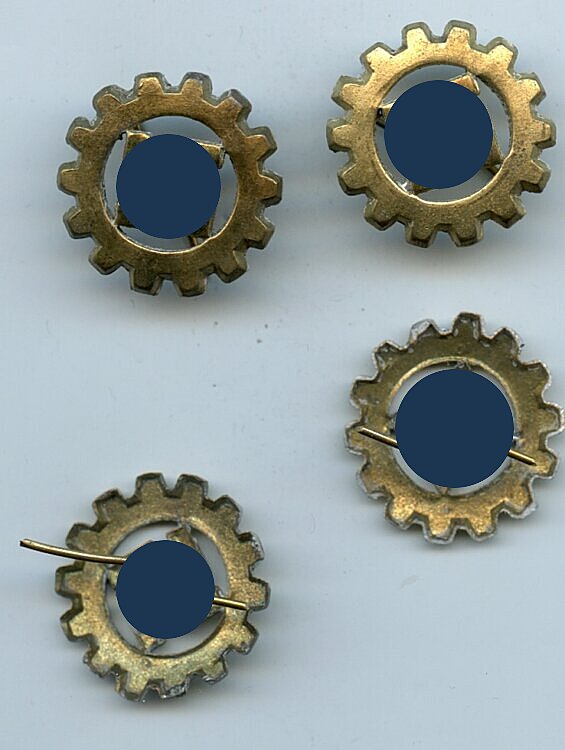
DAF/Werkschar Pair of Shoulder Board Underlays

hollow embossed and gilt. Unissued condition, Condition 2.
Price per pair:
175805
45,00

DAF/Werkschar Pair of Shoulder Board Underlays

The DAF Werkschar shoulder board insignia represent characteristic rank badges of the Deutsche Arbeitsfront (German Labour Front) during the National Socialist period. These hollow-embossed and gilt shoulder boards constitute an important element of paramilitary uniforming within the Nazi organizational structure.

The Deutsche Arbeitsfront (DAF) was established on May 10, 1933, under the leadership of Robert Ley, following the violent dissolution of the free trade unions. As a unified organization, it was intended to encompass all working Germans – both workers and employers. By 1939, membership was effectively compulsory, and the DAF had developed into the Third Reich's largest mass organization with over 25 million members.

The Werkschar formed a special formation within the DAF with a paramilitary character. It was systematically established from 1934 onwards and officially served as factory protection in industrial enterprises. Members of the Werkschar wore special uniforms modeled on military examples and differentiated by various rank insignia. The shoulder boards were an essential element for identifying rank and function within the hierarchy.

The shoulder board insignia described here are hollow-embossed – a manufacturing technique in which the material is worked from the reverse side to create a three-dimensional relief. This technique was characteristic of high-quality versions of rank badges and accoutrements. The gilding indicates an elevated rank or special use, as simple enlisted grades were typically equipped with silver-colored or untreated metals.

The unworn condition of these shoulder boards makes them an interesting historical document. Many uniform effects were destroyed or lost after the war ended in 1945. Unworn pieces in good condition are therefore relatively rare and of particular documentary value for historical research.

The uniforming of the Werkschar followed strict guidelines laid down in various service regulations of the DAF. The shoulder boards were worn on both shoulders of the uniform and enabled quick identification of rank and affiliation. The precise design – color, material, and embossing – was strictly regulated and differed according to rank and function.

In the context of Nazi rule, the Werkschar also had a political control function. It served not only factory protection in the narrower sense but also the surveillance of workforces and the enforcement of National Socialist ideology in factories. The paramilitary orientation reflected the general militarization of society in the Third Reich.

After 1945, the DAF and all its subdivisions were dissolved. The uniforms and insignia lost their official function and are today regarded exclusively as historical objects. In Germany, representations and symbols of the DAF are subject to the provisions of the Criminal Code regarding unconstitutional symbols, although use for scientific, historical, or civic education purposes is permitted.

For military historians and uniform specialists, such objects represent important sources for understanding the organizational structures and visual codes of the Nazi regime. The material culture of National Socialism, which includes uniform effects, provides insight into the self-representation and hierarchization within the various organizations.

These shoulder boards, as artifacts of their time, serve as tangible reminders of a dark chapter in German history and contribute to our understanding of how totalitarian systems employed visual symbols and uniforms to establish authority, create hierarchy, and enforce ideological conformity in all aspects of society.