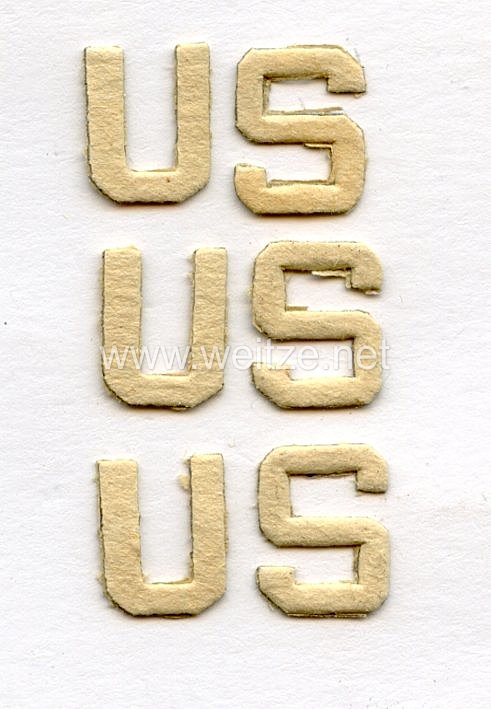
USA Post War Occupation of Germany: US Collar Disc Templates

from a WW2 German cloth insignia manufacturer, post war production of US Army collar disc templates “US”, for hand embroidery purpose, 14 mm height. Condition 2+

Price for each pair:
405504
5,00

USA Post War Occupation of Germany: US Collar Disc Templates

The US collar disc templates from the post-war American occupation of Germany represent a fascinating testament to the complex economic and military relationships between the United States and defeated Germany after 1945. These specialized tools, produced by German textile manufacturers, were used to create hand-embroidered collar insignia featuring the characteristic “US” lettering for American military uniforms.

Following Nazi Germany's unconditional surrender on May 8, 1945, the country was divided into four occupation zones. The American zone encompassed large parts of southern Germany, including Bavaria, Hesse, and parts of Württemberg-Baden. The United States Army stationed hundreds of thousands of soldiers in Germany, initially as an occupation force, and later in the context of the emerging Cold War as defenders of Western Europe against the Soviet threat.

The sheer number of American troops in Germany required enormous logistical efforts, including the production and maintenance of uniforms and insignia. US Army Regulations prescribed in detail how uniforms should appear, including the correct placement and execution of collar insignia. The standardized collar discs with the letters “US” were an essential identifying feature of American soldiers and had to precisely conform to military specifications.

The German textile industry, which had produced for the Wehrmacht during the war, faced existential challenges after 1945. Many factories were destroyed or damaged, raw materials were scarce, and traditional markets had collapsed. Production for the occupation forces offered these companies a means of economic survival. Particularly smaller and medium-sized enterprises specializing in cloth insignia and military badges could utilize their craftsmanship skills and existing equipment to obtain contracts from the American Army.

The templates in question, with a height of 14 mm, were specifically manufactured for hand embroidery. This technique was labor-intensive but enabled high quality and precision in badge production. The templates served as patterns by which skilled embroiderers could apply the letters “US” onto fabric bases. These handcrafted insignia were often of higher quality than machine-manufactured variants and were used both for new uniforms and for repairs and replacements.

The collaboration between German manufacturers and the American occupation authority was part of a larger program for Germany's economic stabilization. The Marshall Plan, officially the European Recovery Program, which began in 1948, aimed to rebuild the European economy while simultaneously pushing back communist influence. Awarding production contracts to German companies contributed to job creation and gradual economic recovery.

The production of military insignia by former Wehrmacht suppliers is also culturally and historically significant. It symbolizes Germany's radical transformation from a totalitarian aggressor to a democratic ally of the Western world. The same tools and skills that once produced Nazi symbols were now employed to manufacture American military insignia – a material manifestation of profound political and social change.

For collectors and military historians, such templates offer unique insights into the practical aspects of military logistics and post-war German-American relations. They document the often-overlooked economic interconnections between occupiers and occupied, and demonstrate how pragmatic necessities could transcend ideological boundaries.

The fact that these objects are preserved today as collectibles underscores their historical significance as witnesses to a transitional period in which former enemies became allies and in which the foundations were laid for the transatlantic partnership that continues to this day.

r