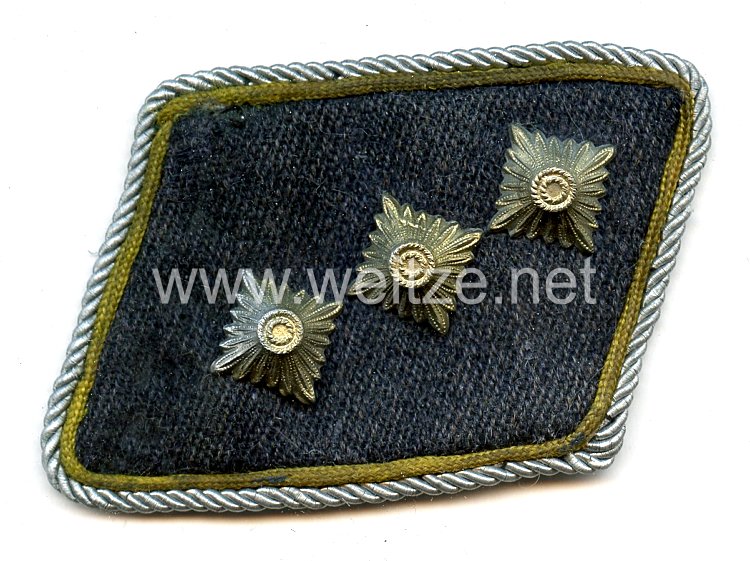
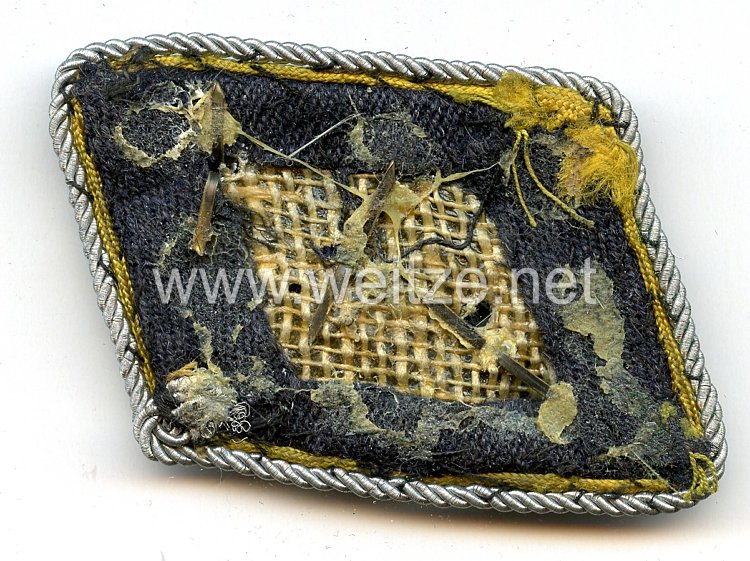
NSFK Single Collar Tab for a Sturmführer
The present NSFK collar tab for a Sturmführer represents a significant artifact from the history of the National Socialist Flying Corps (Nationalsozialistisches Fliegerkorps, NSFK), a paramilitary organization of the Third Reich that existed from 1937 to 1945.
The NSFK was founded on April 17, 1937, through the merger of the German Air Sports Association (Deutscher Luftsportverband, DLV) with other aviation organizations. The organization was under the leadership of Corps Leader Friedrich Christiansen and later, from 1943, Alfred Keller. The NSFK primarily served pre-flight training and the promotion of aviation ideology in National Socialist Germany, though it also had paramilitary duties in training future Luftwaffe pilots.
The collar tabs of the NSFK were essential components of the uniform and served to identify rank and affiliation. They were worn in pairs on the collar patches of the uniform. The single collar tab described here shows the rank side for a Sturmführer, a rank positioned in the middle leadership level of the NSFK hierarchy.
The rank structure of the NSFK was modeled after other NS organizations and included various leader ranks. The Sturmführer corresponded approximately to a captain (Hauptmann) in the Wehrmacht and typically commanded a Sturm unit, a basic organizational element of the NSFK. These units were responsible for practical flight training and conducting training measures.
The design of NSFK collar tabs followed specific regulations laid down in the organization's uniform regulations. Rank insignia were displayed through various designs of braids, piping, and symbols. Characteristic rank insignia were prescribed for a Sturmführer that distinguished him from other ranks. The collar tabs were manufactured on dark blue base cloth, symbolizing the connection to aviation.
The described condition of the object “worn, with adhesive traces on the reverse” indicates authentic use. The attachment methods for collar tabs varied: while pins or rivets were frequently used originally, gluing was also later employed. The visible signs of wear and adhesive traces are typical characteristics of actually worn uniform pieces from this era.
The NSFK's uniforming was modified several times over the years and adapted to requirements. The basic uniform consisted of a dark blue jacket with corresponding trousers, to which various badges and effects were worn depending on position. The collar tabs were always present in pairs: one side showed the rank, the other side the unit or specialization.
The NSFK played an important role in the Third Reich's air war preparations. Officially declared a civilian organization, it factually served to circumvent the restrictions of the Treaty of Versailles. Thousands of young men received their basic flight training here before being drafted into the Luftwaffe. The organization had glider schools, powered flight groups, and theoretical training facilities throughout the Reich territory.
Sturmführer of the NSFK bore responsibility for the training and leadership of their subordinate members. They had to demonstrate both aviation knowledge and organizational abilities. The position typically required several years of experience in the organization and appropriate aviation qualifications.
After the end of World War II, the NSFK, like all other NS organizations, was banned and dissolved by the Allies. Uniform pieces and insignia were partly destroyed, partly ended up in private hands as souvenirs or collector's items. Today, such objects represent important historical sources that provide insight into the organizational structure and appearance of this paramilitary formation.
From a scientific perspective, collar tabs and other uniform pieces of the NSFK are significant study objects for researching NS organizations and their visual representation. They document the sophisticated system of rank insignia and the importance that uniformed appearance and hierarchical structure had in the National Socialist system.