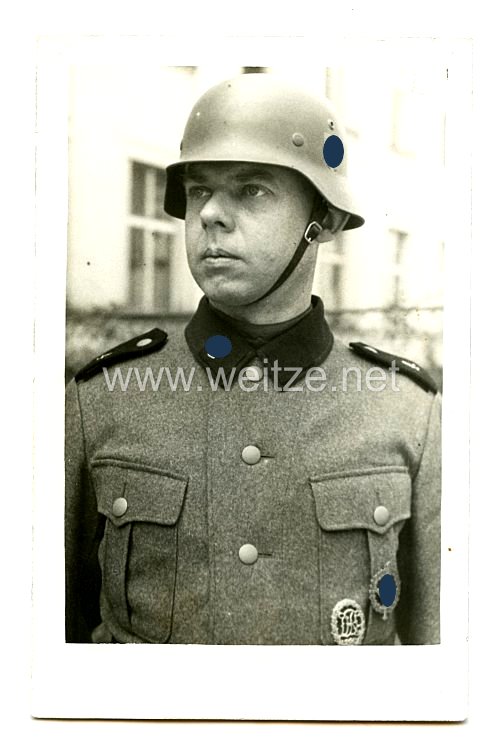
Waffen-SS Portrait Photograph, Member of the 4th Company in the SS-Division "Totenkopf"
This portrait photograph documents a member of the 4th Hundertschaft (company) of the SS Division “Totenkopf”, one of the most notorious and controversial military formations of Nazi Germany. Such photographs in postcard size were widespread during World War II, serving both personal and propaganda purposes.
The SS Division “Totenkopf” was established in October 1939 under the command of SS-Obergruppenführer Theodor Eicke. Eicke had previously served as Inspector of Concentration Camps and commander of the SS-Totenkopfverbände, which were responsible for guarding concentration camps. The division initially recruited primarily from members of these Death's Head guard units, establishing its particular position within the Waffen-SS.
The organizational structure of the division followed military patterns, with a Hundertschaft designating a company-sized unit. This term was typical for early SS formations and was later largely replaced by standard military nomenclature. The 4th Hundertschaft would have been part of a larger regiment or Standarte and typically comprised between 100 and 200 men.
Portrait photographs like the described object were created for various reasons. They served as personal mementos for family members and comrades, but were also used for official documents, personnel files, and propaganda purposes. The postcard format was particularly practical as it could be easily mailed and corresponded to contemporary standards for correspondence. Many soldiers had such photographs taken in professional photo studios, especially before deployments to the front.
The uniforms and insignia visible in such photographs provide important clues for identification. Members of the SS Division “Totenkopf” wore the characteristic Death's Head insignia on the right collar tab of their uniform, while the left collar tab displayed rank insignia. The sleeve typically bore the “Totenkopf” cuff band, indicating divisional affiliation.
The military history of the division was overshadowed by numerous war crimes. As early as the Western Campaign in 1940, the division perpetrated the Le Paradis massacre, in which 97 British prisoners of war were murdered. During the war against the Soviet Union beginning in 1941, the division was deployed on the Eastern Front and involved in numerous crimes against the civilian population and prisoners of war.
The division fought in significant battles including the Battle of Demyansk (1942), the Third Battle of Kharkov (1943), and the Battle of Kursk (1943). It suffered considerable casualties and had to be repeatedly reinforced. Toward the end of the war, the division was deployed in Hungary and later in Austria, where remnants of the formation surrendered in May 1945.
From a historical and collectible perspective, such photographs are important contemporary documents today. They document not only the individual life stories of the depicted persons but also the uniform history and organizational aspects of the Waffen-SS. The condition grade 2 indicates good quality, with possibly slight signs of use but no significant damage.
The legal and ethical handling of such objects is subject to strict regulations in Germany and other countries. Trade and presentation of Nazi memorabilia are only permissible within the framework of historical research, education, and documentation. German criminal code § 86a regulates the handling of symbols of unconstitutional organizations, with exceptions for scientific and educational purposes.
Photographs like this are important sources for military-historical research, as they provide insights into the everyday reality of soldiers. They supplement written sources and enable detailed reconstruction of uniforms, equipment, and organizational structures. At the same time, they require critical contextualization that does not ignore the crimes of the depicted formation.
For collectors and historians, the provenance of such objects is of particular importance. The history of origin can provide important information about the depicted person and their career. It also assists in authentication and historical classification of the object.