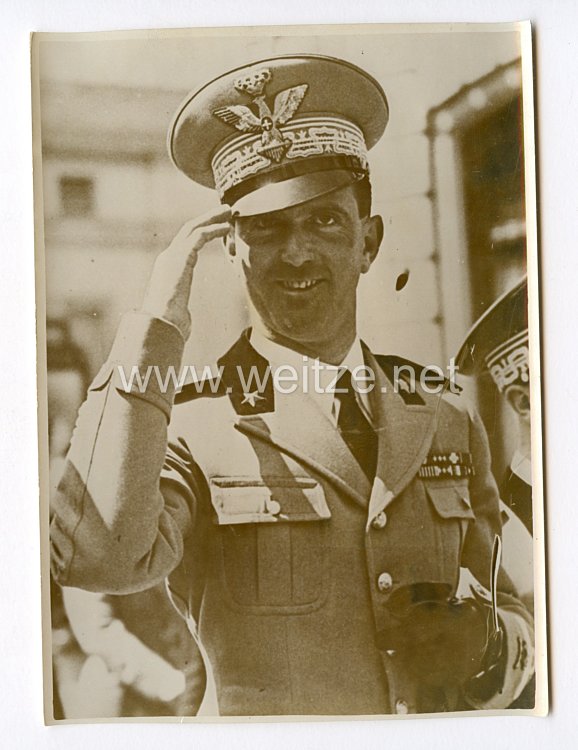
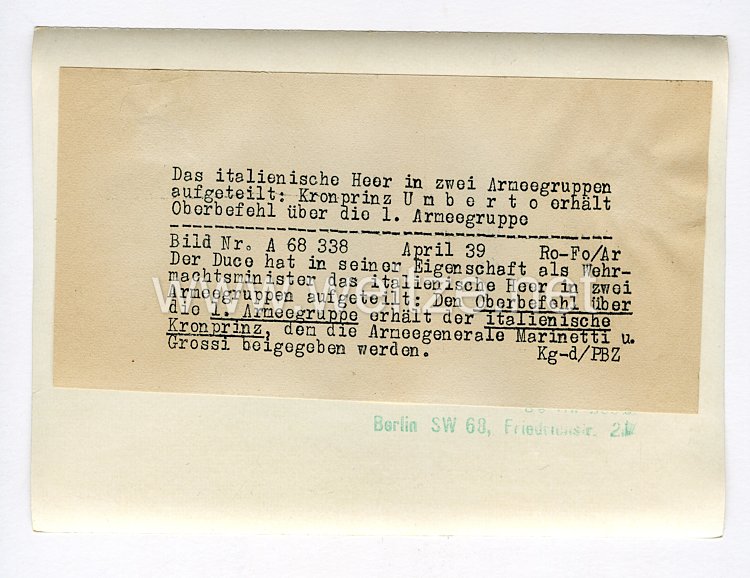
Third Reich Press Photograph. The Italian Army Divided into Two Army Groups: Crown Prince Umberto Receives Supreme Command over the 1st Army Group. April 1939.

Dimensions approx. 13 x 18 cm, with description on reverse, used condition.
311303
30,00

Third Reich Press Photograph. The Italian Army Divided into Two Army Groups: Crown Prince Umberto Receives Supreme Command over the 1st Army Group. April 1939.

Press Photography in the Third Reich: The Italian Army Reform of 1939

This press photograph from April 1939 documents a significant moment in the history of the Italian Army immediately before the outbreak of World War II. It shows the organizational restructuring of the Italian armed forces under the leadership of Crown Prince Umberto of Savoy, who was appointed commander-in-chief of the newly created 1st Army Group.

Historical Context of the Italian Army Reform

In the spring of 1939, Europe was already on the brink of a new world war. Fascist Italy under Benito Mussolini had continued its expansionist policy and stood in close alliance with National Socialist Germany. The division of the Italian Army into two army groups was a direct consequence of the regime's military ambitions and the necessary reorganization of the armed forces for coming conflicts.

The appointment of Crown Prince Umberto, son of King Victor Emmanuel III, as commander of the 1st Army Group was of both military and symbolic significance. Born in 1904, Umberto had received military training and had progressed through various ranks in the Italian Army. His appointment was intended to link the legitimacy of the monarchical House of Savoy with the fascist regime and demonstrate national unity.

The Role of Press Photography in National Socialism

Press photographs like this one were essential instruments of propaganda and information control in the Third Reich. The Reich Ministry of Public Enlightenment and Propaganda under Joseph Goebbels exercised strict control over all media, including photographic reporting on domestic and foreign events. Photographs from allied states, particularly from Italy, were carefully selected and distributed to strengthen the Rome-Berlin Axis.

The standard size of approximately 13 x 18 cm corresponds to the typical format for press photos of this era. These photographs were produced in large editions and distributed to newspaper editorial offices, propaganda offices, and archives. The reverse inscription present on this specimen was common and typically contained information about the event, date, and sometimes censorship or clearance marks.

The Italian-German Military Alliance

In April 1939, relations between Germany and Italy were at their peak. The Pact of Steel (Patto d'Acciaio) was to be signed just one month later, on May 22, 1939, formalizing the military alliance between both powers. The German press therefore reported intensively on military developments in Italy, and such press photographs served to demonstrate the strength and organization of the allied armed forces.

The reorganization of the Italian Army into two army groups was part of a broader modernization and expansion of the Italian armed forces. Italy had already undertaken military adventures in Ethiopia (1935-1936) and Spain (1936-1939) and was preparing for further conflicts. The army groups were intended to provide a flexible and efficient command structure for potential theaters of war in Europe and the Mediterranean region.

Crown Prince Umberto as a Military Figure

Umberto of Savoy had still been a child during World War I, but was prepared in the interwar period for a future role as a military leader. However, his position as commander of the 1st Army Group was largely representative. Actual operational control lay with professional military officers and ultimately with Mussolini himself, who as Duce held supreme command over all Italian armed forces.

During World War II, Umberto would hold various commands, including on the French front in 1940 and later in other theaters. After the fall of Mussolini in 1943 and Italy's capitulation, he played an important role in co-belligerent Italy alongside the Allies.

Documentary Value

Such press photographs possess considerable historical value today as primary sources. They document not only military events but also the way these events were prepared for propaganda purposes and presented to the public. The “used condition” of the photograph suggests that it was actually used in newspaper editorial offices or propaganda bureaus, which underscores its authenticity and documentary character.

The preservation of such documents enables historians to study the mechanisms of news control, the portrayal of allied partners, and the visual propaganda of the Third Reich. They are indispensable tools for understanding the prehistory of World War II and the complex relationships between the Axis powers.

r