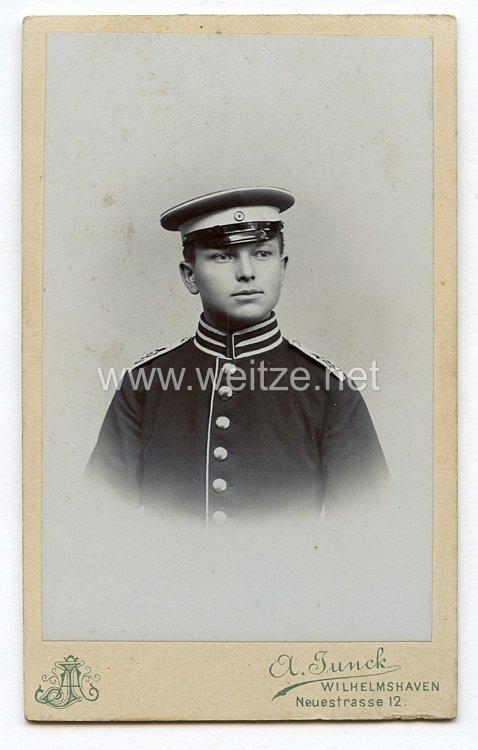
Photograph Imperial German Navy: Naval Battalion Small Cabinet Photo of a Marine

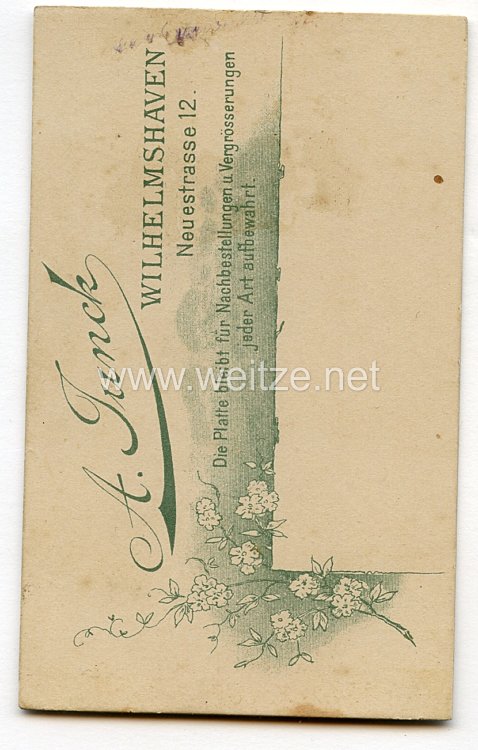
in “Carte de Visite” format, photo studio in Wilhelmshaven, condition 2
347003
25,00

Photograph Imperial German Navy: Naval Battalion Small Cabinet Photo of a Marine

This cabinet photograph of a sailor from the Imperial Naval Battalion (Kaiserliches Seebataillon) in carte-de-visite format from Wilhelmshaven documents a significant aspect of German naval history during the late 19th and early 20th centuries. Such photographs were not merely personal mementos, but also important testimonies to the military culture and identity of that era.

The Imperial Naval Battalion (Kaiserliches Seebataillon) was founded on January 16, 1852, as the “Marine-Infanterie-Bataillon” (Marine Infantry Battalion) in Kiel, representing the land-fighting force of the Prussian and later German Imperial Navy. After the founding of the German Empire in 1871, it was subordinated to the Imperial Navy (Kaiserliche Marine) as the Seebataillon. The unit was initially headquartered in Kiel, later moving to Wilhelmshaven, which explains the significance of photography studios in this location. The naval infantry soldiers were specially trained marines deployed for land operations as well as for the protection of naval bases and ships.

Wilhelmshaven itself had been the most important German naval port on the North Sea since 1869. The city rapidly developed into a significant naval base and housed numerous military installations. The presence of photography studios specializing in military portraits was typical in such garrison towns. These studios offered soldiers the opportunity to have professional portraits made, which they could send to their families or keep as mementos of their military service.

The carte-de-visite format, patented around 1854 by French photographer André Adolphe Eugène Disdéri, revolutionized portrait photography. These small photographs, typically measuring about 6 x 9 cm and mounted on cardboard, were affordable and easy to mail. A veritable collecting boom developed in the second half of the 19th century. Soldier portraits in this format were particularly popular and were kept in special albums. The somewhat larger cabinet format (approximately 11 x 16.5 cm) became popular from the 1860s onward and offered greater detail.

The uniform of the naval infantry was characteristic and differed from the regular naval uniform. They wore dark blue tunics with red facings and braiding, marking their membership in the naval infantry. Uniforming followed strict regulations laid down in the respective dress regulations of the Imperial Navy. Headgear, badges, and rank insignia enabled precise identification of rank and unit affiliation.

The naval soldiers of the Imperial Naval Battalion participated in numerous colonial expeditions and military operations. They served in German colonial territories in Africa, China, and the South Pacific. Their deployment during the Boxer Rebellion in China in 1900-1901, where they fought alongside international troops, became particularly well known. Contingents of the Naval Battalion were also stationed in German East Africa, German Southwest Africa, and other colonial territories.

The photographic documentation of soldiers served several functions. On one hand, it served personal remembrance and connection to family at home. On the other hand, such portraits expressed pride in military service and membership in a prestigious unit like the Naval Battalion. The professional staging in the photo studio, often with props and before painted backdrops, underscores the representative character of these photographs.

After World War I, the Naval Battalion was dissolved in accordance with the provisions of the Treaty of Versailles. Its traditions were partially continued by the Reichsmarine and later by the Navy of the Federal Republic of Germany. Today, such historical photographs are considered valuable sources for military historical research, uniform studies, and the social history of the German Empire.

The state of preservation of such photographs varies greatly, depending on storage conditions and handling over more than a century. Photographs in condition 2 typically show slight signs of use but are still well preserved and valuable as historical documents. They enable modern viewers to gain an immediate visual impression of the soldiers of this era and contribute to understanding the Wilhelmine period.