Federal Republic of Germany (FRG) Police Shako for Enlisted Personnel Schleswig-Holstein

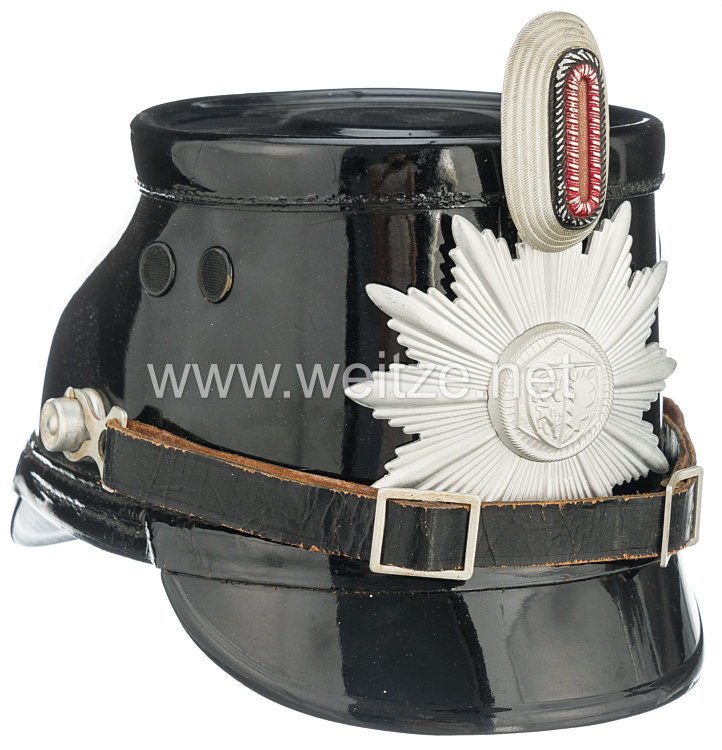
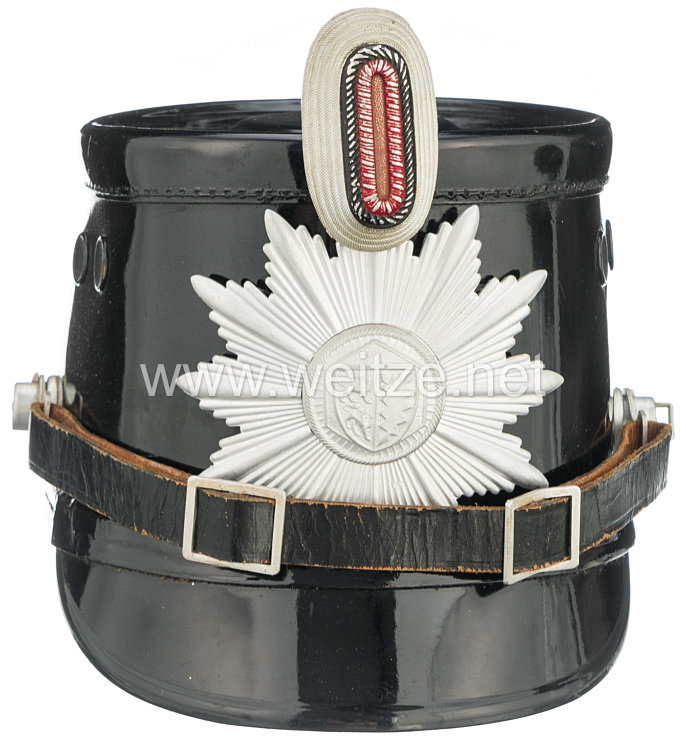
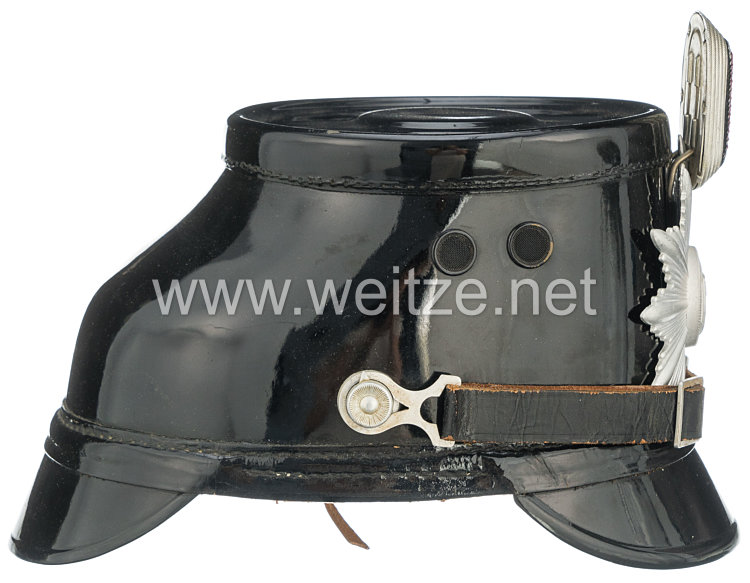
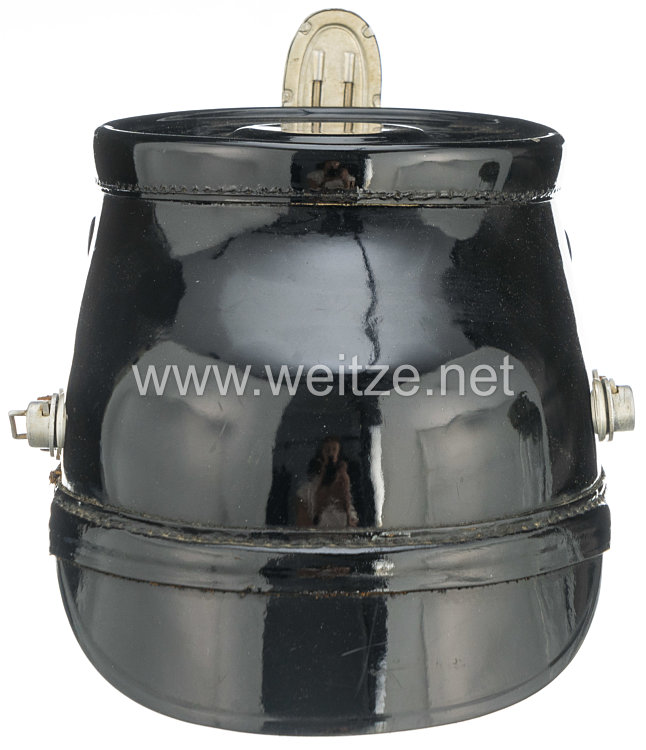
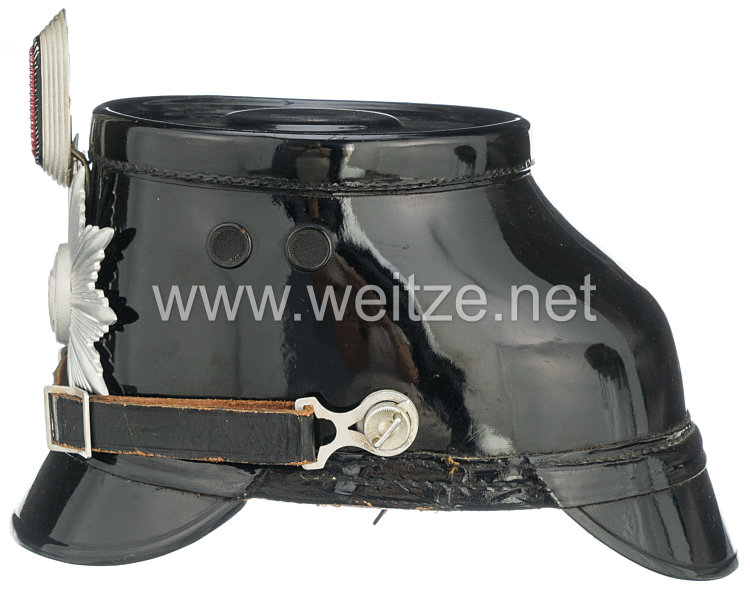
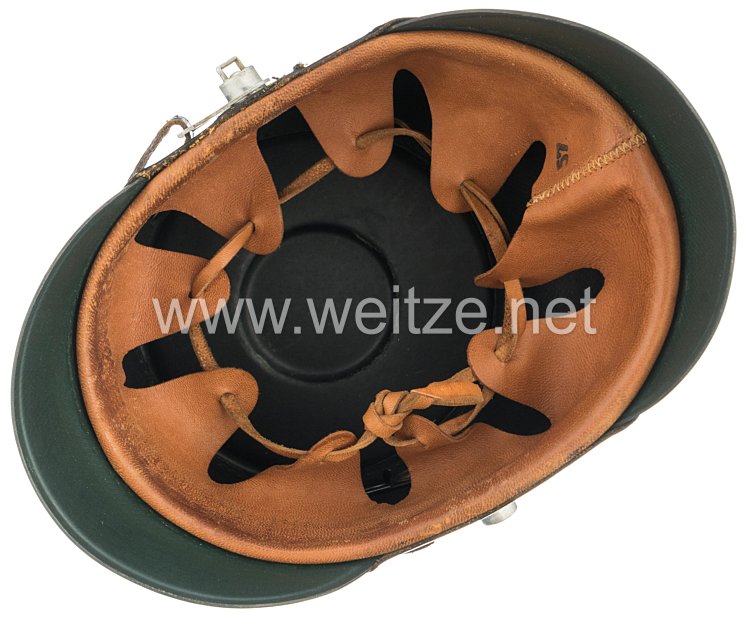
Worn circa 1950. Black shako made of vulcanized fiber. Front features large silver-colored police star, center displays the coat of arms of Schleswig-Holstein, black leather chinstrap attached to button 91. Lacquered cockade. Interior with sewn-in liner. Size 57. Condition 2.
447003
200,00

Federal Republic of Germany (FRG) Police Shako for Enlisted Personnel Schleswig-Holstein

The police shako from Schleswig-Holstein represents a significant transitional phase in the history of German police uniforms after World War II. This headgear, worn around 1950, symbolically stands for the reconstruction of state structures in the young Federal Republic of Germany and the reorganization of police forces in the individual federal states.

After Germany's unconditional capitulation in May 1945, the Allied occupation powers initially assumed complete state authority. Police powers were gradually transferred back to German authorities, with each federal state required to build its own police organization. In Schleswig-Holstein, which belonged to the British occupation zone, this process began as early as 1945/46. The British military administration placed particular emphasis on demilitarizing the police and ensuring their democratic orientation.

The shako as headgear has a long military tradition dating back to the early 19th century. Originally from Hungary, it was adopted by various armies throughout Europe. In Germany, both military and police units wore shakos in the 19th and early 20th centuries. The reintroduction of this traditional headgear in the post-war period was remarkable, as it represented a deliberate connection to German police traditions while maintaining a clear distinction from National Socialism.

The present specimen is made of black vulcanized fiber, a pressed hardpaper material distinguished by its robustness and weather-resistant properties. This material was particularly practical in the post-war period as it was inexpensive to produce – an important factor during the economically difficult years of reconstruction. The black color was traditionally characteristic of German police uniforms and was retained to emphasize the authority and seriousness of law enforcement agencies.

The central element of the front is the large silver-colored police star, a symbol that had already been used by German police forces in the Weimar Republic and partially during the Imperial era. At the center of the star is the coat of arms of Schleswig-Holstein with its characteristic blue lions and silver nettle leaves, representing the historical regions of Schleswig and Holstein. This regional identification was typical of the federal structure of the Federal Republic, in which each state was responsible for its own police force.

The black leather chin strap served not only the practical purpose of securing the headgear but was also a traditional design element. The attachment to button 91 refers to standardized uniform regulations. The lacquered cockade on the side of the shako was also a traditional element of German uniforming and served as an additional identifying feature.

The interior construction with leather-reinforced lining – reinforced with leather strips – provided wearing comfort and proper fit. The stated size 57 corresponds to a head circumference of 57 centimeters and was a standard adult size.

The use of shakos in the German police was time-limited. As early as the late 1950s and early 1960s, most federal states began switching to more practical and modern headgear. Traditional shakos were increasingly used only for ceremonial occasions or parades before eventually disappearing completely from active service. The peaked cap became established as the standard headgear, being more practical for everyday use and more representative.

Today, such shakos from the early Federal Republic are sought-after collector's items that provide important insights into uniform history and the state development of post-war Germany. They document the efforts of the young democracy to find a balance between traditional authority and new democratic values. Specimens with regional peculiarities such as the Schleswig-Holstein state coat of arms are particularly historically significant, as they reflect the federal diversity of the Federal Republic.

These artifacts serve as tangible reminders of a crucial period in German history when the foundations of modern democratic policing were being established. The shako represents both continuity with pre-Nazi traditions and a conscious break with the immediate past, embodying the complex process of building a new German identity in the aftermath of the Second World War.

r