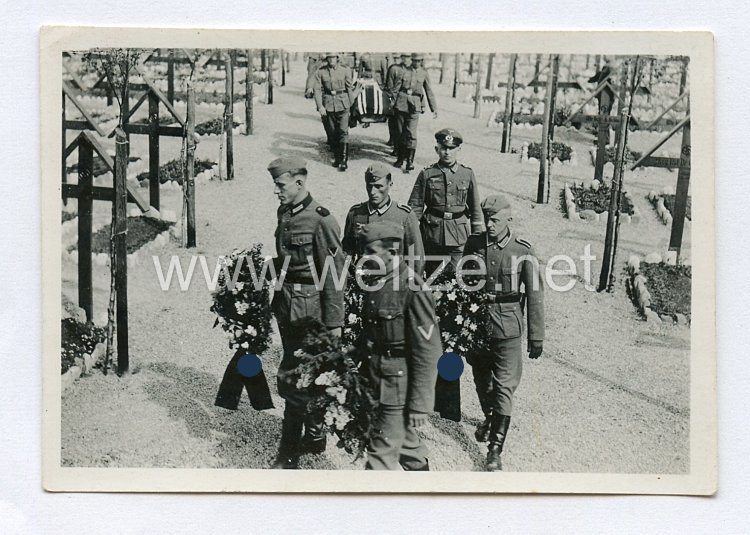
Wehrmacht Heer Photograph, Funeral of a Soldier

Dimensions approx. 8.5 x 5.8 cm. Used condition.
327202
10,00

Wehrmacht Heer Photograph, Funeral of a Soldier

Historical Context: Wehrmacht Heer Photographs of Soldier Burials

Photographs of soldier burials from the Second World War period represent significant historical documents that reflect both military traditions and the human dimension of warfare. This photograph depicting the burial of a Wehrmacht Heer soldier belongs to a category of images produced in large numbers during the conflict from 1939 to 1945.

Military Burial Traditions

The Wehrmacht maintained strict protocols for military burials throughout the Second World War. These ceremonies followed centuries-old Prussian and German military traditions and were intended both to honor the fallen and provide comfort to their comrades. The Heeresdienstvorschrift (H.Dv., Army Service Regulations) detailed the procedures for military burials, including the participation of honor guards, the firing of salutes, and the design of graves.

Typically, a soldier's burial included several elements: the laying out of the deceased, often with military decorations, the presence of an honor formation, possibly a field chaplain for religious ceremonies, and the participation of the unit's comrades. The coffin was usually adorned with the Reich war flag or with a steel helmet and rifle.

Photography in Military Context

Photography played a central role in the Wehrmacht during the Second World War. In addition to official war correspondents (PK - Propaganda Companies), ordinary soldiers also created countless private photographs. The availability of affordable cameras, particularly German brands such as Agfa or Voigtländer, enabled many Wehrmacht personnel to create personal photographic documents.

The present format of approximately 8.5 x 5.8 cm corresponds to typical print sizes of that era. Such photographs were often developed in series and served various purposes: as personal memories, for sending to relatives, or for documenting unit life.

The Significance of Burial Photographs

Photographs of burials held multiple meanings for soldiers. They documented the respectful treatment of fallen comrades and were meant to show relatives at home that their sons, brothers, or fathers had been buried with military honors. In an era when many families had no opportunity to attend the funeral or visit the grave, such photographs offered some comfort.

At the same time, these images served to maintain morale within the troops. They conveyed the message that the Wehrmacht did not forget its fallen and paid them final respects, even under wartime conditions.

Graves Service and War Graves Care

The Wehrmacht maintained an organized graves service responsible for registering, burying, and maintaining soldier graves. Special graves officers kept records of burial sites, which were later important for identification and possible reburial. After the war, the Volksbund Deutsche Kriegsgräberfürsorge (German War Graves Commission) assumed the task of recording and maintaining scattered graves of German soldiers.

Historical Source Value

Today, such photographs possess considerable historical and archival value. They document not only military ceremonies but also provide insights into uniforms, equipment, geographical locations, and the everyday reality of war. For researchers, they are valuable primary sources for social and military history.

Historians use such images to reconstruct the material culture of the Wehrmacht, make unit identifications, and understand the lived reality of soldiers. At the same time, these images remind us of the human cost of war and the millions of victims claimed by the Second World War.

Collectibles and Memory Culture

In the military historical collecting community, such photographs are valued as authentic period documents. They enhance understanding of the era and contribute to preserving memory. At the same time, they require responsible handling that respects the historical context and maintains the dignity of the depicted persons.

This photograph in used condition shows typical signs of aging that underscore its authenticity and identify it as an original document from the Second World War period.

r