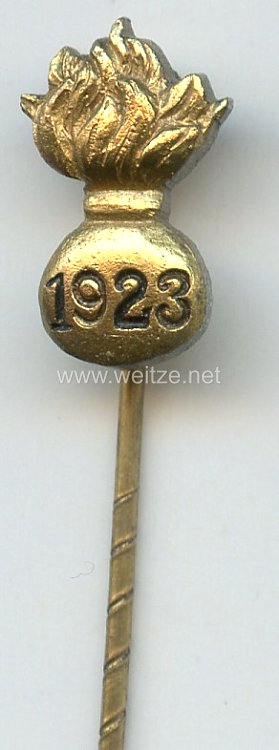
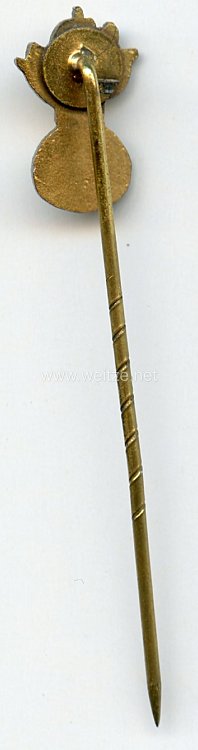
Waffenring der Deutschen Schweren Artillerie - Membership Badge
The Waffenring der Deutschen Schweren Artillerie (Association Ring of German Heavy Artillery) represents a significant organization within German military history of the interwar period. This association emerged during an era marked by profound upheavals following World War I, as former members of the heavy artillery sought to maintain their comradeship and military traditions.
Heavy artillery played a decisive role in German warfare during World War I. Weapons such as the schwere Feldhaubitze 13 (heavy field howitzer), the 21-cm mortar, and the legendary Krupp long-range guns shaped the battlefields of Verdun, the Somme, and Flanders. After the armistice of 1918 and the Treaty of Versailles in 1919, the German army was drastically reduced. The treaty limited the Reichswehr to 100,000 men and almost completely prohibited heavy artillery, forcing former artillerymen into a new social reality.
In this historical context, numerous veterans' associations and Waffenringe (weapon rings) emerged, serving as gathering points for former soldiers. The Waffenring of German Heavy Artillery was one such organization that united veterans of this branch of service. These associations served multiple functions: they fostered comradeship, preserved military traditions, supported needy members and their families, and organized commemorative events.
The present membership badge was worn on a long pin, which was typical for association badges of the Weimar Republic and early 1930s. Such badges were usually worn on the lapel and served as a visible sign of belonging to the veteran community. The design of such badges often followed military symbolic traditions and incorporated elements such as gun depictions, oak leaves, imperial eagles, or coats of arms.
The production of these badges was carried out by specialized decoration manufacturers and metalware producers, who often also manufactured military awards. Well-known companies of this period included C.E. Juncker from Berlin, Souval from Vienna, or various Pforzheim establishments. The badges were manufactured in different quality grades, from simple non-ferrous metal versions to high-quality pieces made of silver or with enamel work.
The Waffenringe and their badges must be viewed in the larger context of the German veterans' movement of the interwar period. Organizations such as the Stahlhelm, Bund der Frontsoldaten (Steel Helmet, League of Front Soldiers), the Reichsbund jüdischer Frontsoldaten (Reich Association of Jewish Front Soldiers), or the Kyffhäuserbund represented various political and social currents. These associations played an important role in the political culture of the Weimar Republic and were later partially integrated into National Socialist organizations or dissolved.
The military-historical significance of such membership badges lies in their function as material witnesses of commemorative culture. They document how former soldiers processed their war experiences and expressed their identity as veterans. At the same time, they reflect the social tensions of the Weimar Republic, in which military traditions continued to be cultivated despite the defeat in World War I.
The condition grade 2 of the present badge corresponds in numismatic and militaria collecting evaluation scales to a very good state of preservation with minor signs of wear. This indicates that the piece was either well preserved or only worn on special occasions.
For collectors and historians, such badges are important objects of study. They provide insights into organizational structures, visual culture, and the social networks of former soldiers. Research into these objects contributes to understanding the complex transitional phase between the end of the German Empire and the rise of National Socialism.
Today, membership badges of Waffenringe are preserved in military-historical collections, museums, and by private collectors. They serve as illustrative material for conveying the history of World War I and its aftermath. The scholarly engagement with these objects occurs within the framework of memory culture research and military history, with critical historical contextualization always in the foreground.