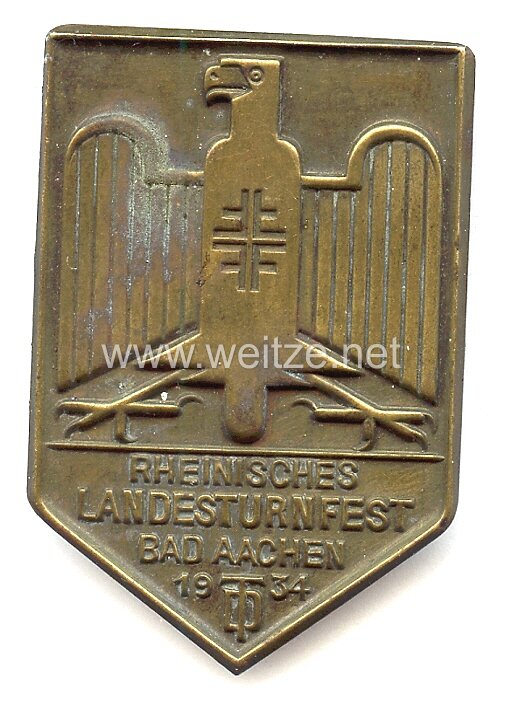
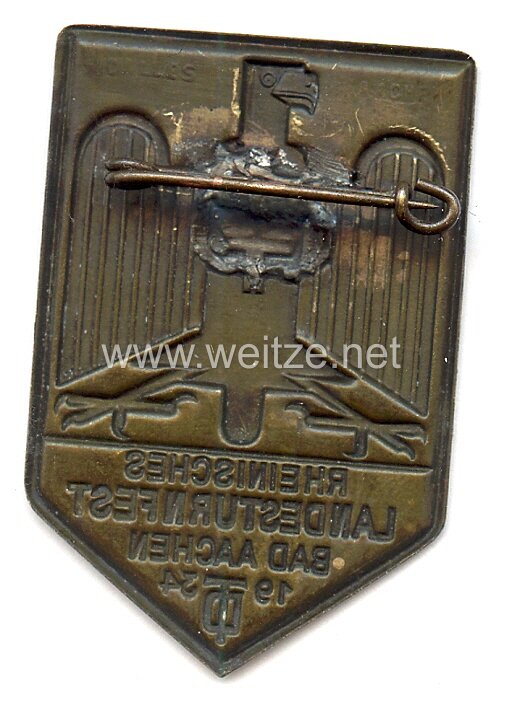
Third Reich - Rhineland Regional Gymnastics Festival Bad Aachen 1934
The Rheinisches Landesturnfest (Rhineland Regional Gymnastics Festival) of 1934 in Bad Aachen represents a significant example of the appropriation of the German gymnastics movement by the National Socialist regime. This metal badge, manufactured by the firm Calles of Aachen, impressively documents this historical development.
The German gymnastics movement had its roots in the Wars of Liberation against Napoleon, when Friedrich Ludwig Jahn (1778-1852) promoted gymnastics as a means of physical and mental strengthening of German youth. Throughout the 19th and early 20th centuries, gymnastics and sports clubs developed into important social institutions, often associated with democratic and liberal ideals.
After the seizure of power in 1933, the Nazi regime systematically began to control and coordinate all areas of society. The gymnastics movement was not exempt from this process. During the Gleichschaltung (coordination), the traditionally autonomous gymnastics clubs were incorporated into National Socialist organizational structures. The Deutscher Reichsbund für Leibesübungen (German Reich League for Physical Exercise) became the central organ of state-directed physical education.
The Regional Gymnastics Festival in Bad Aachen in 1934 took place at a time when this transformation was already largely complete. Such large-scale events served several purposes for the regime: they were meant to demonstrate the cohesion of the “Volksgemeinschaft” (people's community), promote the physical fitness of the population (also with regard to military preparation), and display the power of the new state.
The metal badge itself is a typical example of the commemorative culture of that time. Such badges were produced in large numbers and distributed to participants, organizers, and visitors. They served as souvenirs and symbols of identification. The production by the firm Calles, a local Aachen company, demonstrates the involvement of regional businesses in the production of such memorabilia.
The technical execution as a metal badge was characteristic for the period. This manufacturing method allowed cost-effective mass production while maintaining appealing design. The attachment by means of a pin was standard for event badges and enabled wearing on clothing or uniforms.
Bad Aachen (today Burtscheid, a district of Aachen) was significant as a venue. The region had a long tradition in the gymnastics movement, and Aachen itself was symbolically charged as the coronation city of German kings and emperors. The choice of location underscored the regime's claim to historical continuity.
The designation “III. Reich” (Third Reich) on the badge is indicative of Nazi propaganda, which presented its own regime as a continuation of the Holy Roman Empire and the German Empire. This historical construction was meant to confer legitimacy.
In the broader historical context, it must be noted that sport and physical education in National Socialism served not only to promote health but were an integral part of education for “military capability.” The systematic physical training of the population was part of the preparation for the planned war.
For collectors and historians, such badges are important sources for researching the everyday history of National Socialism. They document how the regime consolidated its rule through the penetration of all areas of life - including sport and leisure. The condition grade 2 (very good) indicates that the piece has been carefully preserved over the decades.
Today, such objects are preserved in museums and collections as testimonies of a dark period in German history. They serve the purpose of education and warning, not glorification. The scholarly engagement with such artifacts contributes to understanding how totalitarian systems function and how they instrumentalize all areas of social life for their purposes.