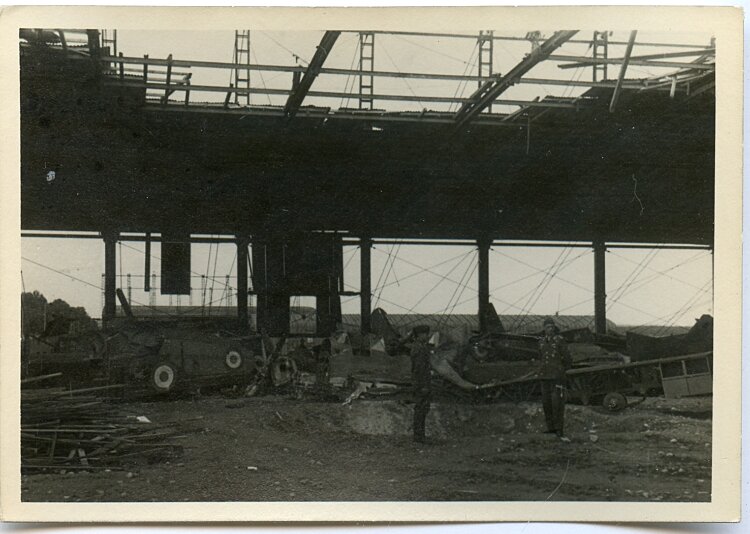
Photograph of French Aircraft Workshop Hangar

circa 6 x 9 cm, condition 2
126302
5,00

Photograph of French Aircraft Workshop Hangar

Photographs of French Aircraft Workshops: Documentation of Early Aviation Industry

This photograph of a French aircraft workshop, measuring approximately 6 x 9 cm, represents an important historical document from the developmental history of military aviation. Such photographic records typically originated between World War I and the interwar period, when France belonged to the leading nations in aircraft production.

France played a central role in the development of military aviation. Even before 1914, the country established a significant aircraft industry with manufacturers such as Blériot, Nieuport, SPAD, Morane-Saulnier, and Farman. These companies initially produced in smaller workshops, but the outbreak of World War I necessitated a massive expansion of production capacities.

During World War I (1914-1918), France had to dramatically increase its aircraft production. In 1914, the Armée de l'Air possessed approximately 140 aircraft; by 1918, France had produced more than 67,000 aircraft. This unprecedented production increase required the construction of numerous new workshop halls and the expansion of existing facilities. The workshops were developed into industrial complexes where hundreds of workers, including many women, manufactured the traditional wood and fabric construction of aircraft.

The architecture of aircraft workshops of this era was characterized by large, open spaces that enabled flexible arrangement of workstations. They typically consisted of steel or wooden structures with large window surfaces to provide natural light for precise assembly work. The halls had to be sufficiently high and wide to enable the assembly of complete aircraft, whose wingspans often measured 10 meters or more.

Photographs of workshops served various purposes: they documented industrial progress, were used for propaganda purposes to demonstrate military strength, and served as administrative records for production reports. Some photographs were strictly confidential, as they contained strategically important information about production capacities and aircraft types. Others were deliberately published to strengthen civilian morale or deter potential adversaries.

During the interwar period (1919-1939), the French aircraft industry had to undergo significant restructuring. Many manufacturers merged or ceased production. Nevertheless, France remained a significant producer of military aircraft. New companies such as Dewoitine and Morane-Saulnier developed modern all-metal aircraft that required new production methods and modernized workshops.

The 6 x 9 cm format corresponds to a standard format of contemporary photography, frequently produced by medium format cameras or as enlargements from smaller negatives. Such photographs were often glued into photo albums or kept as loose collections. They documented daily life in the armaments industry and are today valuable sources for technological and social history.

The condition rating of “Condition 2” according to the standard collector scale indicates very good to good preservation, with only minimal signs of use present. This is remarkable for a photograph that may be a century old.

Such historical photographs are today important research objects for aviation historians, as they provide details about production methods, work organization, and technical equipment that are often not documented in written sources. They reveal the human dimension of industrial mass production and commemorate the thousands of workers who contributed to building military air power.