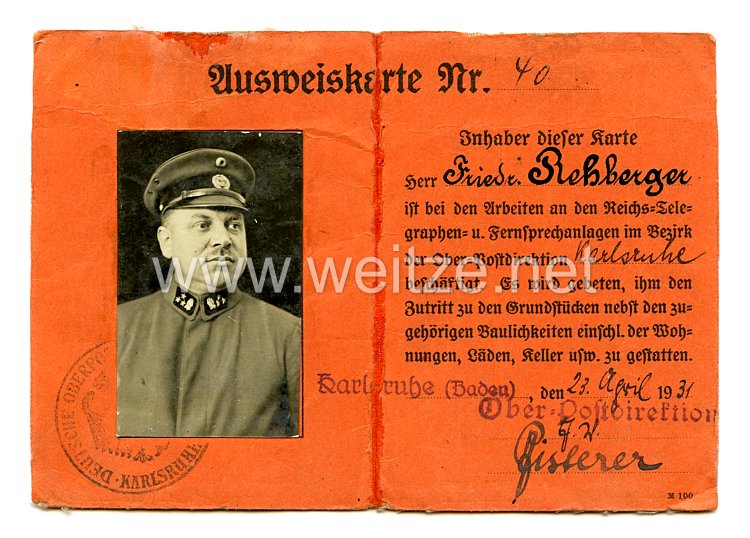
Weimar Republic - Telegraph and Telephone Systems Identity Card for a Postal Official in Karlsruhe
Identity Card for Postal Officials of the Weimar Republic: Telegraph and Telephone Systems
This identity card for a postal official from Karlsruhe, issued on April 23, 1931, represents a significant historical document from the late phase of the Weimar Republic. It documents not only the administrative organization of the German postal system during a turbulent historical period, but also the increasing professionalization and standardization of state communications.
The Reichspost in the Weimar Republic
After World War I and the collapse of the German Empire, the postal system had to be fundamentally reorganized. The Reichspost became one of the most important institutions of the young republic. The Law on the Postal System of the German Reich of March 18, 1924, created the legal foundation for a unified, centralized postal system. The Reichspost held the monopoly for telegraph, telephone, and postal services, employing over 350,000 civil servants and employees in the 1930s.
The telegraph and telephone systems represented a particularly sensitive area. They were not only central to civilian communication but also to military and police purposes. Therefore, employees with access to these facilities were subject to strict security regulations and background checks.
Identity Card Culture and Legitimation
The introduction of photographic identity cards for postal officials was part of a comprehensive modernization of state administration. In the 1920s, legitimation documents with photographs were systematically introduced to prevent identity fraud and control access to sensitive areas. These cards served multiple purposes: they legitimized the bearer before other authorities, provided access to postal facilities, and documented the respective official's authorizations.
The identity card from Karlsruhe dated April 1931 was issued at a time when Germany was experiencing a severe economic and political crisis. The Great Depression had hit Germany with full force, unemployment was rising dramatically, and political radicalization was increasing. Nevertheless, state institutions like the Reichspost continued to function professionally and reliably.
Karlsruhe as a Postal Location
Karlsruhe was an important hub in the southern German communications network. The city had modern telegraph and telephone facilities and was part of the interregional messaging system. The Oberpostdirektion Karlsruhe (Regional Postal Directorate) was responsible for a large part of Baden and employed numerous specialists for the maintenance and operation of technical installations.
Technical Development
In the early 1930s, telecommunications experienced significant technical advances. Automatic switching technology was expanded, and the telephone network continuously grew. Postal officials working in this field required increasingly specialized technical knowledge. They were responsible for the installation, maintenance, and repair of complex electromechanical systems.
The End of an Era
The 1931 identity card comes from the final years of the Weimar Republic. Only two years after its issuance came the Nazi seizure of power in January 1933. The Reichspost was quickly brought into line and integrated into the totalitarian state apparatus. Many postal officials who served during the Weimar period had to adapt to the new political circumstances or lost their positions for racist or political reasons.
Collector Value and Historical Significance
Such identity documents are important historical sources today. They document the everyday history of public administration, the development of identification and control technologies, and the biographies of individual officials. The folded and used condition of the document underscores its authenticity and attests to its practical use in service.
For collectors of military and historical items, such documents are of particular interest as they provide insight into state organization and the lived experience of the time. They complement the picture we gain from official documents and statistics with the human dimension of history.