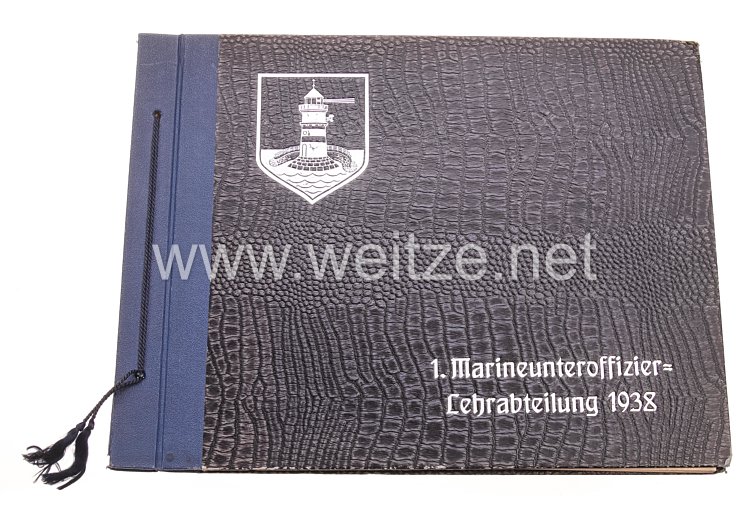
Kriegsmarine Album Commemorating the 1st Petty Officer Training Division 1938
The Kriegsmarine Album commemorating the 1st Petty Officer Training Department 1938 represents a fascinating testimony to the military training structure of the German Kriegsmarine in the immediate pre-war period. Such memorial albums were an integral part of military tradition and served both personal remembrance and the strengthening of esprit de corps among servicemen.
The Marine Petty Officer Training Departments (Marineunteroffizier-Lehrabteilungen) were specialized training units of the Kriegsmarine responsible for training non-commissioned officers. These institutions played a central role in building up German naval forces following rearmament, which officially began with the Anglo-German Naval Agreement of 1935. The year 1938 marked a phase of intensive expansion and professionalization of the Kriegsmarine under Grand Admiral Erich Raeder, who had served as Commander-in-Chief since 1928.
Training to become a Marine Petty Officer was a demanding process encompassing both theoretical knowledge and practical skills. Petty officers formed the backbone of the Kriegsmarine and were responsible for leading smaller units, maintaining complex weapons systems, and training ordinary seamen. The training departments taught navigation, weapons technology, engineering, military leadership, and naval discipline.
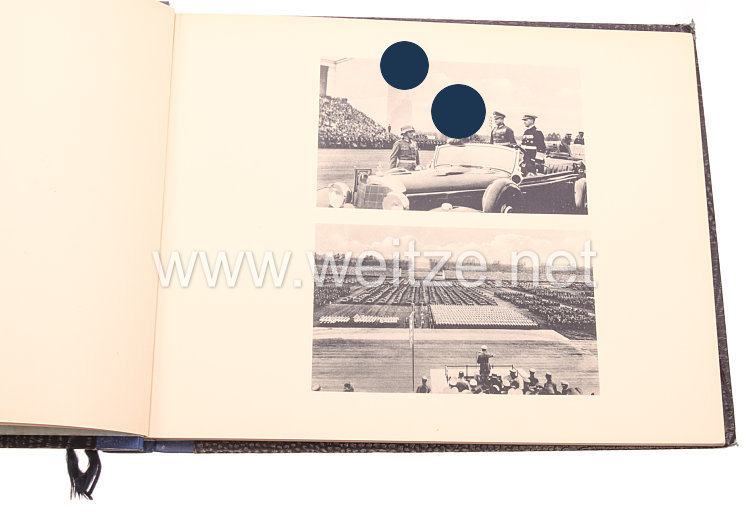
Such memorial albums were typically produced at the end of a training year and contained professionally printed photographs of course participants, instructors, training facilities, and important events during the training period. With approximately 26 printed photographs across 12 pages, this album corresponds to the standard format of such commemorative publications. The blue-black cover with gold or silver inscription was characteristic of official naval publications of this era.
The 1st Petty Officer Training Department was presumably stationed at one of the major naval training bases, possibly in Wilhelmshaven, Kiel, or Stralsund. These locations had the necessary infrastructure for comprehensive training, including classrooms, workshops, firing ranges, and access to training vessels.
The year 1938 held particular significance for the Kriegsmarine. It marked a phase of accelerated rearmament within the framework of the so-called Z-Plan, which envisioned a massive expansion of the fleet. The annexation of Austria in March 1938 and the Sudetenland Crisis in autumn of the same year increased pressure on military training to provide qualified personnel in sufficient numbers.
The photographic documentation in such albums followed strict conventions. They typically included group photographs of course participants in uniform, portraits of training officers, images of training activities such as drill exercises, technical training or sporting events, as well as photographs of equipment and facilities used. These images were usually taken by professional naval photographers or commissioned civilian photographers.
The condition with bumped edges is typical for such objects that were often kept as personal mementos and occasionally viewed. The fact that the album has survived is remarkable, as many such items were lost or deliberately destroyed in the turmoil of World War II and the immediate post-war period.
From a historical perspective, such albums offer valuable insights into daily life in military training, uniforms, the spatial conditions of training facilities, and the faces of young men preparing for military careers. They document a world that would be fundamentally changed by war just a few years later. Many of those depicted in such albums would fight on the world's oceans in the coming years, and a significant proportion would not return – the Kriegsmarine suffered the highest losses of all German armed forces branches at approximately 70 percent.
Today, such albums are important sources for military history research, offering insights into institutional culture, training methods, and the visual self-representation of the Kriegsmarine. They complement official documents and service regulations through their personal perspective and help paint a more complete picture of this historical epoch.