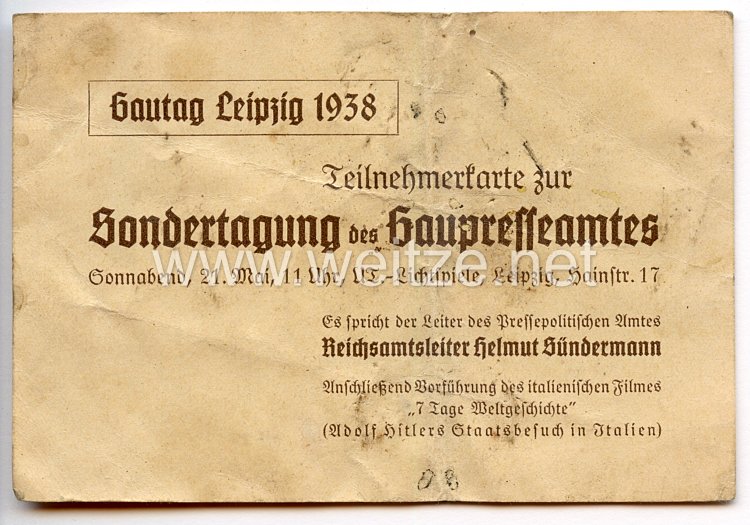
Third Reich - Gautag Leipzig 1938 - Participant Card for Special Conference of the Gau Press Office

Folded, used condition.
374900
25,00

Third Reich - Gautag Leipzig 1938 - Participant Card for Special Conference of the Gau Press Office

The participant card for the special conference of the Gau Press Office at the Leipzig Gau Day 1938 represents a significant document from the propaganda machinery of the Third Reich. Such cards were issued for special events of the NSDAP (National Socialist German Workers' Party) and served as access authorizations and identification documents for selected participants.

The Gau Days (Gautage) were central party events in the organizational structure of the NSDAP. Germany was divided into 43 Gaue (regions), each led by a Gauleiter (regional party leader). The Gau Saxony with its capital Leipzig represented a significant administrative district. Gau Days served ideological training, demonstrations of power, and the consolidation of party structures at the regional level.

The year 1938 marks a decisive turning point in the history of the Nazi regime. It was the year of the Anschluss of Austria in March, the Sudeten Crisis and the Munich Agreement in September, as well as the November Pogroms (Kristallnacht) on November 9-10. During this year, the regime intensified its expansionist policies and dramatically escalated the persecution of the Jewish population.

The Gau Press Office (Gaupresseamt) played a central role in the Nazi propaganda organization. It was responsible for coordinating and supervising local and regional press, distributing party materials, and ensuring the ideological alignment of media reporting. Under the overarching direction of the Reich Ministry for Public Enlightenment and Propaganda led by Joseph Goebbels, the Gau Press Offices formed the decentralized network for controlling public opinion.

The special conferences of the Gau Press Office were specialized events where press representatives, party functionaries, and propagandists gathered. These meetings served to train participants in propaganda techniques, communicate current party lines, and coordinate regional press work. Participants received instructions on reporting political events and were indoctrinated in Nazi ideology.

Such participant cards were carefully designed and typically featured Nazi symbolism such as swastikas, eagles, or other party symbols. They were numbered and personalized to maintain strict control over the number and composition of participants. The foldable format allowed for multiple pages of information in a compact space, including program items, access permissions to various event sections, and possibly meal vouchers.

Leipzig as a venue was of particular significance. The city was traditionally a center of book printing and publishing in Germany and hosted the important Leipzig Book Fair. This media-historical tradition made Leipzig a symbolically important location for NSDAP press events.

Preserved participant cards from this period are important historical sources for researching Nazi propaganda structures today. They provide insights into the organizational penetration of society by the NSDAP and document the systematic coordination (Gleichschaltung) of the media landscape. The folded, used condition of such documents testifies to their actual use and authentic provenance.

For collectors and historians, such documents represent significant testimonial materials that make the bureaucratic and organizational reality of the Nazi state tangible. They illustrate how the regime spread its ideology and mobilized its followers through countless events, conferences, and training sessions. At the same time, they serve as reminders of a dark chapter in German history and the role of media in spreading totalitarian propaganda.

r