Hannover

Kingdom of Hanover Shabraque and Pistol Holsters from the Estate of King Ernst August I of Hanover

Circa 1840/50. Exquisitely crafted saddle cloth and pistol holsters of leather, the show sides decorated with red cloth, the upper edge trimmed in morocco leather, the cloth adorned with broad gold lace. The undersides lined with brown linen cloth. The straps stamped with an inventory number, furthermore an inventory label present. Condition 2.

The shabraque and pistol holsters originate from the “Welf Auction” by Sotheby's in 2005, in which the personal possessions of the House of Hanover were auctioned.
476353
3.500,00

Kingdom of Hanover Parade Belt Buckle for Officers until 1866 King Georg V

circa 1860. Small brass box buckle, gilded with applied silver-plated crowned cipher “GR V.” within oak leaf wreath, without catch hook, width of buckle approx. 5.2 cm, very fine condition, very rare
518397
850,00

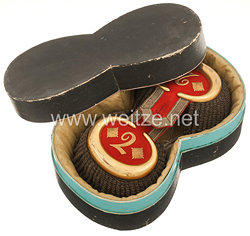
Kingdom of Hanover Pair of Epaulettes for a General of Infantry and Chief of the 2nd Infantry Regiment

Station Hildesheim, Hameln (Celle), circa 1860. Large pattern, the fields with ponceau red cloth, gold crescents, gilt rank stars and large regimental number "2", rigid silver bullion, the surrounding braid with orange tracer, red cloth backing. In original case. Lightly worn. Condition 2. Very rare.
375762
2.500,00

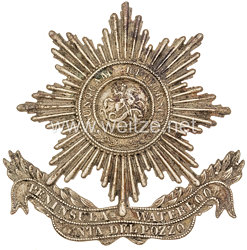
Kingdom of Hannover Shako Plate for Enlisted Men of the Garde-Jäger-Bataillon

Circa 1860. 8-pointed star, at center Saint George slaying the dragon, surrounded by the motto “Nunquam Retrorsum” (Never Backward), below the scroll “Peninsula Waterloo Venta Del Pozzo”. Brass alloy, reverse with remains of iron mounting brackets. Height approx. 8.5 cm. Condition 2. 


371793
450,00

Kingdom of Hanover Pair of Epaulettes for a High-Ranking State Official

Circa 1860. Large epaulettes with fields of gold-colored metallic thread embroidery, gold bullion with blue interwoven threads, crescents of woven gold metallic thread, rigid gold bullion fringe, crown embroidered in metallic thread, beneath it the coat of arms shield of bright red cloth with applied “Leaping Horse” (Springendes Pferd), red cloth backing and yellow silk lining, with hooks for attachment. In original box, label “J.M. Hausmann Court Gold and Silver Manufacturer in Hanover”, box lining damaged. Condition 2.
519895
1.600,00

Kingdom of Hanover Pair of Epaulettes for a Forestry Official

circa 1850. The epaulettes with green cloth fields, gold lace with green stripes and brass crescents with borders of gold-green bullion wire, applied with the crown above the coat of arms shield of bright red fabric with the silver “Leaping Horse” above the wolfsangel, green cloth backings, with official buttons. The cloth backings of one epaulette with small moth holes. In original box, label “J.M. Hausmann Hof-Gold- und Silber-Fabrikant in Hannover”, the lid damaged and loose. Condition 2.
519891
600,00

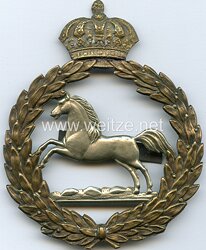
Kingdom of Hanover Shako Plate for Enlisted Men of the 1st (Leib-) Regiment

Circa 1860. Brass, the horse silver-plated, no bandeau, on the reverse the mounting loops replaced by a central split pin and the crown reattached during the period with a small metal plate. Worn condition, Condition 2.
284227
400,00

Kingdom of Hanover Shako Plate for Officers of the Foot Artillery Regiments

circa 1830. The large plate of fire-gilt brass with polished edges, the central medallion with separately applied silver Hanoverian horse (affixed with 6 screws on reverse) and surrounding motto band “Nec Aspera Terrent”, surmounted by large Hanoverian royal crown, the medallion surrounded by laurel wreath over crossed cannon barrels and motto band “PENINSULA WATERLOO”. Reverse with both mounting loops, height approx. 10.7 cm. Only lightly worn, the original fire-gilding still very well preserved, condition 2+.
An extremely rare officer's plate for the large bell-topped shako of the Hanoverian Artillery, in this condition certainly unique!
518446
1.650,00

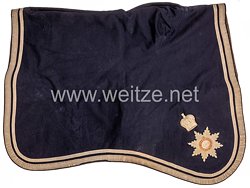
Kingdom of Hannover Shabraque (Saddle Cloth) for Wing Adjutants of the Garde-Husaren-Regiment

Hannover location, circa 1860. Elegant cloth of dark blue wool with double silver lace border, at the rear corners on both sides applied in metal the Hanoverian Royal Crown above the large star of the Guard Regiments (George Star), the surrounding motto gilt with red background. The underside protected by black oilcloth, with 2 integrated pockets. Light signs of use and age. On the interior with old inventory label “Hannover.. Wing-Adjut. Shabraque 1893 from Penzing..”. Condition 2.

In the year 1893, numerous holdings were returned to Marienburg from Austrian exile.

This piece originally came from the Welf auction at Marienburg Castle and was sold by Sotheby's in October 2005.
A very beautiful and rare piece, the 1st time in our offerings in over 30 years.

437037
2.850,00

Kingdom of Hannover Shako (Kepi) for Enlisted Men of the Guard Regiment from the Period of the Austro-Prussian War 1866

Garrison Hannover. Circa 1860/66. Tall felt shako with black cloth covering and black horizontal leather front visor and leather top, front mounted with nickel silver star depicting Saint George slaying the dragon and the motto “numquam retrorsum” (Never backward), below separately mounted nickel silver honor band “Peninsula Waterloo”. Complete with black horsehair plume, which was also worn for “normal” duty. Black leather chinstrap, attachment according to regulation inside the black leather sweatband. Interior with fine black leather sweatband and linen lining. Size 54. Condition 2.

Very rare and beautifully preserved piece!
518339
3.000,00

Kingdom of Hanover Cartridge Box with Shoulder Belt for Enlisted Men of the Line Infantry Regiments

Circa 1860. Black leather cartridge box, interior with wooden insert for powder charges for the rifle, complete with white rawhide shoulder belt, with attached inventory number from the Welfen Museum, or the Royal Arms Collection. Clear signs of wear from use, the lid of the cartridge box with age-related wear, condition 2-. Very rare.

This piece originates from the Royal Hanoverian Collection at Marienburg Castle and was sold at the Sotheby's auction at Marienburg near Hildesheim in October 2005.

518620
1.200,00

Kingdom of Hanover Cartridge Box with Shoulder Belt for Officers of Line Infantry Regiments

Circa 1860. Black cartridge box made of morocco leather, interior with wooden insert for powder charges for the pistol, complete with shoulder belt made of white deerskin, lined inside with brown deerskin, with genuine silver buckles, with attached inventory number from the Welfenmuseum or the Royal Arms Collection. Light wear from use, condition 2. Very rare.

This piece originates from the royal Hanoverian collection at Marienburg Castle and was sold at the Sotheby's auction at Marienburg near Hildesheim in October 2005.
518607
1.850,00

Kingdom of Hanover Sabretache for Enlisted Men and Non-Commissioned Officers of the Royal Gendarmerie

Chamber piece, circa 1855. Manufactured from brown leather, red felt cover with surrounding broad yellow braid, in the center crowned royal cipher of King Georg V, interior reverse with chamber marking "K G 6". Worn, a few small moth damages, condition 2.
The sabretache in this form was also worn by the Guard Hussar Regiment.
518605
1.500,00

Kingdom of Hanover Sabretache for Officers of the Mounted Artillery

circa 1850. Sabretache made of black patent leather with large applied gilt metal letters “R A”, interior with closable leather pocket. Clearly worn, still uncleaned, condition 2-. Very rare.
518602
2.000,00

Kingdom of Hanover Cartridge Box for Officers of the Queen's Dragoon Regiment

circa 1837. The cartridge box lid made of gilt brass sheet with applied silver decorations: the crowned star of the House Order with swords, below it the bandeau of the Queen's Dragoons “Peninsula-Waterloo-Barossa” with laurel leaves. Fitted on both sides with 2 attachment hooks on lion heads for the shoulder belt. Complete with attached inventory number of the Welfenmuseum, or the Royal Arms Collection. Lightly worn, condition 2.

This piece comes from the Royal Hanoverian Collection at Marienburg Castle and was sold at the Sotheby's auction at Marienburg near Hildesheim in October 2005.
518428
3.500,00

Kingdom of England Hanover King's German Legion Large Shako Plate for Officers of the Line Infantry

circa 1812. Large fire-gilded brass plate depicting the crowned King George III, height 14.5 cm, with 2 attachment loops on reverse. Lightly worn in excellent condition, extremely rare. Worn by officers at the Battle of Waterloo.

The King's German Legion (KGL) was a large German military formation in British service. It existed during the Napoleonic Wars, from 1803 to 1816. The KGL is regarded as the only German formation that fought continuously against the occupiers during the French occupation of the German states. Prince Adolph Frederick, Duke of Cambridge, seventh son of King George III, was appointed Commander-in-Chief. During the course of the Napoleonic Wars, it grew into a complete fighting force that ultimately comprised infantry, artillery and cavalry, reaching a strength of 15,900 men in 1813.

In 1816 the Legion was dissolved and its members were largely incorporated into the Hanoverian Army of the newly formed Kingdom of Hanover, where they were regarded as elite soldiers.
518424
1.800,00

Kingdom of Hanover Shoulder Belt Plate for Officers of the Regiment Bremen III. Battalion

Circa 1820. Large oval plate made of heavy brass sheet, fire-gilded, 6.3 x 9.1 cm, with genuine silver overlay: Bremen city coat of arms beneath British royal crown, surrounding banderole “Regiment Bremen III. Bataillon”. Reverse with hook and carrying buttons. Lightly worn, the original gilding still very well preserved, condition 2. Extremely rare, we are not aware of any other example in private ownership.
The shoulder belt plate was worn on the leather shoulder belt.

The III. Battalion of the Bremen Landwehr Regiment was part of the army of the Kingdom of Hanover, particularly after the reorganization of troops from 1815 onwards. The Hanoverian Army, which existed from 1814 to 1866, was divided into field battalions and Landwehr battalions. A regiment in the Kingdom of Hanover typically consisted of one field battalion (professional soldiers) and several Landwehr battalions (Landwehr conscripts from the provincial districts), which together formed the regular army. After the Napoleonic Wars, the Hanoverian troops were officially formed into regiments on February 4, 1815, often with 1 field battalion and 3 Landwehr battalions forming a unit. The Landwehr battalions were formed from regional recruits, so the Bremen Landwehr Battalion (later III. Battalion in the formation) consisted primarily of soldiers from Bremen and surrounding areas.
518421
2.500,00

Electorate of Hannover Shoulder Belt Plate for Enlisted Men of the 4th Regiment

Circa 1815. Large oval plate of heavy sheet brass, 5.7 x 7.2 cm, convex and engraved with crowned cipher “GR” above “4te Regiment”. Clearly worn with typical wear and age patina, reverse suspension loop defective, condition 2-3. Extremely rare, we know of no other example in private hands.
The shoulder belt plate was worn on the leather shoulder belt.

The “4th Regiment”: Infantry Regiment (Stade): Around 1782/1783 the regiment was listed by Scharnhorst with garrison in Stade and Harburg as one of the Hanoverian regiments. After the Napoleonic period and the elevation of Hannover to a kingdom (from 1814/15), the numbering of regiments was more clearly structured. The 4th Infantry Regiment was later stationed in Stade. This tradition passed partially into the 4th Hanoverian Infantry Regiment Nr. 164 after the annexation of Hannover by Prussia in 1866.


The Electorate of Braunschweig-Lüneburg (also Chur-Braunschweig-Lüneburg), unofficially also called Electorate of Hannover (also Chur-Hannover or Kurhannover), was from 1692 the ninth Electorate of the Holy Roman Empire. Until the personal union with Great Britain in 1714, Hannover was the capital city. It ended in 1807 with incorporation into the Kingdom of Westphalen, and after the Congress of Vienna in 1814 with the foundation of the Kingdom of Hannover.
518420
1.500,00

Kingdom of Hannover Pair of Epaulettes of an Oberforstmeister (Chief Forest Master)

circa 1850, epaulettes with gold fields, bearing applied Hanoverian coat of arms, on the escutcheon the silvered leaping horse on green field above gilded wolf hook (Wolfsangel) on deep red fabric field in gilded frame beneath gilded Hanoverian royal crown. The straps with gold braid with green stripes, complete with buttons, the gold crescents bordered in gold/green bullion wire, gold loose bullion/fringe inside with yellow silk lining, undersides of green felt each with one hook for attachment to the shoulders of the uniform tunic, complete with original box, condition 2. Very rare.
518368
1.600,00

Kingdom of Hannover Ceremonial Shabraque and Pistol Holsters from the Estate of Field Marshal Ernst August I of Hannover

Circa 1830/40. Highly elegant and exquisitely crafted saddle cloth and pistol holsters of leather, the display sides adorned with red cloth, the upper edge trimmed in morocco leather, the cloth decorated with rich gold embroidery, sequins and bullion thread, the shabraque at the corners with large embroidered crowns, on the pistol holsters these at the center. On the underside the pieces lined with brown linen cloth. Condition 2.

The shabraque and pistol holsters originate from the “Welfen Auction” by Sotheby's in 2005, in which the personal possessions of the House of Hannover were auctioned.

The shabraque and matching pistol holsters represent a unique piece; no other example of this type is known. For the King, particularly high-quality workmanship and the most valuable materials were employed.

From 1760 to 1820, George III was in personal union Elector (later King) of Hannover and King of England. His son Ernst August I (*1771, † 1851) entered the Hanoverian Army in 1791 and rose rapidly through its ranks. During the First Coalition War (1793-97) he served in Flanders as Commander of the 1st Cavalry Brigade in the combined army consisting of British, Hanoverian and Austrian troops. As early as 1798 he was promoted to Lieutenant General and in 1803 to General. During the occupation of Hannover from 1803 to 1813 he served in the British Army. In 1813 he was present at the Battle of Leipzig and was appointed Field Marshal on November 26, 1813. It can be assumed that he later received the magnificent shabraque as a symbol of his outstanding status as Field Marshal.


454990
12.000,00

Kingdom of Hannover Saddle Cloth for Field Grade Officers

Circa 1860. The saddle cloth made of fine blue cloth with red piping and applied silver braid, leather straps on the sides, black leather appliqués at the lower edge to protect against abrasion from the rider's legs, with remnants of labels on these. On the underside soft, light-colored felt-like fabric. Condition 2.

The saddle cloth originates from the “Welf Auction” by Sotheby's in 2005, in which the personal possessions of the House of Hannover were auctioned.
476350
1.500,00

Kingdom of Hanover General's Shabraque

Circa 1860. The shabraque of fine blue cloth with red border and applied gold braid trim, leather straps on the sides, black leather appliqués at the lower edge to protect against abrasion from the rider's legs, with remnants of labels on these. Soft brown fabric on the underside. Condition 2.

The shabraque comes from the “Welfen Auction” by Sotheby's in 2005, in which the personal belongings of the House of Hanover were auctioned.
476352
2.500,00