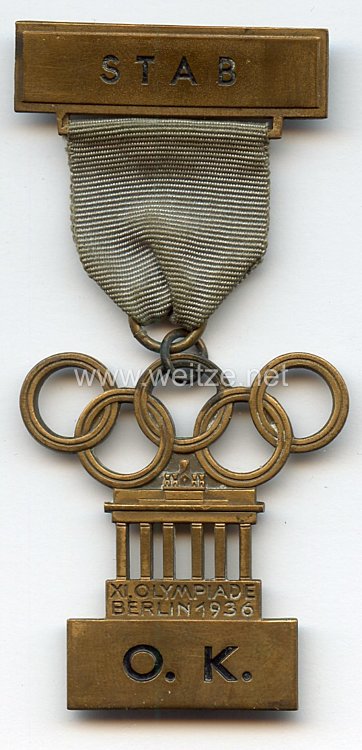
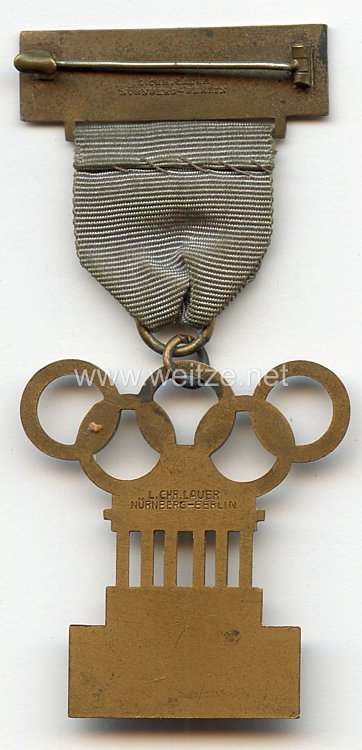
XI. Olympic Games 1936 Berlin - Official Participant Badge of a Staff Member of the Organizing Committee
This official participant badge for a member of the Organizing Committee staff of the XI Olympic Games 1936 in Berlin represents a significant contemporary historical document that provides insight into the organizational structure and visual identity of one of the most extensively documented Olympic Games in history.
The 1936 Summer Olympics took place from August 1 to 16, 1936, in Berlin and were the first Games to be comprehensively instrumentalized for propaganda purposes. The Organizing Committee, officially designated as the “Organizing Committee for the XI Olympiad Berlin 1936,” was formed under the leadership of Dr. Theodor Lewald as president and Dr. Carl Diem as general secretary. Organizational work began as early as 1933, after Berlin had been awarded the Games by the International Olympic Committee in 1931.
The badge described here is made of tombac, a copper-zinc alloy distinguished by its gold-like coloring and durability. It bears the characteristic designation “Stab” (Staff) on the wearing clasp and “O.K.” (Organizing Committee) on the pendant. The light blue ribbon corresponds to the official colors of the Olympic Movement and was deliberately chosen to symbolize the international orientation of the event.
The manufacturer L.Chr.Lauer of Nuremberg-Berlin was a renowned firm specializing in the production of orders, decorations, and badges. The company, founded in the 19th century, supplied both government and private clients and was known for its high-quality craftsmanship. The fact that the firm maintained locations in both Nuremberg and Berlin underscores its significance and production volume during this period.
The Organizing Committee for the 1936 Games was a complex bureaucratic structure comprising several thousand employees. The Staff formed the central administrative unit responsible for coordinating the various organizational areas. Duties included planning and conducting the competitions, accommodating the athletes, security, press relations, and logistical management of an event involving over 3,900 athletes from 49 nations.
The various access authorizations and identification badges were an essential component of the security and organizational structure. They enabled clear identification of the various functionaries and granted them appropriate access rights to different areas of the Olympic grounds. The Reichssportfeld, where most events took place, was strictly controlled, and only persons with appropriate credentials were granted access to sensitive areas.
The design of such badges followed strict guidelines established by the Organizing Committee. The use of Olympic symbols, color schemes, and material selection were precisely specified to ensure a uniform appearance and make counterfeiting more difficult. The pin construction with wearing clasp and pendant was practically designed to enable secure wearing on uniforms or civilian clothing.
From today's perspective, such badges are important collectibles and research objects that provide information about organizational practices and the material culture of the Olympic Games of that era. The Condition 2 specified in the description corresponds in the evaluation scale for military and historical objects to a very good to good state of preservation with only minor signs of wear, which underscores the rarity and value of the piece.
The 1936 Olympic Games were a turning point in the history of modern sports, not only because of their propaganda exploitation but also because of numerous sporting innovations. For the first time, the Olympic flame was carried in a torch relay from Olympia to Berlin, for the first time there was comprehensive television coverage, and the organizational professionalism set new standards. The Organizing Committee developed procedures and standards that in some cases are still applied today.
Badges such as the one described here document the hierarchies and structures within the organization and are thus important sources for researching administrative history and the social history of sports. They also demonstrate the craftsmanship quality and design care with which even functional objects were produced during this period.
These identification pieces served multiple purposes beyond mere access control. They represented status within the organizational hierarchy, facilitated communication between different departments, and served as proof of authority when making decisions or giving instructions. The distinction between different levels of staff through variations in badges, ribbons, and inscriptions created a visible system of organizational structure that was immediately recognizable to all participants.