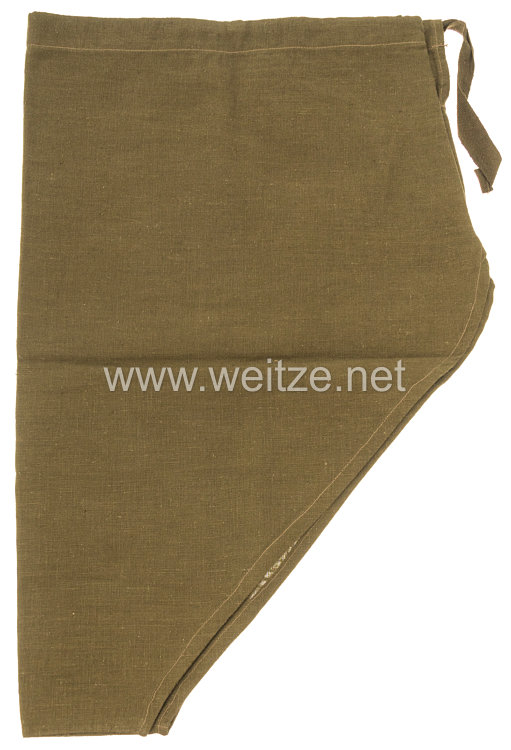
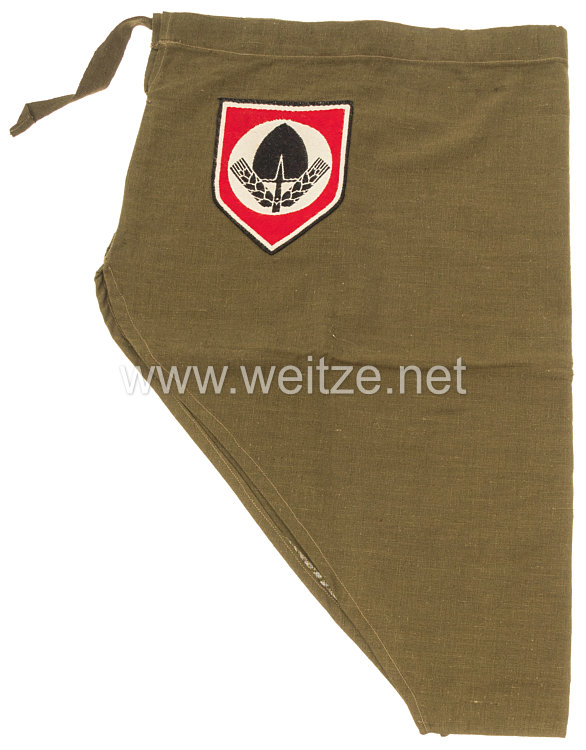
Reich Labor Service (RAD) Swimming Trunks

Cotton fabric, with sewn-on RAD emblem on the side for sports clothing. Interior with RAD chamber stamp "1037 R.A.D.B.A.Br.", manufacturer marking "Wagner & Walther" and size designation "III". Condition 2.

See "Sport and the Third Reich, history, uniforms, insignia, and awards, Volume I, by Newbrough"
437099
220,00

Reich Labor Service (RAD) Swimming Trunks

The Reichsarbeitsdienst (RAD) swimming trunks represent a particular aspect of uniformed sports clothing in Nazi Germany. The Reich Labor Service was established on June 26, 1935, through the “Law for the Reich Labor Service” as a state organization and was compulsory for all young Germans aged 18 to 25.

This object displays the characteristic design of RAD sports clothing. The cotton fabric swimming trunks bear the sewn-on RAD emblem on the side, which was specifically designated for sports clothing. The internal marking with the chamber stamp “1037 R.A.D.B.A.Br.” refers to a specific RAD service office, with the abbreviation indicating a unit within the Reich Labor Service administrative structure.

The manufacturer's marking “Wagner & Walther” documents private production by one of the numerous suppliers for RAD equipment. The size designation “III” corresponds to the standardized sizing system used in the distribution of service clothing. This system enabled efficient management and distribution of equipment to RAD members.

At its peak, the Reichsarbeitsdienst comprised approximately 350,000 young men and women housed in labor camps. The organization was strictly hierarchically structured and militarily organized, although it formally did not constitute a military formation. The period of service initially lasted six months and was later adjusted to various durations.

Sport and physical fitness played a central role in the RAD. The organization followed the National Socialist ideology of the people's community (Volksgemeinschaft) and physical capability. Several hours daily were allocated for sporting activities, including cross-country runs, swimming, athletics, and team sports. The swimming trunks were therefore an essential component of every RAD man's personal equipment.

The marking of sports clothing with the RAD emblem served multiple purposes: it documented organizational affiliation, prevented confusion with civilian clothing, and emphasized the communal character of the organization. The emblem typically displayed the stylized spade blade, the central symbol of the RAD, which symbolized both labor and military readiness.

The procurement and management of RAD equipment were subject to strict regulations. Each service member received a complete basic kit upon entry, which included work and service clothing as well as sports clothing. The swimming trunks were part of this standardized equipment and had to be manufactured according to specified specifications.

The quality of manufacture varied depending on the year of production and manufacturing site. While high-quality materials were still used in the early years of the RAD, the war years from 1939 onwards increasingly led to material shortages and a deterioration in quality. Cotton became scarcer, and substitute materials had to be used.

After the end of World War II, the Reichsarbeitsdienst was dissolved by the Allies. Control Council Directive No. 23 of December 17, 1945, explicitly prohibited the organization and all its structures. Uniforms and equipment items were largely destroyed or confiscated in occupation zones.

Today, authentic RAD sports clothing items such as these swimming trunks are rare testimonies to everyday culture in Nazi Germany. They document the penetration of all areas of life by state organizations and the importance attached to physical fitness and community education. For historical research, such objects provide important insights into the material culture and organizational structures of the Reich Labor Service.

The reference to “Sport and the Third Reich” by Newbrough represents one of the specialized works that document the comprehensive role of sport in National Socialist organizations. Such literature helps contextualize individual objects within the broader framework of the regime's sports and physical education policies.