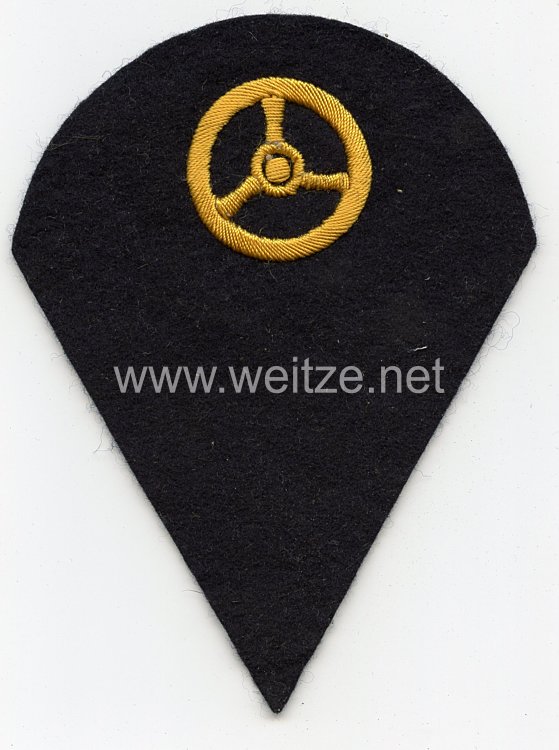
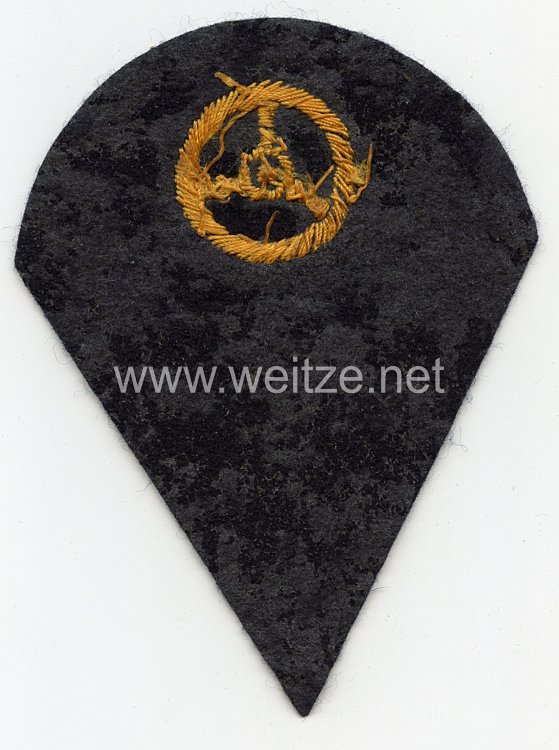
Kriegsmarine Enlisted Men's Sleeve Insignia Motor Vehicle Personnel Career Track
The Kriegsmarine sleeve insignia for enlisted personnel of the motor vehicle specialist career path represents an interesting example of the differentiated career identification system within the German Kriegsmarine during World War II. These specialized badges served the immediate identification of naval personnel with particular qualifications and assignments.
The Kriegsmarine, as one of the three branches of the Wehrmacht, developed a complex system of uniform insignia and markings that went far beyond mere rank designation. With increasing mechanization and specialization of military duties, it became necessary to make various career paths and specializations externally identifiable. The motor vehicle specialist career path was one of several technical specializations that gained importance during the 1930s and 1940s.
The specimen described here is manufactured in the version for the Kollani (Kollektor uniform, also known as the blue work uniform). This was the dark blue working uniform of the Kriegsmarine, worn for daily service and practical work. The hand-embroidered execution indicates high-quality manufacture, with distinctions made between machine-produced and hand-embroidered variants. Hand-embroidered badges were frequently produced by private manufacturers and often showed finer workmanship than standardized mass-produced items.
The motor vehicle specialist career path comprised naval personnel responsible for the operation, maintenance, and repair of motor vehicles. Although the Navy is primarily associated with ships and naval combat, it required extensive land-based infrastructure. Naval bases, shipyards, supply depots, and training facilities required a considerable vehicle fleet. Furthermore, naval units operated on land, especially the naval infantry and coastal defense units, which depended on motorized transport.
The career badge was typically worn on the left upper arm of the uniform. The exact position and manner of wearing were detailed in the Kriegsmarine uniform regulations. Different regulations applied to enlisted ranks compared to non-commissioned officers and officers. The badges for enlisted personnel were generally simpler in design and adapted to the respective uniform type.
The introduction of such career badges occurred gradually during the 1930s, as the rebuilt German Navy modernized its organizational structure. The Reichsmarine had been severely restricted after World War I by the Treaty of Versailles, but from 1935 onward, with the official renaming to Kriegsmarine, a phase of intensive expansion and reorganization began. In this context, uniform regulations were revised and expanded multiple times.
Materials and manufacturing techniques varied depending on the manufacturer and time of production. Early badges often showed higher quality in materials and workmanship, while towards the end of the war, simplifications and material shortages led to simpler versions. Hand-embroidered specimens on cloth backing were particularly common with privately procured uniform items, as soldiers often had additional or replacement equipment made at civilian tailoring shops.
The condition of this specimen is indicated as 2-, which according to common collector grading corresponds to good to very good condition with minor signs of use. Such badges were worn daily and were subject to corresponding wear. The condition provides insights into the usage history of the piece and its authenticity.
For military historical research, such career badges offer valuable insights into the organizational structure and daily life of the Kriegsmarine. They document the increasing specialization and professionalization of military services and illustrate how the Navy attempted to integrate modern technical requirements into its traditional structure. The motor vehicle specialist career path represents the interface between maritime tradition and modern motorization that became characteristic of 20th-century warfare.
These insignia also reflect the administrative complexity of a modern military organization. The Kriegsmarine maintained detailed records and regulations governing every aspect of uniform wear, demonstrating the importance placed on visual identification and military hierarchy. For collectors and historians today, authentic pieces like this hand-embroidered badge provide tangible connections to this historical period and help document the material culture of World War II German naval forces.