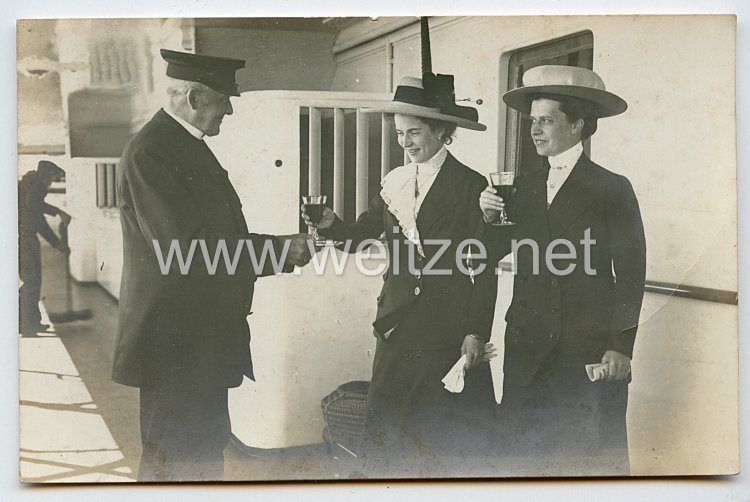
German Empire 1871-1918 Photographic Postcard Viktoria Luise Aboard a Ship

Circa 1910. Condition 2.
427899
15,00

German Empire 1871-1918 Photographic Postcard Viktoria Luise Aboard a Ship

This photographic postcard depicts Princess Viktoria Luise of Prussia (1892-1980) aboard a ship and dates from around 1910. Such postcards not only document the royal family of the German Empire, but also reflect the enormous popularity of photographic media and their significance for the public perception of the monarchy during the Wilhelmine era.

Viktoria Luise, born on September 13, 1892, in Potsdam, was the only daughter and youngest child of Kaiser Wilhelm II and Empress Augusta Victoria. As the Kaiser's only daughter, she enjoyed a special position at the Prussian court and became her father's favorite child. Her presence on this postcard aboard a ship reflects the maritime enthusiasm of the Wilhelmine period and the close connection of the Hohenzollern family to the Imperial Navy.

The German Empire under Wilhelm II cultivated a pronounced naval enthusiasm, which manifested itself in the ambitious fleet expansion under Grand Admiral Alfred von Tirpitz. The imperial family supported this maritime policy not only politically but also symbolically through frequent presence at fleet parades, ship launches, and cruises on the imperial yacht Hohenzollern. Viktoria Luise regularly accompanied her father on such maritime ventures, and these moments were photographically captured and distributed as postcards.

The period around 1910 marks the height of postcard culture in Germany. Between 1890 and 1914, the postcard medium experienced an unprecedented boom. Photographic postcards featuring members of the imperial family were particularly popular and served to spread monarchical ideals and personalize royal authority. They were produced in high print runs and both collected and mailed. The depiction of Viktoria Luise on a ship combined several contemporary elements: the young princess's popularity, naval enthusiasm, and modern image technology.

In 1909, Viktoria Luise received an extraordinary honor: she was appointed Colonel-in-Chief of the 2nd Life Hussars Regiment and henceforth wore hussar uniform. This was an unprecedented distinction for a woman in the Prussian military system and underscored her special status. The princess took this role seriously and frequently appeared in uniform, which further increased her popularity. The passenger ship SS Prinzessin Viktoria Luise, one of the world's first cruise ships, was also named after her.

The photographic representation on the postcard followed the conventions of the time. Such photographs were usually taken by court photographers such as T. H. Voigt, Atelier Bieber, or other renowned photographers who had the privilege of portraying the imperial family. The images were then licensed to postcard publishers who produced them in mass editions. The maritime setting gave the representation a modern, cosmopolitan note and corresponded to the Empire's self-image as an emerging world power.

The condition grade 2 (very good) of this postcard suggests careful preservation, possibly as part of a collection. Such cards were frequently kept in special postcard albums that were widespread in middle-class households. Collecting postcards with royal motifs was a popular hobby and an expression of monarchical sentiment.

The historical significance of this postcard extends beyond its material value. It documents the monarchy's media strategies in the early 20th century and the role of photography in political communication. Viktoria Luise herself married Duke Ernst August of Brunswick in 1913, a union that represented a dynastic reconciliation between the Hohenzollerns and the Guelphs. This wedding was the last great festival of European monarchies before World War I.

After the collapse of the Empire in 1918, Viktoria Luise lived until her death in 1980 and became the last living bearer of the title of a Prussian princess. Postcards like this are today important historical documents that provide insight into the culture of representation, the media landscape, and the social values of Wilhelmine Germany.