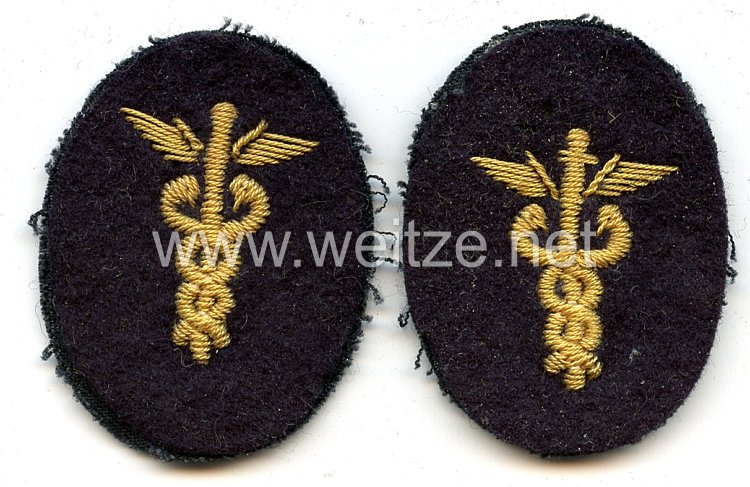
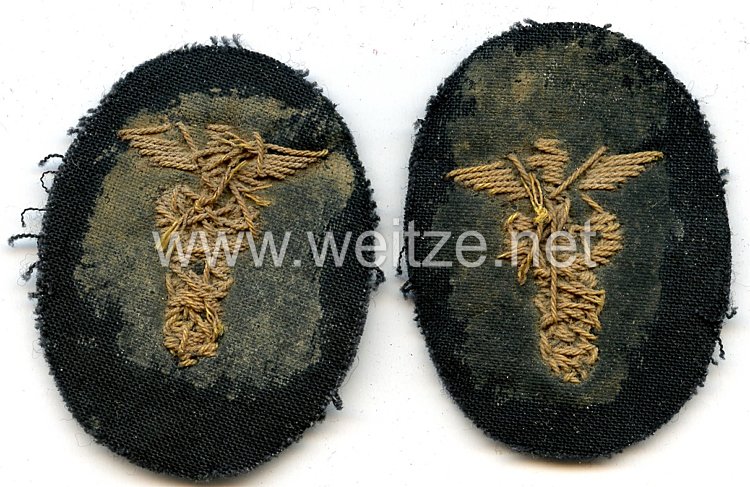
Kriegsmarine Pair of Sleeve Insignia for an Administration Officer
The present sleeve insignia for an Administrative Officer of the Kriegsmarine represent an important aspect of the complex rank insignia system of the German Kriegsmarine during World War II. These hand-embroidered Cellon versions testify to the elaborate manufacturing process and the importance attached to the correct identification of different service branches within the Navy.
The Kriegsmarine, which existed as the official naval force of the German Reich from 1935 to 1945, developed a differentiated system for identifying various officer career paths. While sea-going officers wore the traditional gold sleeve stripes, different career insignia were introduced for specialists and technical officers, worn between the sleeve stripes.
Administrative Officers formed an essential component of the naval organization. They were responsible for all administrative, economic, and logistical tasks within the Kriegsmarine. Their scope of duties included the administration of provisions, clothing, pay, accounting, and general administrative matters on ships, in shore installations, and at naval offices. The career insignia of administrative officers consisted of a stylized dark green star, worn between the gold sleeve stripes on both sleeves of the uniform jacket.
The insignia described here are executed in Cellon hand embroidery, indicating high-quality manufacture. Cellon was a cellulose-based material used as a base for hand embroidery, providing a smooth, glossy surface. This technique was primarily used for officers' insignia and was considered more elegant than the simpler, machine-woven or directly cloth-embroidered variants for non-commissioned officers and enlisted men.
The manufacture of such hand-embroidered sleeve insignia was carried out by specialized companies and military effects manufacturers. Well-known manufacturers included Erel, BeVo, and numerous smaller workshops that produced both for official requirements and for private purchase by officers. Officers were frequently required to procure parts of their uniform equipment themselves, which explains the existence of a commercial market for uniform effects.
The system of career insignia was regulated by various dress regulations and service instructions. The “Dress Regulations for the Kriegsmarine” (M.Dv. Nr. 421) specified in detail which insignia were to be worn by which personnel group. For administrative officers, wearing the green star between the sleeve stripes was prescribed, with the number of stripes indicating the respective rank.
The rank structure of administrative officers included various grades from Verwaltungsassessor (equivalent to a Lieutenant at Sea) through Marinezahlmeister and Marineoberzahlmeister to Oberkriegsverwaltungsrat. Each rank was characterized by a specific number and arrangement of gold sleeve stripes, between which the green career insignia was placed.
The importance of administrative officers to the functionality of the Kriegsmarine cannot be overstated. At a time when the Navy grew from approximately 20,000 men in 1935 to over 800,000 men in 1945, efficient administrative structures were essential. The supply of the U-boat arm, the administration of large naval bases such as Wilhelmshaven, Kiel, and later also occupied ports in Norway and France, as well as the organization of naval artillery ashore, required an extensive administrative apparatus.
The condition of the present insignia is given as 2-, indicating well-preserved condition with minor signs of wear. This corresponds to a pair that was worn but shows no significant damage. Such pieces are today of historical interest to collectors and museums, as they represent authentic testimonies of uniform history and military history.
Following the unconditional surrender on May 8, 1945, the Kriegsmarine was dissolved. Many uniform parts and insignia were lost, destroyed, or taken as souvenirs. Preserved examples such as these sleeve insignia today offer important insights into the material legacy and organizational structure of the German Navy of this era.