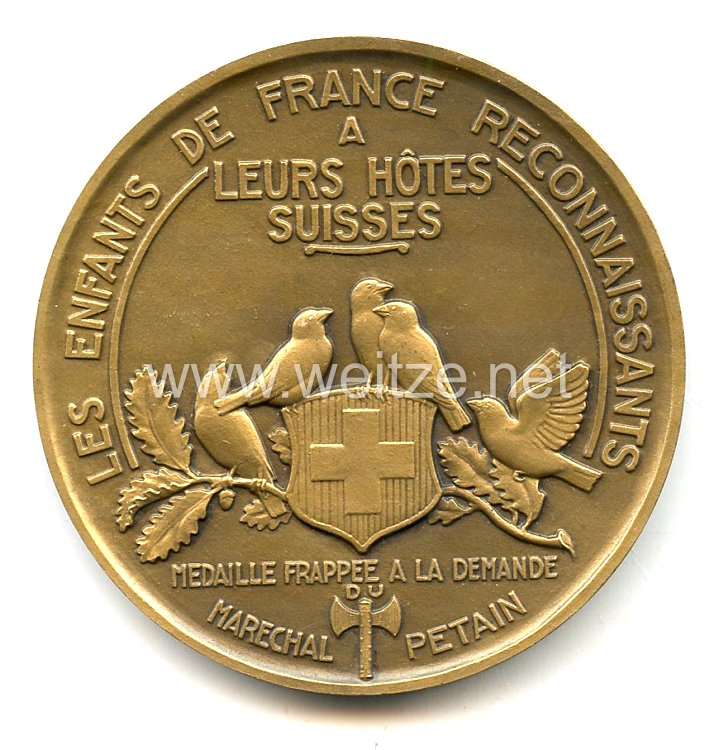
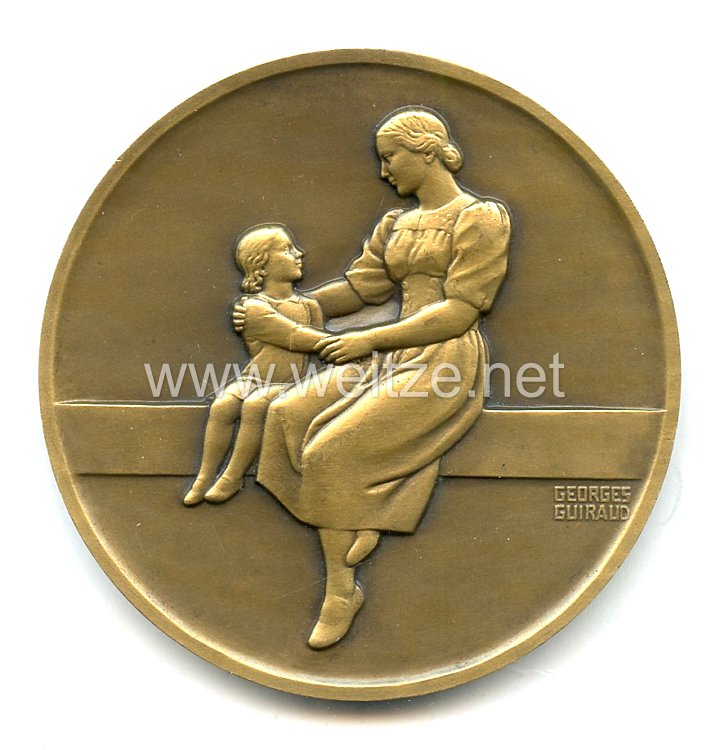
France Vichy Government Medal "Les Enfants de France Reconnaissants"

Base metal, diameter approximately 67 mm. Condition 2. 


378698
200,00

France Vichy Government Medal "Les Enfants de France Reconnaissants"

The "Les Enfants de France Reconnaissants" Medal of the Vichy Government

The medal "Les Enfants de France Reconnaissants" (The Grateful Children of France) represents a remarkable, albeit controversial, testimony to French history during World War II. This decoration was created under the Vichy Government, the authoritarian regime that governed the unoccupied part of France from 1940 to 1944 and collaborated with Nazi Germany.

Following France's devastating defeat in June 1940 and the armistice with Germany, a new political system emerged under the leadership of Marshal Philippe Pétain. The government, which established its seat in the spa town of Vichy, developed its own ideology known as the "Révolution nationale" (National Revolution). This was based on the principles of "Travail, Famille, Patrie" (Work, Family, Fatherland) and represented a radical break with the republican traditions of the Third Republic.

The Vichy government placed particular emphasis on family policy and child welfare, though within the context of its authoritarian and collaborationist agenda. The medal "Les Enfants de France Reconnaissants" fits into this propaganda system and was presumably intended to symbolize the connection between the regime and French youth. With a considerable diameter of approximately 67 millimeters, this is a relatively large medal, suggesting its ceremonial significance.

The production from base metal (a copper alloy) was typical during the war years, as precious metals like gold and silver were needed for the armaments industry. The economic constraints of occupied France are also reflected in the material choice for such civilian decorations. Despite these limitations, medals and badges were regarded as important propaganda instruments, and their production continued.

The Vichy regime created numerous decorations and honors to emphasize its legitimacy and appeal to various social groups. In addition to military orders, civilian medals were awarded for services in areas such as agriculture, social work, and youth promotion. The medal "Les Enfants de France Reconnaissants" may have been connected with welfare organizations caring for war-affected children, or with youth organizations that the regime used for indoctrinating the younger generation.

Particularly noteworthy are organizations such as the "Chantiers de la Jeunesse" (Youth Workshops), a paramilitary organization for young men, or various welfare institutions operating under the regime's patronage. The iconography and symbolism of such medals typically emphasized themes such as national unity, gratitude, self-sacrifice, and the paternal care of the state.

After the Liberation of France in 1944, the Vichy government was dissolved, and its leading members were prosecuted for high treason and collaboration. Pétain himself was sentenced to death in 1945, though the sentence was commuted to life imprisonment. The decorations created by Vichy were not recognized by the restored French Republic and lost their official validity.

Today, such medals from the Vichy period possess primarily historical and collectible value. They serve as material witnesses to a dark period in French history and are of interest to historians for understanding the propaganda and legitimization strategies of the regime. The trade and collection of such objects occur within the context of historical education and scholarly research.

The preservation of such artifacts is important for historical memory and the confrontation with the past. France has undergone a long process of coming to terms with the Vichy years, which only led to an official acknowledgment of the French state's complicity in the deportation of Jews in the 1990s. In this context, objects like this medal are not merely collectibles but also educational tools that remind us of the dangers of authoritarianism and collaboration.

The preservation of this medal in condition 2 indicates good conservation, which is remarkable for an object over 80 years old. Such well-preserved examples are of particular value to museums and educational institutions, as they authentically reproduce the original design and craftsmanship, thereby conveying a more accurate picture of the material culture of this era.