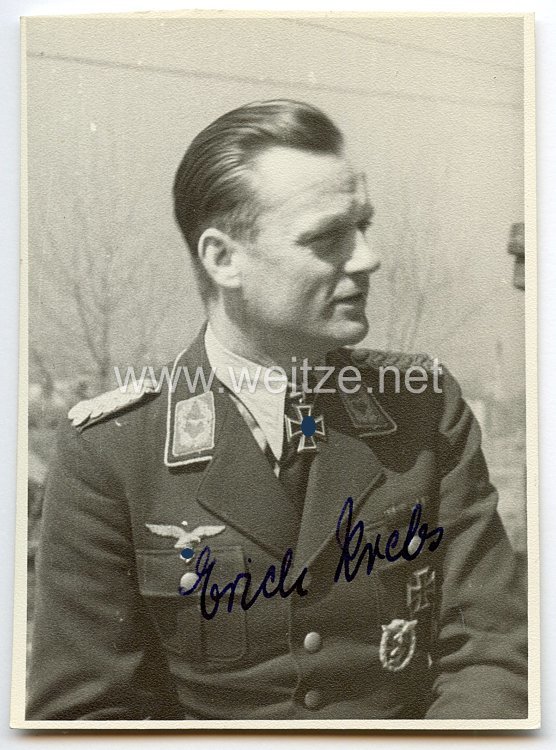
Luftwaffe - Original Signature of Knight's Cross Recipient Major Erich Krebs

on a very fine portrait photograph measuring 8 x 11 cm, with excellent ink signature “Erich Krebs”, Condition 2.
Erich Krebs was awarded the Knight's Cross on February 16, 1942, as Hauptmann and Commander of 1./Flak-Regt.11 (mot.).
334497
220,00

Luftwaffe - Original Signature of Knight's Cross Recipient Major Erich Krebs

This document represents a signed portrait photograph of Major Erich Krebs, a German Luftwaffe officer during World War II who was awarded the Knight's Cross of the Iron Cross on February 16, 1942. Such signed photographs of Knight's Cross recipients formed an important part of military commemorative culture and propaganda during the war.

Erich Krebs received the Third Reich's highest bravery decoration as a Hauptmann (Captain) and commander of the 1st Battery of Flak Regiment 11 (motorized). The award was made in recognition of his military achievements in air defense, a critical area of German warfare. Flak Regiment 11 was a motorized unit deployed for mobile air defense and operated on both the Eastern and Western fronts.

The Luftwaffe's Flak artillery played a central role during World War II. These units were not only responsible for defending against enemy air attacks but were frequently employed in ground combat as well. The famous 8.8 cm Flak proved to be one of the Wehrmacht's most versatile weapon systems, used against both aircraft and tanks. Officers like Krebs, who commanded Flak batteries, bore enormous responsibility for protecting military and civilian targets.

The Knight's Cross of the Iron Cross was instituted on September 1, 1939, by Adolf Hitler as a renewal of the Prussian Iron Cross. It represented the highest grade of the Iron Cross and was awarded for exceptional bravery or successful military leadership. By war's end, approximately 7,300 individuals received this decoration, including members of all Wehrmacht branches. The award carried considerable prestige and recipients were often employed for propaganda purposes.

Signed portrait photographs of Knight's Cross recipients were widespread during the war. They served multiple purposes: they were used as propaganda material, distributed to comrades and relatives, or sent to collectors upon request. Many of these photographs show officers in uniform with their decorations, with the Knight's Cross clearly visible at the neck. Signatures were typically applied in ink and varied according to the individual handwriting of the bearer.

The present format of 8 x 11 cm corresponds to a common standard size for portrait photographs of that era. This size was practical for mailing and storage in albums or frames. The photographic technology of the 1940s enabled high-quality black and white images, often produced by professional military photographers or civilian studios.

The ink signature on such photographs is today an important authenticity marker. Collectors and historians pay particular attention to features such as ink color, writing style, and signature placement. Original signatures from the period differ distinctly from later reproductions or forgeries. The signature “Erich Krebs” on this photograph was applied by the bearer himself, which gives the document its historical and collectible value.

After the war, a significant collector market developed for military autographs and photographs. While these objects were initially kept mainly by former soldiers in the postwar period, an international market for military-historical documents later emerged. Today such pieces are valued by military historians, museums, and private collectors, with historical context and scholarly examination always paramount.

The preservation of such historical documents is of great importance. Photographs and signatures from this period are susceptible to light, moisture, and improper storage. The stated “condition 2” indicates well-preserved condition, which is remarkable for documents over 80 years old. Professional conservation and proper storage are crucial for the long-term preservation of such historical documents.

From a historical perspective, such signed photographs are valuable sources for researching military history, decoration practices, and individual biographies of World War II soldiers. They complement official documents, war diaries, and other primary sources, helping to paint a more complete picture of this historical epoch.

r