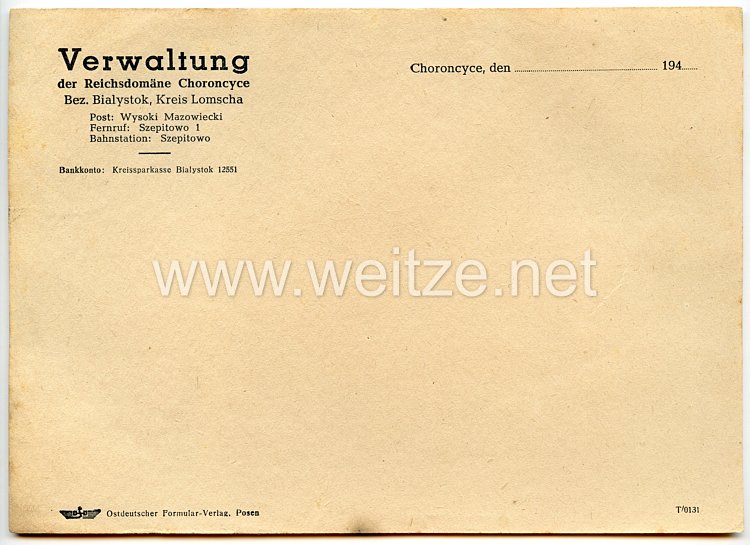
Third Reich - Administration of the Reichsdomäne Choroncyce District Bialystok County Lomscha - Letterhead
This letterhead from the Administration of the Reichsdomäne Choroncyce in the Białystok District, Lomscha County, represents a significant historical document from the period of German occupation of eastern Poland during World War II. This blank, pre-dated form from the 1940s offers a unique insight into the administrative penetration of occupied territories by Nazi Germany.
Following the German invasion of Poland in September 1939 and the subsequent Molotov-Ribbentrop Pact, Poland was divided between the German Reich and the Soviet Union. The Białystok region initially fell under Soviet control but was conquered by German troops after the launch of Operation Barbarossa in June 1941. The area was subsequently not incorporated into the General Government but directly subordinated to Prussian administration as the Bezirk Bialystok, administratively attached to the Zichenau administrative district in East Prussia.
The Lomscha County (Polish: Łomża) was one of the administrative districts within this structure. The German occupation administration established a comprehensive system for controlling and economically exploiting the occupied territories. Reichsdomänen (Reich domains) were state-owned agricultural estates that frequently arose in the occupied eastern territories through the expropriation of Polish and Jewish landowners. These domains served multiple purposes: supplying the Wehrmacht, economically exploiting the region, and preparing for the planned German settlement under the General Plan East.
The administration of such Reich domains required an extensive bureaucratic apparatus. Letterhead with pre-printed headers was an essential instrument of this administration and was used for daily correspondence with superior authorities, other administrative offices, the Wehrmacht, and local agencies. The pre-dating with “194...” allowed flexible use over several years, indicating resource scarcity and the pragmatic necessities of the war economy.
The administrative structure in the Białystok District was complex. At its head stood an Oberpräsident (chief president) directly subordinated to the Reich Minister of the Interior. Erich Koch, who simultaneously served as Gauleiter of East Prussia and Reich Commissioner of Ukraine, exercised considerable influence over the region. The local administration consisted of German officials, often from the Old Reich or other occupied territories, tasked with implementing National Socialist policies.
The Reichsdomäne Choroncyce was part of a system of over one hundred such estates established in the occupied eastern territories. These domains were frequently managed by the Haupttreuhandstelle Ost (Main Trustee Office East), an organization responsible for the “utilization” of confiscated Polish and Jewish property. The agricultural production of these estates was of strategic importance for German warfare, as it was meant to contribute to supplying the Eastern Front and the Reich.
The workforce on these domains frequently consisted of forced laborers – Polish civilians, Soviet prisoners of war, and deported Jews who had to work under inhumane conditions. The administrative documents of these institutions, including letterhead, indirectly document the bureaucratic normality with which these crimes were organized.
Following the course of the war and the advance of the Red Army in summer 1944, the Białystok District was liberated by Soviet troops. The German administration fled or was captured, and many administrative documents were lost or destroyed. Preserved documents such as this letterhead are therefore of particular historical value, as they document German occupation rule and its bureaucratic structures.
For historical research, such seemingly mundane administrative documents are of great significance. They provide evidence of the systematic penetration and exploitation of occupied territories, the involvement of numerous German civil servants in the occupation regime, and the bureaucratic routine that enabled and accompanied crimes. The letterhead of the Reichsdomäne Choroncyce stands as an exemplar of the administrative dimension of German occupation rule in Eastern Europe during World War II.