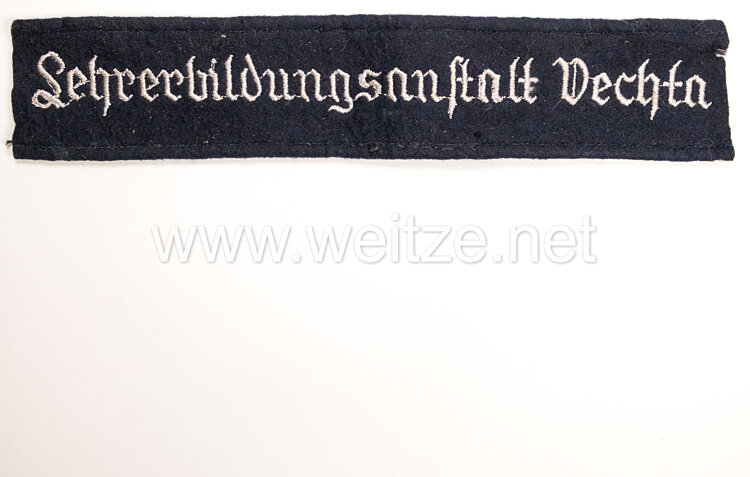
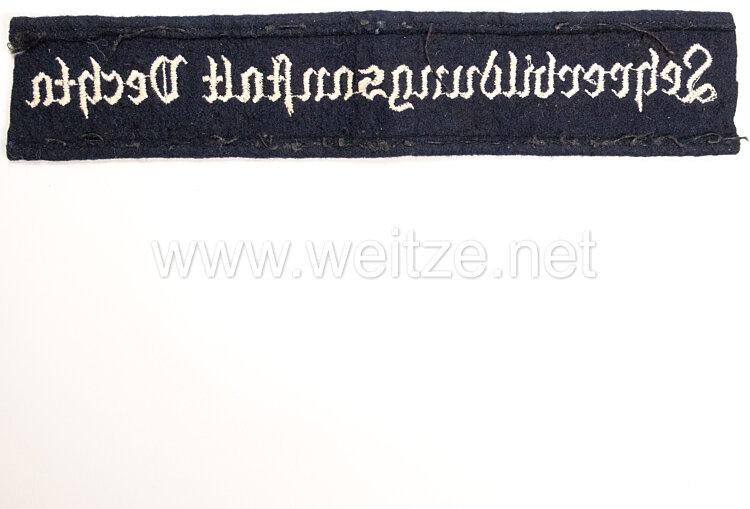
HJ - Armband "Lehrerbildungsanstalt Vechta"
The armband of the Teacher Training Institute Vechta represents a rare and historically significant artifact of National Socialist educational policy during the Third Reich. This armband made of blue felt cloth belonged to the uniform of the Hitler Youth (HJ) and specifically indicated membership in the teacher training institute in Vechta, an institution for training elementary school teachers according to National Socialist principles.
The Teacher Training Institutes were central institutions in the NS educational system, which were systematically coordinated after 1933. In Vechta, a town in the Oldenburg Münsterland region, such an institution existed that trained young men as teachers. These teachers were not only supposed to impart knowledge but above all to pass on National Socialist ideology to the coming generation. The integration of teacher training into the structures of the Hitler Youth was part of the comprehensive penetration of all educational institutions with NS ideology.
The armband itself followed the strict uniform regulations of the HJ, which were refined several times over the years. The use of blue felt cloth was characteristic of certain HJ units and special formations. The lettering was usually applied in white or silver-colored letters, with the exact execution corresponding to the respective guidelines of the Reich Youth Leadership. Such armbands were worn on the left upper arm of the HJ uniform and served for immediate identification of membership in a particular unit or institution.
The Teacher Training Institutes in the Third Reich underwent fundamental reorientation from 1933 onwards. The Reich Ministry of Science, Education and National Culture under Bernhard Rust reformed the entire teacher training system. The training period was shortened, the proportion of ideological instruction was massively increased, and physical fitness as well as pre-military training became central components. Particularly ideological education occupied a broad space, with racial science, heredity, and National Socialist interpretation of history being taught.
The connection between teacher training institutes and the Hitler Youth was institutionally anchored. Candidates for the teaching profession generally had to be active HJ members and ideally already hold leadership positions within the organization. The teacher training institutes were often organized as closed boarding schools, in which the prospective teachers lived in a strictly regimented community. This approach was intended to ensure the formation of a new generation of educators according to National Socialist ideals.
The present specimen with a length of 20.5 cm was obviously shortened, indicating subsequent adjustment or possibly damage. The original length of such armbands usually ranged between 30 and 40 cm, depending on the wearer's arm size. The shortening could have various reasons: practical adjustment to a younger or smaller wearer, damage to the ends, or subsequent alteration after the war's end.
The blue felt cloth as base material was typical for HJ armbands and corresponded to the material specifications of the Reich Youth Leadership. Felt was robust, relatively inexpensive, and easy to process. The color choice of blue possibly had symbolic significance or served to distinguish from other HJ formations, which frequently wore black armbands.
The historical significance of such objects lies in their function as material witnesses to a system that completely subordinated education and training to ideology. The teacher training institutes were key institutions in the indoctrination of youth, as they trained the multipliers who later worked in schools throughout the Reich. After 1945, these institutions were dissolved and the teacher training system fundamentally reformed.
Today, armbands like this are important study objects for historians researching the NS educational system. They document the systematic appropriation of youth and the instrumentalization of education for totalitarian purposes. Collectors and museums preserve such objects as memorials and teaching aids for future generations.