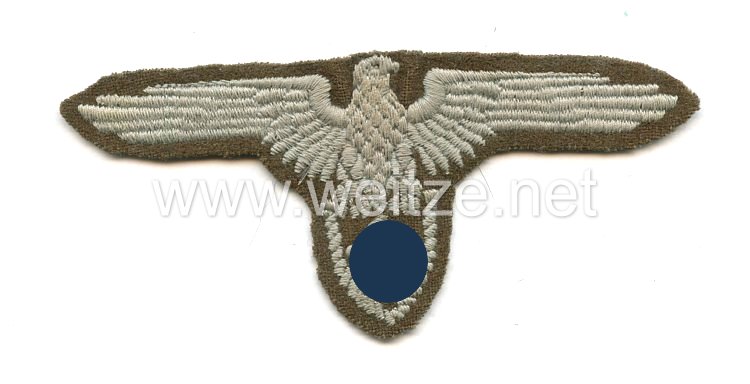
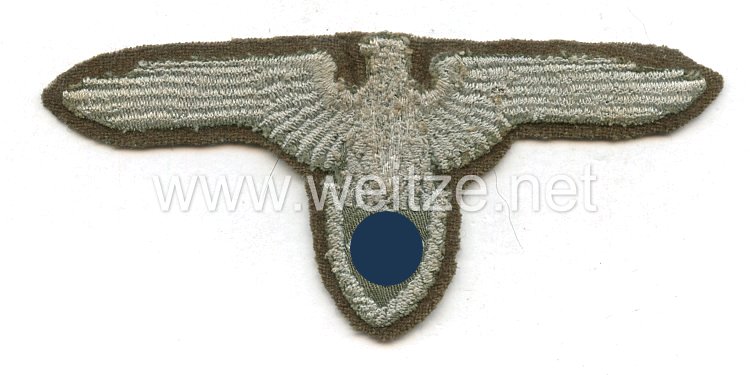
Freiwillige Schutzstaffel der Deutschen Volksgruppe der Slowakei Sleeve Eagle for Enlisted Men

Machine-embroidered version, on brown wool, very rare. Condition 2
352197
425,00

Freiwillige Schutzstaffel der Deutschen Volksgruppe der Slowakei Sleeve Eagle for Enlisted Men

The Sleeve Eagle of the Voluntary Protection Squadron of the German Ethnic Group in Slovakia

The described sleeve eagle for enlisted ranks of the Freiwillige Schutzstaffel (Voluntary Protection Squadron) of the German ethnic group in Slovakia represents a rare testimony to the complex history of German minorities in Central Europe during World War II. This machine-embroidered version on brown fabric represents the uniform insignia of an organization that emerged in the context of National Socialist ethnic policies.

The German ethnic group in Slovakia formed a significant German minority in the newly created Slovak state under Jozef Tiso after the dismemberment of Czechoslovakia in 1939. The German inhabitants of Slovakia, mainly residing in the Spiš region, Pressburg (Bratislava), and other areas, were organized following the model of other Volksdeutsche organizations in Southeast Europe.

The Freiwillige Schutzstaffel (FS) was founded in 1938/39 as a paramilitary formation of the German ethnic group. It was organizationally and ideologically oriented toward the German SS but remained an independent organization under the leadership of the German Party in Slovakia, headed by Franz Karmasin, who served as ethnic group leader from 1940. The FS primarily served for self-defense and demonstration of German presence in the Slovak state.

The sleeve eagle as a national emblem represented a central identifying feature of the uniform. The machine-embroidered version on brown fabric corresponds to the characteristic design for enlisted ranks. The eagle was typically worn on the left upper arm and indicated membership in the formation. The brown base color corresponded with the brown uniform of the FS, which was modeled after SA and SS examples.

The technical execution of the insignia as machine embroidery was common for enlisted ranks and differed from higher-quality, often hand-embroidered variants for leaders. The embroidery typically shows a stylized eagle with outstretched wings, holding a swastika in its talons – the characteristic symbol of National Socialist organizations.

The rarity of such insignia can be explained by several factors: The German ethnic group in Slovakia was numerically limited, the FS existed for only a few years, and many members were later incorporated into the Waffen-SS. With the formation of the SS Division “Prinz Eugen” and other units, numerous ethnic Germans from Southeast Europe, including Slovakia, were recruited. From 1944 onwards, members of the FS were increasingly integrated into regular German military units.

The end of World War II also meant the end of the German ethnic group in Slovakia. The Beneš Decrees of 1945 led to the extensive expulsion of the German population from Czechoslovakia, including Slovakia. The Carpathian Germans lost their centuries-old homeland, and organizations like the FS were dissolved. Uniform parts and insignia were largely destroyed or lost, explaining their rarity today.

From a historical perspective, such insignia document the history of the Volksdeutsche movement in Southeast Europe and the instrumentalization of German minorities by the Nazi regime. The Freiwillige Schutzstaffel was part of a comprehensive system for organizing and mobilizing German population groups outside the Reich territory, coordinated by the Volksdeutsche Mittelstelle (VoMi) under SS-Obergruppenführer Werner Lorenz.

The organization's structure mirrored that of the German SS, with ranks, uniforms, and insignia adapted to local conditions. Members underwent ideological training and physical exercises, preparing them for potential military service. The brown uniforms and accompanying insignia were designed to create visual unity and demonstrate allegiance to National Socialist ideology.

Today, such objects are important material witnesses for museums and scholarly collections dealing with the history of World War II, German minorities in Eastern Europe, and the Nazi era. They require critical historical contextualization and serve the documentation and examination of this complex epoch.