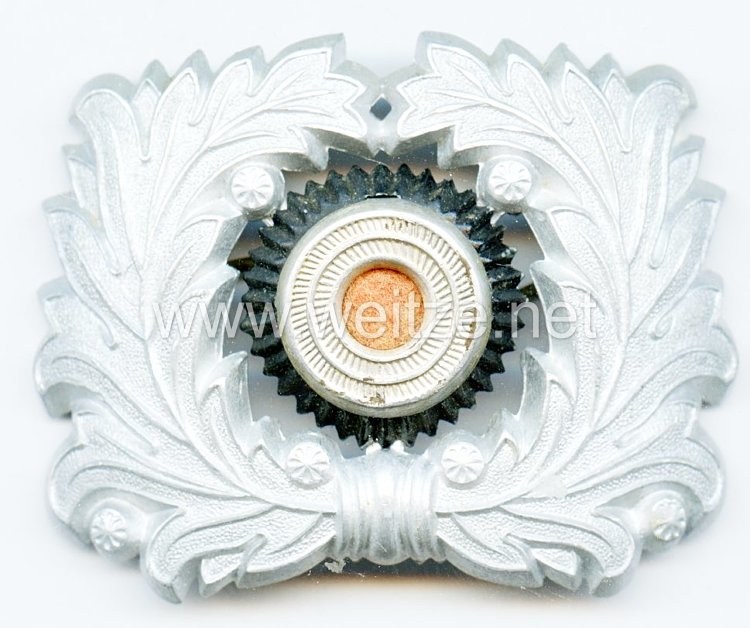
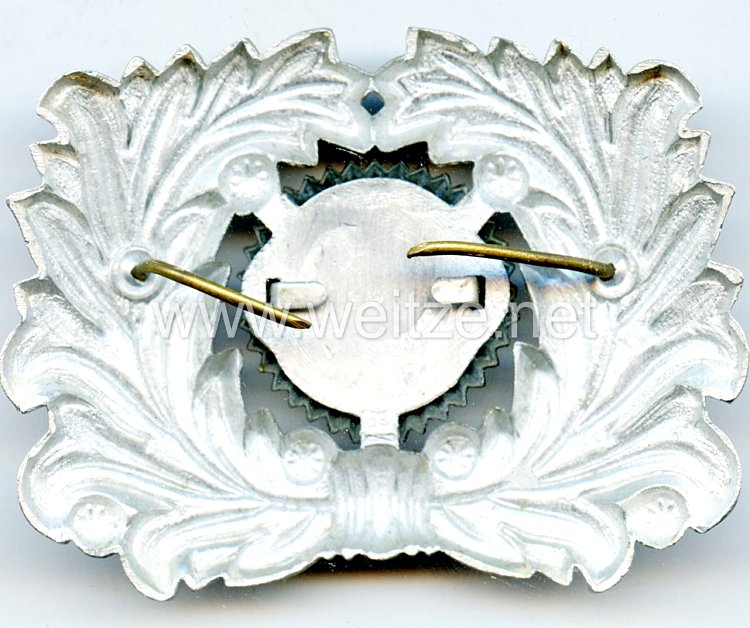
Reichsfinanzverwaltung/Zollgrenzschutz Oak Leaf Wreath and Cockade for Enlisted Men's Visor Cap

Aluminum, condition 2-.
440496
70,00

Reichsfinanzverwaltung/Zollgrenzschutz Oak Leaf Wreath and Cockade for Enlisted Men's Visor Cap

The Reichsfinanzverwaltung (Reich Finance Administration) and the Zollgrenzschutz (Customs Border Guard) represented a significant state institution in the German Reich, responsible for border surveillance and customs collection. The object described here – an oak leaf wreath with cockade for the peaked cap of enlisted men – represents an important element of the uniform of this paramilitary formation.

The Zollgrenzschutz was officially established on October 1, 1937, and was administratively subordinate to the Reich Finance Ministry. This organization arose from the necessity to more effectively monitor German borders while ensuring customs collection. With the Nazi seizure of power in 1933, the reorganization of state administrative structures was advanced, which also affected the finance administration.

The uniforms of the Zollgrenzschutz were strongly oriented toward military models. The peaked cap (Schirmmütze) as headgear was a central element of the service uniform and served not only practical purposes but also represented state authority. The oak leaf wreath with cockade described here was worn on the front of the peaked cap and identified the wearer as a member of the Reich Finance Administration.

The material aluminum was typical for such insignia, as it was lightweight, inexpensive to manufacture, and corrosion-resistant. The use of aluminum enabled mass production of the insignia while maintaining acceptable quality. The oak leaf wreath as a motif had a long tradition in German symbolism and stood for strength, permanence, and national unity.

The cockade in the Reich colors of black-white-red was the central symbol of state authority. It was attached in the center of the oak leaf wreath and was found in similar form on all formations of the Reich administration. The specific design of the wreath and cockade followed precise regulations laid down in the uniform specifications of the Reich Finance Administration.

The Zollgrenzschutz developed over time into a significant paramilitary formation. By 1939, the organization had grown to approximately 53,000 men. Members received military training and were stationed at Reich borders. With the outbreak of World War II in September 1939, large parts of the Zollgrenzschutz were integrated into the Wehrmacht, particularly into border protection and security units.

The rank insignia and uniform parts of the Zollgrenzschutz differed in details from those of the Wehrmacht but retained a military character. For enlisted men (Mannschaften), meaning the simple ranks without non-commissioned or commissioned officer status, the oak leaf wreath with cockade described here was prescribed. Higher ranks wore partially different or additional insignia.

The manufacture of such uniform parts was carried out by various suppliers who produced on behalf of the Reich Finance Administration. Quality could vary depending on the manufacturer and production period. Early pieces from 1937-1939 often show higher-quality workmanship than later wartime productions, where material shortages led to quality compromises.

After the end of World War II in 1945, the Zollgrenzschutz was dissolved. Uniform parts and insignia were partially confiscated by the occupying powers or destroyed by former wearers. Surviving pieces are today witnesses to a historical epoch and of interest to collectors of military-historical objects as well as to museums and research institutions.

The present object in condition 2- (indicating light signs of use) is a typical example of the mass production of uniform insignia in the Third Reich. It documents the uniform practices of a state organization that operated at the intersection between civil administration and military formation. Such objects are important for understanding the institutional structures and visual representation of state power in National Socialist Germany.