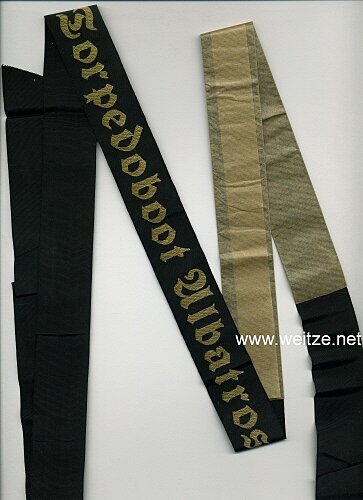
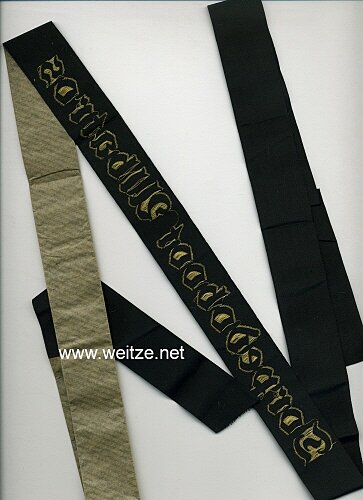
Cap Tally "Torpedoboot Albatros"
The cap tally bearing the inscription “Torpedoboot Albatros” (Torpedo Boat Albatros) represents a fascinating piece of German naval history from either the Imperial Navy or the later Kriegsmarine. Cap tallies were an essential component of German naval uniforms, serving both identification purposes and maintaining unit traditions.
The Imperial German Navy (Kaiserliche Marine) introduced the cap tally system in the late 19th century. Regulations from 1888 stipulated that sailors' cap ribbons should display the name of their respective ship or unit in gold lettering on a black background. This tradition was continued by the Reichsmarine (1919-1935) and the Kriegsmarine (1935-1945), with designs and manufacturing techniques evolving over time.
The present example is manufactured using metal thread weaving, a high-quality production technique in which gold-colored or silvered metal threads were woven into the black base fabric. This elaborate method ensured exceptional durability and an elegant sheen. The fact that this tally has survived in mint condition with its original packaging paper suggests it was either an unissued reserve piece or a carefully preserved souvenir.
The name “Albatros” appeared multiple times throughout German naval history. The Imperial Navy operated several ships bearing this name, including a torpedo boat of the Iltis class from 1898 and a torpedo boat of the 1916 construction series. The Reichsmarine and Kriegsmarine also deployed various units carrying this traditional name. Torpedo boats played a crucial role in German naval strategy, particularly in coastal defense, fleet escort duties, and nighttime offensive operations.
German Navy torpedo boats evolved from small, coastal vessels in the late 19th century to high-seas combat ships. During World War I, torpedo boats proved indispensable components of the High Seas Fleet. They participated in numerous operations in the North Sea, including the famous Battle of Jutland (May 31 - June 1, 1916). The crews of these vessels were considered naval elite, as service aboard these often small, fast, and agile boats required exceptional seamanship and courage.
In World War II, Kriegsmarine torpedo boats played important roles in securing sea lanes, minelaying operations, and combating Allied naval forces. They were particularly active in Norwegian waters, the English Channel, and the Baltic Sea. Crews wore their cap tallies with pride as symbols of belonging to their unit.
The collection and preservation of such cap tallies holds special significance in military-historical research. They enable historians to reconstruct the organizational structure of the navy, trace ship crews, and follow individual fates. Cap tallies in this exceptionally fine condition are rare today, as most examples were worn for years and show corresponding signs of use.
The manufacture of cap tallies was strictly regulated and carried out by authorized manufacturers. The quality of metal thread weaving varied depending on producer and time period. During wartime, material shortages sometimes led to quality reductions. A mint-condition tally with original packaging indicates careful storage or that it was never issued for service.
Today, such militaria are important testimonies to maritime history and are valued equally by museums, archives, and collectors. They commemorate the men who served aboard these ships and document a significant chapter of German naval history. The cap tally “Torpedoboot Albatros” exemplifies the long tradition of the German Navy and the importance of torpedo boat forces in the naval wars of the 20th century.