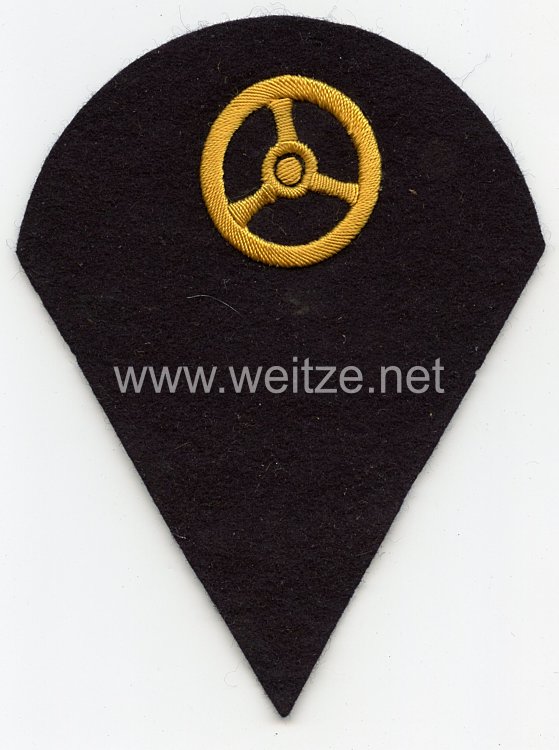
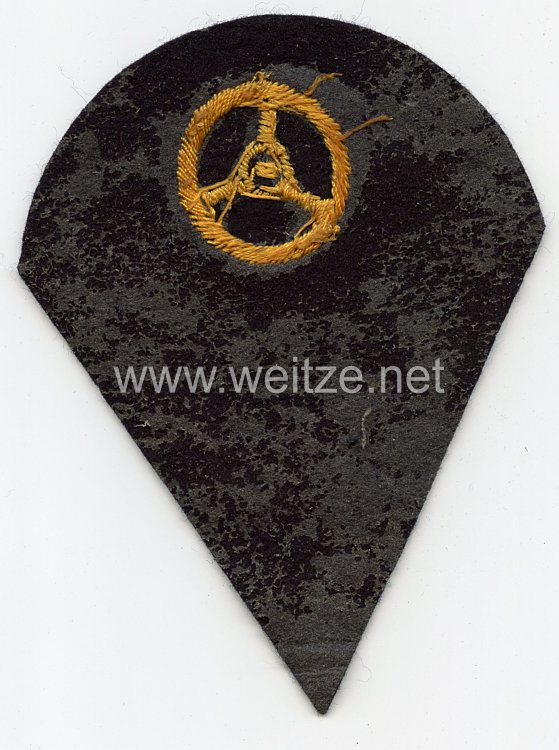
Kriegsmarine Enlisted Ranks Sleeve Insignia for Motor Vehicle Personnel Career
The Kriegsmarine sleeve badge for enlisted men of the motor transport career path represents a fascinating example of the specialized career insignia used within the German Navy during the Second World War. These badges served not only to identify specialist personnel but also reflected the increasing mechanization and specialization of maritime forces.
The Kriegsmarine, as the naval branch of the Wehrmacht, was established in 1935 following Germany's official renunciation of the Treaty of Versailles. With the construction of a modern war fleet came the simultaneous need for specialized personnel in various technical areas. The motor transport career path belonged to the important support functions, as the Navy operated not only ships but also extensive land-based infrastructure, naval bases, shipyards, and supply facilities, all of which required motorized vehicles.
The version for the Kollani (colonial cloth uniform) refers to the badge variant designed for the khaki-colored summer uniform. The Kollani was a lighter uniform made from tropical-suitable material, worn in warmer climates or during the summer months. The hand-embroidered execution indicates high-quality craftsmanship, where the motif was applied to the backing material with needle and thread, as opposed to machine-woven or machine-embroidered variants.
The career badges of the Kriegsmarine were worn on the left upper arm according to uniform regulations. They typically consisted of symbolic representations depicting the respective field of activity. For the motor transport career path, this was usually a stylized automobile steering wheel or a combination of motor vehicle technical symbols, often in yellow or gold embroidery on a dark background for standard naval uniforms, or in correspondingly adapted colors for the Kollani version.
The introduction of such special badges occurred gradually from the mid-1930s onward. The Uniform Regulations for the Kriegsmarine (Anzugordnung or AO) and the associated implementation provisions precisely regulated which badges were to be worn by which rank groups and career paths. Enlisted men, non-commissioned officers, and officers each had different badge variants, distinguished by material, quality of execution, and sometimes design.
Motor transport personnel of the Kriegsmarine were responsible for the operation and maintenance of all motorized land vehicles deployed in naval service. This included trucks for material transport, passenger cars for officers and courier duties, tractors for heavy equipment, as well as specialized vehicles for various technical tasks in harbors and shipyards. With the expansion of German naval presence during the war across large parts of Europe and North Africa, the importance of this career path was further enhanced.
The hand-embroidered execution of such a badge indicates manufacture either by professional insignia embroidery firms or by specialized military tailoring shops. During the war, there were numerous authorized manufacturers of uniform effects who worked according to official specifications. Quality could vary, with hand-embroidered versions generally considered superior to the later, often cost-driven simplified machine productions.
The preservation condition of such historical textiles depends on various factors. Use on the Kollani often meant greater stress from sunlight and more frequent washing, which could lead to fading and material fatigue. Nevertheless, many of these badges survived the decades, especially when properly preserved by collectors.
In historical context, these career badges represent the organizational structure and professionalism that the Kriegsmarine aspired to achieve. They illustrate that a modern navy required far more than just sailors – it depended on a complex network of specialists, each making their specific contribution to the fleet's functionality. The motor transport career path may appear at first glance to be a peripheral function, but it was essential for the logistical support of maritime operations.
Today, such badges are important study objects for military historians and uniform scholars. They help understand the complex hierarchy and organization of the Kriegsmarine and offer insights into the material culture and everyday reality of naval personnel of that era.