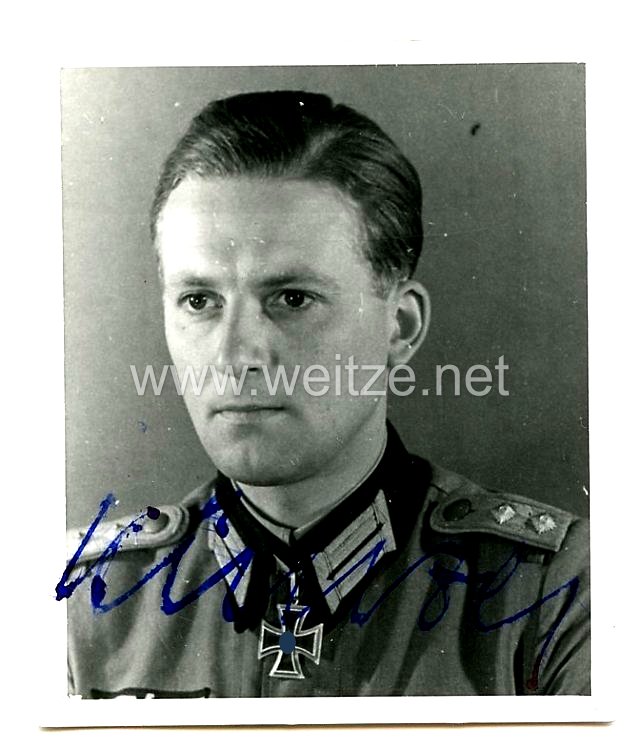
Army - Post-War Signature of Knight's Cross Recipient Hans-Joachim Künzel
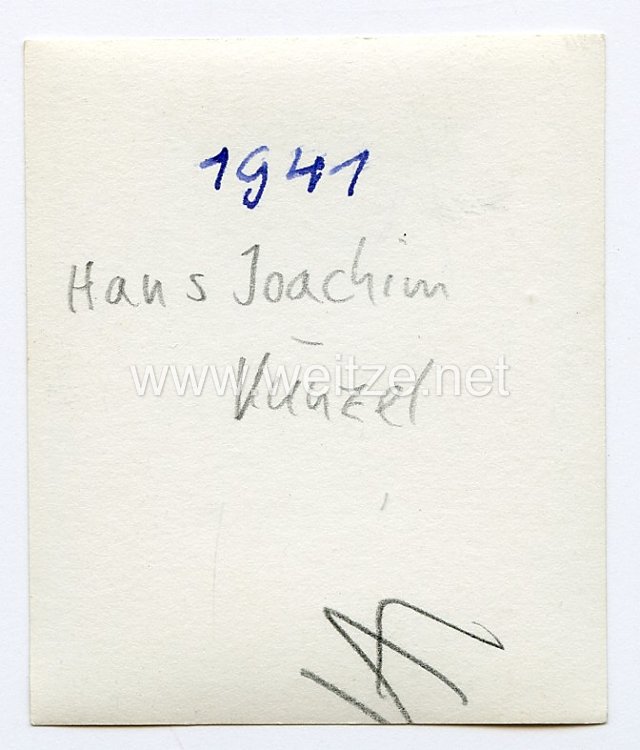
The present object is a post-war photograph bearing the signature of Hans-Joachim Künzel, a German officer of the Wehrmacht and recipient of the Knight's Cross of the Iron Cross. The photograph, measuring approximately 5 x 6 cm, is a print made after 1945 and represents an important category of military historical collectibles: signed photographs of Knight's Cross recipients from the post-war period.
Hans-Joachim Künzel was born on June 10, 1919, and served as an officer in the Wehrmacht's Army during World War II. He was awarded the Knight's Cross of the Iron Cross on May 6, 1945, shortly before the war's end. His military career led him through various combat operations on the Eastern Front, where he distinguished himself through exceptional bravery and leadership qualities.
The tradition of post-war signatures developed in the decades after 1945, when militaria collectors began seeking out World War II veterans and requesting autographs. This practice became particularly popular from the 1960s through the 1990s, when many former soldiers were still alive and willing to sign photographs, books, or other memorabilia. These signatures served both to authenticate historical photographs and to provide personal documentation for collectors.
The Knight's Cross of the Iron Cross was one of the highest military decorations of the German Reich during World War II. It was instituted on September 1, 1939, by Adolf Hitler and awarded to soldiers of all service branches for exceptional bravery or outstanding military leadership. Approximately 7,300 individuals received this decoration during the war.
Photographs of Knight's Cross recipients exist in various categories: contemporary images from the war period, often used as propaganda material, as well as post-war photographs that either reproduce historical images or show more recent portraits of veterans. The present post-war print belongs to the second category and was likely created for collector purposes.
The military-historical significance of such signed photographs lies in their function as primary historical sources. They document not only the lives and actions of individual soldiers but also the post-war culture of remembrance and collecting. The signature itself becomes a historical artifact, creating a connection between past and present.
In the collecting landscape, such signed photographs are evaluated according to various criteria: rarity of the signature, historical significance of the person, condition of the photograph and signature, and provenance. Signatures from officers who died early after the war are considered particularly rare and valuable. Authentication is performed through comparison with known signature samples and documentation of origin.
The legal and ethical aspects of collecting World War II militaria are complex. In Germany, trade in Nazi memorabilia is subject to strict legal regulations. However, photographs of Wehrmacht members without unconstitutional symbols are legally collectible when they serve historical education and documentation purposes.
The stated condition 2 corresponds to very good preservation condition with only minimal signs of use on the standard grading scale. This indicates that the photograph has been carefully preserved and its signature remains clearly legible.
Such post-war signatures enable modern researchers and historians to capture the human dimension of military history. They remind us that behind military decorations and ranks lie individual biographies that must be understood in the context of their time. The scholarly examination of the Wehrmacht and its members remains an important field of military historical research.