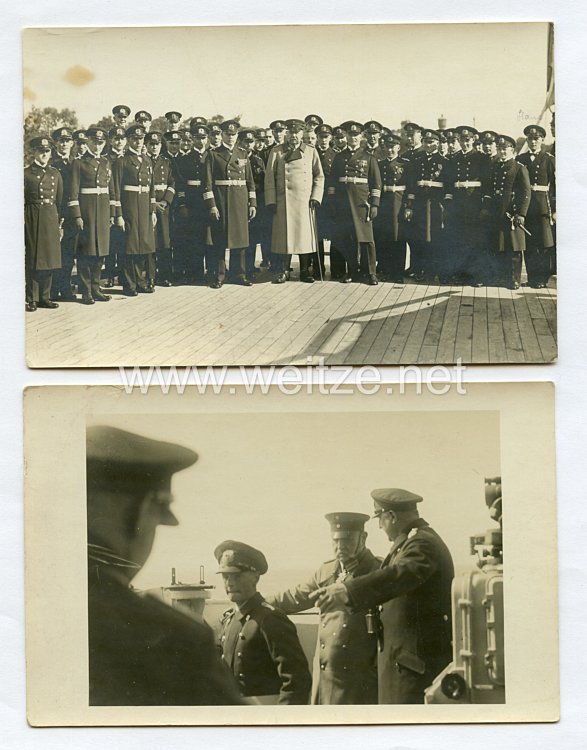
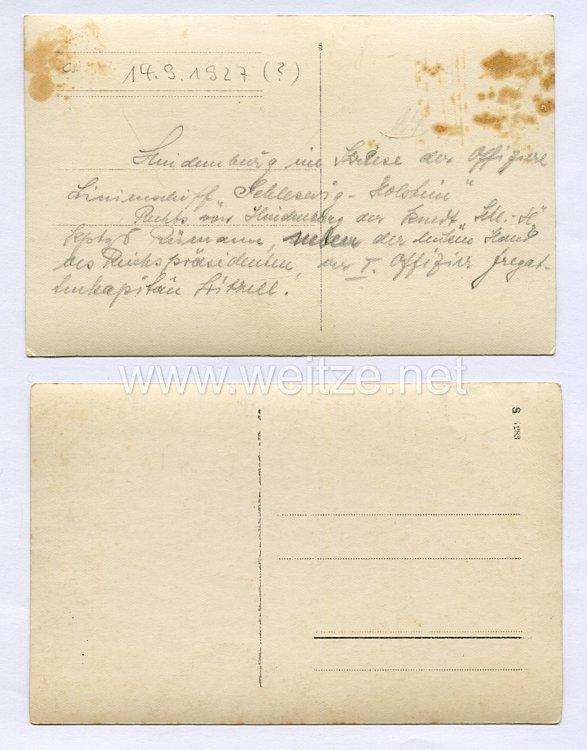
Weimar Republic Photographs, Paul von Hindenburg on the Battleship “Schleswig-Holstein”
These photographs depict Paul von Hindenburg aboard the battleship Schleswig-Holstein during the era of the Weimar Republic (1919-1933). These historical images document a significant moment in German naval history, connecting two central symbols of German history: the legendary Reich President and one of the most famous warships of the Imperial and later Reichsmarine.
Paul von Hindenburg (1847-1934) was one of the dominant figures in German history during the early 20th century. As a Field Marshal, he achieved legendary fame during World War I through victories at Tannenberg and the Masurian Lakes. From 1925 until his death in 1934, he served as the second Reich President of the Weimar Republic. His visits to the Navy were of great symbolic importance, as they demonstrated continuity between Imperial Germany and the new republican order.
The battleship Schleswig-Holstein belonged to the Deutschland-class of the Imperial Navy and was commissioned in 1906. With a displacement of approximately 13,200 tons and main armament of four 28-cm guns in twin turrets, the ship represented pre-war naval architecture. After World War I and the restrictive provisions of the Treaty of Versailles of 1919, Germany was permitted to maintain only a severely limited navy. The Schleswig-Holstein was among the few older units that remained with the young Weimar Republic.
During the Weimar Republic, the Schleswig-Holstein served primarily as a training ship for naval officers and cadets. The vessel undertook numerous training voyages in the Baltic Sea and occasionally abroad. This function was of particular importance, as the Reichsmarine attempted to train professional naval officers and maintain maritime traditions despite the Versailles restrictions.
Photographs of high-ranking state visits aboard warships were of considerable propagandistic significance during the Weimar era. They served to strengthen the legitimacy of the democratic government while emphasizing the continuity of German military traditions. Hindenburg as a symbolic figure of old Prussia and Germany embodied this bridge between Empire and Republic. His presence on the Schleswig-Holstein connected conservative, monarchist traditions with the republican present.
The 1920s and early 1930s were a time of transition for the German Navy. Under the leadership of admirals such as Hans Zenker and later Erich Raeder, the Reichsmarine gradually modernized. While older ships like the Schleswig-Holstein continued to operate as training vessels, new, modern units emerged, such as the famous pocket battleships of the Deutschland-class, known abroad as “pocket battleships.”
The historical significance of the Schleswig-Holstein reached a tragic climax on September 1, 1939, when the ship opened World War II by bombarding the Polish fortifications at the Westerplatte near Danzig. This fact gives all photographs of the ship from the Weimar period a special historical dimension, as they show a vessel that would later become a symbol of the outbreak of war.
Photographs such as these are important sources for German maritime and political history. They document not only technical aspects of naval history but also the ceremonial and representative functions of the Kriegsmarine during the interwar period. Hindenburg's presence underscores the political significance of such events and demonstrates how the Weimar Republic attempted to utilize military traditions for its own legitimation.
For collectors and historians, such original photographs offer an authentic glimpse into the maritime history of the Weimar Republic. They complement written sources and official documentation through visual evidence and enable a better understanding of the atmosphere and context of these historical moments. The used condition of such photographs is typical of contemporary images and in no way diminishes their historical value.