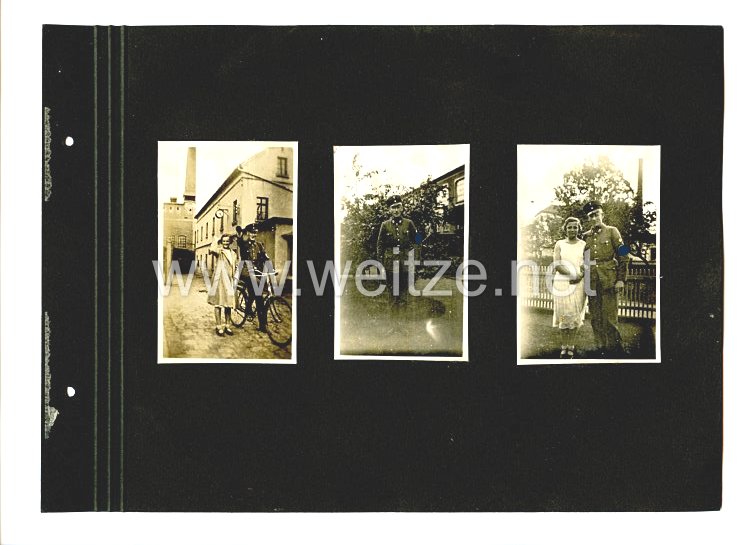
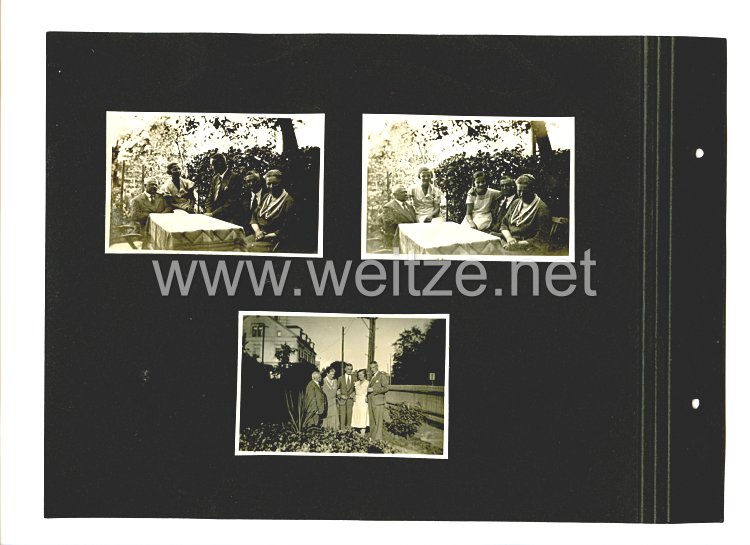
Reichsarbeitsdienst Photographs, Member of the Deutscher Aufbaudienst (DAD)

6 photographs, dimensions approximately 5.2 x 8.4 cm, condition 2.
411595
20,00

Reichsarbeitsdienst Photographs, Member of the Deutscher Aufbaudienst (DAD)

These photographs document a member of the Deutscher Aufbaudienst (DAD) (German Construction Service), an organization closely connected to the Reichsarbeitsdienst (RAD) (Reich Labor Service) that played a significant role in German history during the 1930s and 1940s.

The Reichsarbeitsdienst was established as a state organization on June 26, 1935, through the “Reich Labor Service Law.” All young Germans of both sexes were obligated to serve their people in the Reich Labor Service. The service period initially lasted six months and had to be completed before military service or beginning university studies. The RAD was directly subordinate to Reich Labor Leader Konstantin Hierl, who headed the organization from 1935 to 1945.

The Deutscher Aufbaudienst was a special formation within or parallel to the RAD system. This unit focused particularly on reconstruction and infrastructure projects. DAD members were frequently deployed in construction projects, land reclamation measures, road building, and other projects that served the National Socialist ideology of “labor education” and practical national development.

Photographs like those described here held great significance during this period. They served multiple purposes: first, as personal mementos for the servicemen and their families; second, as propaganda material to showcase the regime's supposed successes; and third, as documentation of completed works. The standard size of approximately 5.2 x 8.4 cm corresponds to the then-common formats for amateur photographs.

The uniform and equipment of the RAD and DAD differed distinctly from those of the Wehrmacht. Members wore earth-brown uniforms with characteristic shoulder straps and rank insignia. The symbol of the Reich Labor Service was the spade, considered the “badge of honor of labor.” Members were organized in military-like structures, with designations such as Arbeitsmann (laborer), Vormann (foreman), Obervormann (senior foreman), and higher ranks.

The activities of the RAD and DAD encompassed a broad spectrum: land improvement and reclamation works, dike construction on the North and Baltic Sea coasts, construction of roads and autobahns, reforestation projects, harvest work, and from 1939 onwards, increasingly military-related tasks such as building fortifications. During the war, RAD units were also deployed for clearing operations after bomb attacks and other war-essential projects.

The organization had a pronounced ideological component. The Labor Service was not only meant to perform practical work but also to educate toward “Volksgemeinschaft” (people's community) and supposedly overcome social differences between various social classes. In practice, this meant intensive political indoctrination of young people.

For collectors and historians, photographs from this period are valuable sources. They document daily life, working conditions, uniforms, and the social environment of service members. The indicated condition grade 2 suggests well-preserved photographs that still show clear details. Such images can provide information about locations, tools and machinery used, as well as living conditions in the camps.

After the end of World War II, the Reich Labor Service was dissolved along with all other Nazi organizations. The Allies banned the organization as part of denazification. Many former RAD members returned to civilian life, while others became prisoners of war.

Today, such photographs are important historical documents that aid in researching this period. They are preserved in archives, museums, and private collections and contribute to understanding this complex and problematic phase of German history.