NSDAP - 6th Hessentag of the NSDAP Gau Kurhessen 28-30.3.1937 in Kassel
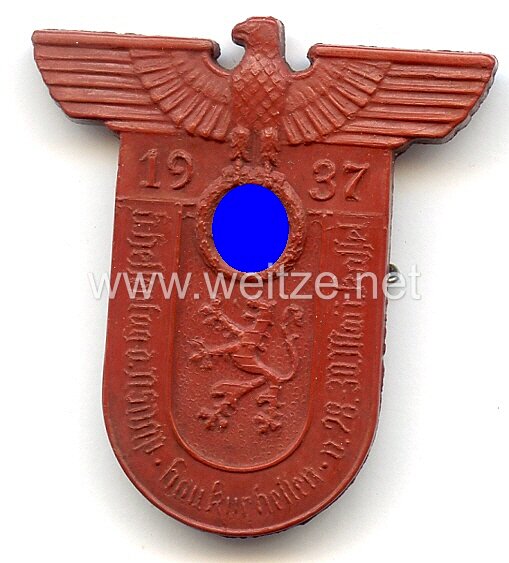
This badge documents the 6th Hessentag of the NSDAP, which took place from March 28-30, 1937 in the Gau Kurhessen in the city of Kassel. This plastic badge, manufactured by the company Bebrit, belongs to the category of political event badges that were produced during the National Socialist rule in Germany for internal party gatherings and propaganda events.
The Gau Kurhessen was an administrative unit of the NSDAP that was formed in 1934 from the merger of the Gaue Hessen-Nassau-Nord and Kurhessen. The Gau territory essentially comprised the northern part of today's federal state of Hessen with the Gau capital Kassel. The Gauleiter was Karl Weinrich, who held this position from 1933 to 1943. The territorial organization into Gaue was of central importance to the NSDAP, as it served both the internal party structure and the ideological penetration of the population.
The Hessentage were regional party events held annually in various cities of the Gau. They served several purposes: demonstrating political power, mobilizing party members, presenting ideological content, and not least staging the leadership principle at the regional level. Such events followed a typical pattern with marches, rallies, speeches by high-ranking party functionaries, and various cultural performances in line with Nazi ideology.
The year 1937 marked a phase of consolidation of National Socialist rule in Germany. The economic situation had apparently improved, rearmament was in full swing, and the regime used mass events intensively for self-presentation and propaganda. Events such as the Hessentag in Kassel were part of a comprehensive system of political rituals ranging from local party meetings to the monumental Reich Party Congresses in Nuremberg.
The badge itself is made of plastic, which was typical for the time. From the mid-1930s onward, plastic was increasingly used instead of metal for such commemorative badges. This had several reasons: plastic was more cost-effective to manufacture, allowed for more detailed design possibilities, and - particularly important - conserved metal resources needed for rearmament. The use of plastic for party badges increased continuously throughout the late 1930s.
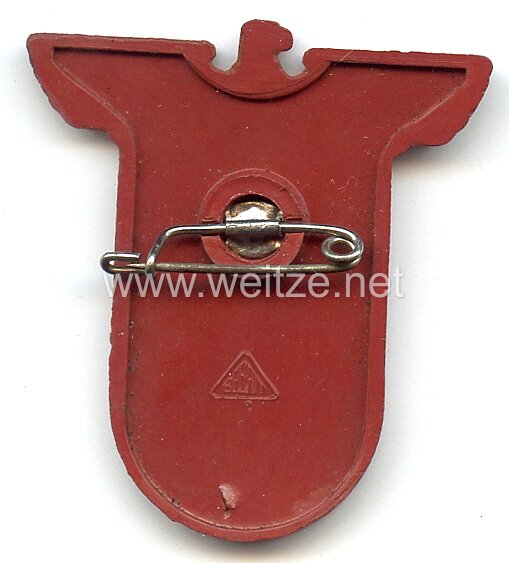
The manufacturer Bebrit was one of several producers of such badges. The production of party badges and decorations was strictly regulated and licensed. Manufacturers had to maintain certain quality standards and were often specialized in specific regions or types of badges. The marking with the manufacturer's name on the reverse was common and served quality control as well as the economic organization of these production sectors.
Such event badges were typically sold or issued to participants. They served multiple functions: as admission authorization, as a visible sign of participation and loyalty, as a souvenir, and not least as a source of income for the party organization. Wearing such badges during the event was customary and demonstrated belonging to the “Volksgemeinschaft” in the National Socialist sense.
The attachment with a pin allowed for easy fastening to clothing, typically on the lapel or uniform jacket. The wearing of such badges followed unwritten conventions, with party members and SA or SS members adorning their uniforms with various badges and decorations.
From a historical perspective, such objects are important sources for researching Nazi rule at the local and regional level. They document the density and frequency of political events, the party's mobilization capacity, and the material culture of National Socialism. At the same time, they raise questions about participation, consent, and social pressure. Participation in such events could be voluntary, but often social or professional pressure was involved.
Today, such badges are collector's items and museum objects. Their trade and possession is legal in Germany as long as no unconstitutional symbols such as swastikas are publicly displayed. They serve historical education and research and help to understand the mechanisms of the Nazi dictatorship. Engaging with such objects requires historical sensitivity and contextualization within the framework of dictatorship, persecution, and the crimes of National Socialism.