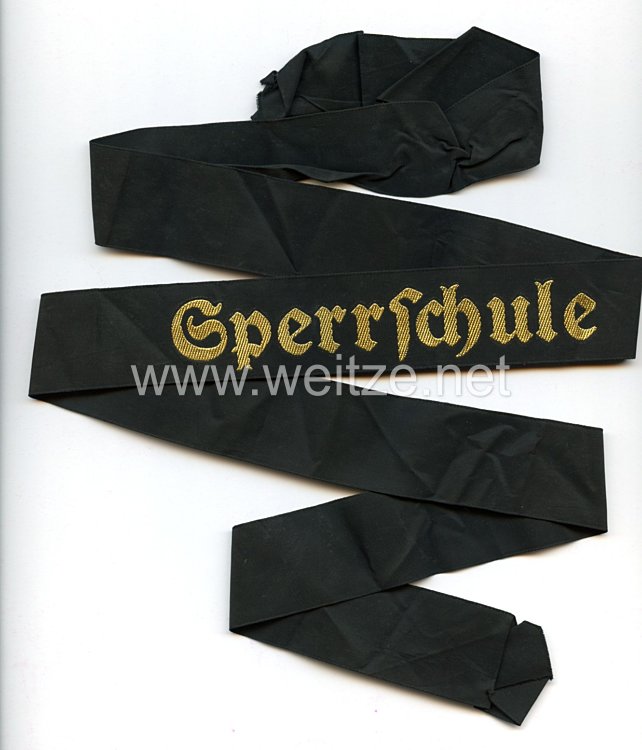
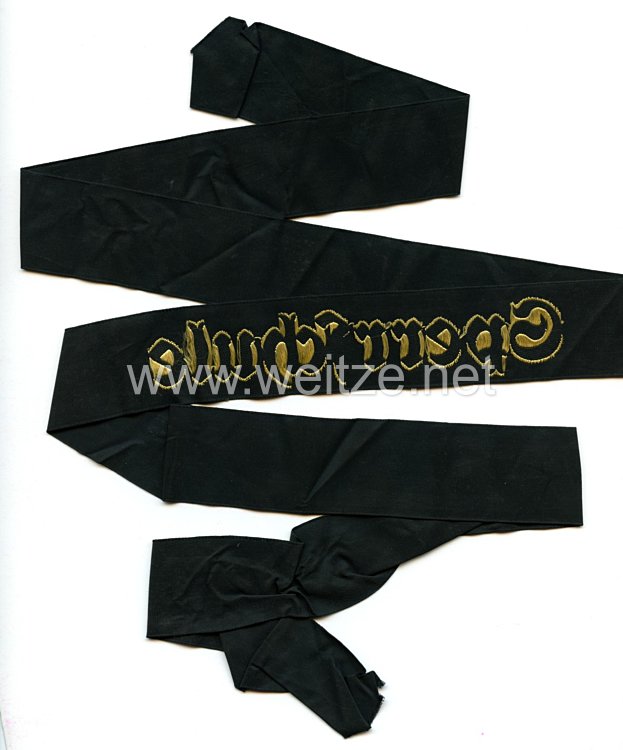
Kriegsmarine Cap Tally "Sperrschule"

Cotton woven construction, length 115 cm, condition 3
419495
55,00

Kriegsmarine Cap Tally "Sperrschule"

The Kriegsmarine cap tally "Sperrschule" represents a fascinating testament to German naval training during World War II. These cap tallies, known in German as Bandschleifen, were an essential component of the Kriegsmarine uniform and served to identify affiliation with specific ships, units, or training establishments.

The Sperrschulen (barrier schools) of the Kriegsmarine were specialized training facilities that dealt with the complex subject of naval warfare in the field of barrier and mine technology. These schools trained personnel for the deployment, laying, and clearance of naval mines and other barrier weapons. The strategic importance of these weapons in naval warfare can hardly be overestimated, as mine barriers were used both for defending one's own coasts and for blockading enemy ports.

Kriegsmarine cap tallies were worn in accordance with the uniform regulations of the Kriegsmarine and were standardized in their design. The present example is woven in cotton, which corresponds to the usual manufacturing method. With a length of 115 centimeters, it matches the regular dimensions of these uniform items. The tallies were worn on the peaked cap and wrapped around the cap, with the ends tied together at the back of the neck.

The design of a cap tally followed an established pattern: on a black or dark blue background, the unit designation was embroidered or woven in gold-yellow lettering. The font corresponded to the maritime traditions of the German Navy and was executed in a characteristic, easily readable Fraktur script. For training establishments such as the Sperrschule, the designation was typically simple and straightforward.

The history of German naval training in mine technology dates back to the Imperial era. Already in World War I, the German Navy recognized the importance of naval mines as a strategic weapon. After the Treaty of Versailles in 1919, although significant restrictions were imposed on the German Navy, with the founding of the Kriegsmarine in the 1930s under the Nazi regime, training in all maritime areas was systematically expanded.

The barrier weapon schools of the Kriegsmarine were located at various sites along the German coast. These establishments taught both theoretical knowledge about different types of mines – including moored mines, ground mines, and magnetic mines – as well as practical skills in their handling. The training also included the development of countermeasures and clearance techniques, as the Kriegsmarine needed not only to establish its own barriers but also to overcome enemy mine barriers.

During World War II, naval mines played a significant role in maritime warfare. The German Kriegsmarine laid thousands of mines in the North Sea, Baltic Sea, and off British coasts. Simultaneously, the Allies had to establish their own mine barriers to combat German U-boats and surface vessels. The personnel trained at the Sperrschule were indispensable for these operations.

The wearers of a Sperrschule cap tally were typically sailors, non-commissioned officers, and officers who had already completed their basic training and were now specializing in this particular field. After successfully completing their training, they were assigned to minesweepers, minelayers, or coastal fortifications, where they applied their acquired knowledge in practice.

Authentication of Kriegsmarine cap tallies requires thorough knowledge of the manufacturing techniques, materials, and fonts of the period. Original pieces were typically produced by specialized firms that often manufactured for the Navy over decades. The quality of the weaving, the style of lettering, and the materials used are important indicators of a piece's authenticity.

After the end of World War II, the Kriegsmarine was dissolved, and many of its uniform items and equipment were either destroyed or found their way into private collections. Today, original Kriegsmarine cap tallies are sought-after collector's items that offer insight into the organization and structure of the German Navy during World War II. They serve as material witnesses to a complex and technically advanced military organization and are of significant historical and museum value.