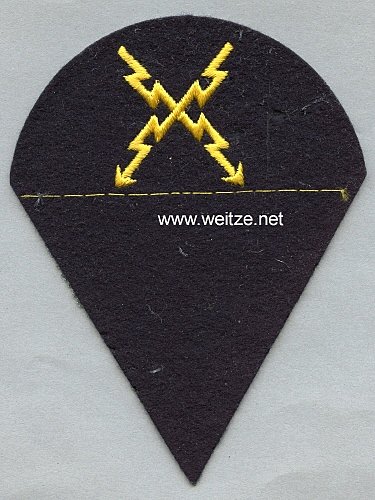
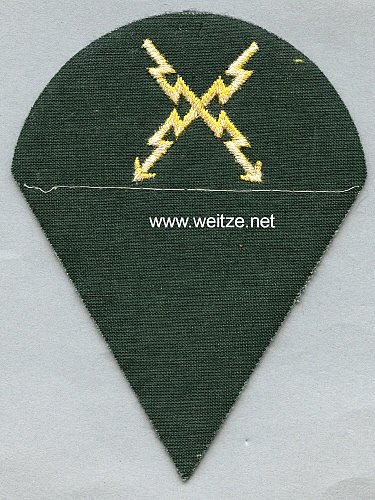
Kriegsmarine Enlisted Ranks Sleeve Insignia for Teleprinter Career Path
The Kriegsmarine sleeve insignia for enlisted personnel in the teleprinter service branch represents a fascinating testament to the highly specialized communications technology employed by the German Navy during World War II. These textile career insignia were worn on the left upper sleeve of service uniforms according to Kriegsmarine uniform regulations and identified the wearer's professional specialization within the maritime forces.
Teleprinter technology had developed since the 1920s into an indispensable component of military communications. The teleprinter, also known as a teletype or telex device, enabled the rapid transmission of written messages over long distances via electrical impulses. For the Kriegsmarine, this technology was of strategic importance, as it provided more reliable and faster communication between shore stations, command centers, and partially with ships at sea.
The career insignia of the Kriegsmarine were regulated by various service regulations, particularly the Uniform Regulations for the Kriegsmarine (Anzugordnung für die Kriegsmarine - A.O.K.). These regulations precisely defined which insignia were to be worn by which ranks and career branches. The enlisted personnel, meaning ranks from seaman to lance corporal, wore their career insignia in a specific design that differed from those of non-commissioned officers and officers.
The design of teleprinter career insignia followed the typical pattern of Kriegsmarine specialist badges: on a dark blue cloth background matching the basic color of the naval uniform, the characteristic symbol of the respective specialty was displayed in light embroidery or weaving. For the teleprinter branch, the insignia typically showed stylized lightning bolts or technical symbols indicating electrical communications technology.
The version for the Colani designates the special variant for the blue working or service uniform of enlisted personnel. The Colani was a practical working garment of the Kriegsmarine, whose designation was possibly derived from the characteristic collar form. This uniform variant was used for daily duty aboard ship and ashore when no representative dress uniform was required.
The organization of teleprinter services in the Kriegsmarine was highly structured. Teleprinters were deployed at naval bases, command centers, and important shore stations. Personnel had to undergo special training that encompassed both technical knowledge of equipment maintenance and repair as well as the ability to transmit messages quickly and precisely. The teleprinter enlisted personnel belonged to the naval communications personnel and played an important role in the communication chain of fleet command.
During World War II, rapid and secure message transmission gained increasing importance. The German Navy employed various communication systems in parallel: radio traffic for ships at sea, teleprinters for land connections, and couriers for particularly secret messages. Teleprinters offered the advantage that messages were documented in text form, thus reducing misunderstandings.
The textile insignia were produced by various manufacturers, both through mechanical and manual fabrication. Quality and execution could vary, with machine-woven versions being more common for standard issue, while embroidered variants were often privately purchased. The insignia were sewn directly onto the sleeve and had to comply with official wearing regulations.
From a collector's perspective, Kriegsmarine career insignia are today sought-after military-historical documents that provide insight into the organizational structure and technical specialization of the German Navy. The condition is usually classified according to a grading system, where “condition 2” generally indicates good preservation with slight signs of wear.
These insignia document not only military organization but also the technological development of communications technology in the first half of the 20th century. They are material witnesses to a time when electronic message transmission revolutionized military communications and laid the foundations for modern digital communication.